the fog of delhi

Outside, a car honked and honked as it drove slowly by, its tires crunching on the street. Then silence — total silence. And then another car, slowly honking as it, too, slowly passed. These were new sounds, disquieting sounds, and they made us look outside.

At first, we thought our window had fogged up. It took us some time to realize that no, Delhi had fogged up, worse than we’d ever seen it.

fog2

This was the street outside our house (as compared to the same view when there is no fog). It was eerie. Stephen King novel eerie. Beyond these two lights, you could see nothing. In the distance, a dog barked sporadically; somewhere across the street, a guard coughed, the sound strangely near in the thick air. Otherwise, except for the few cars slowly passing, Delhi was silent, and that was the scariest part of all.

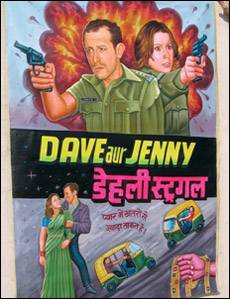
Dave and Jenny, Bollywood style

If you heard about this on NPR’s Studio 360, you’d like our upcoming book: a humorous travel memoir of expat life in New Delhi. Send us your email or follow us on Twitter so we can add you to our mailing list!

There was once a time in Delhi when shining malls and Café Coffee Days didn’t exist as refuges from heat and stench. In this land before liberalization, sanctuary could be found in the local cinema halls that apparently dotted the Indian urban landscape. But multiplexes are driving them out of business — and, as collateral damage, taking with them the Bollywood poster painters who relied on their business.

Every year, Jenny and I send out a photoshopped holiday card to our friends and family. When we found out that some Bollywood poster painters are still eking out a living near Old Delhi, we knew that this year’s card would be hand-made. We dissected a bunch of old Bollywood posters for composition and style, took pictures of our faces in our desired poses, and set out a neighborhood near the Red Fort armed with vague contact instructions: “Find the Darya Ganj fire station. Make a right. Walk a hundred yards and ask the paan wallah for Vijay.”

The paan wallah sent us to a bicycle rickshaw stand, where sleeping rickshaw pullers competed for space with the myriad rickshaw parts strewn about. We sat at the stand and chatted with Manesh, who seemed to manage the rickshaw syndicate, until Vijay Singh pulled up on a rickshaw of his own. Vijay and Manesh then took us up the dirt road across the street to Vijay’s open-air studio. Fading starlets gave us sultry glances from dusty wooden walls as we sat on a wooden charpoy to talk.

With Manesh translating, we told Vijay exactly what we wanted — the composition, the elements, the style, the poses, the title, the tagline. Happy for the business, Vijay was nonetheless confused about how we’d found him. Not sure how to explain that our relationship with the woman on the expat listserv who recommended him, we just told him that he was “very famous.” His smile told us that that was what he was hoping to hear.

I returned the next weekend with my father and money for the deposit. Manesh wasn’t there; this time, we sat at the rickshaw stand with a drunk mechanic who kept telling us “I speak English tutti-frutti” and “Vijay is my brother” and “You want some whiskey?” Finally Vijay and Ranjeet, his English-speaking partner, pulled up in a rickshaw. We discussed again the composition and the poses while the drunken mechanic danced around, sent a peon for soda, and interrupted us with “Vijay famous artist!” and “My cousin-brother!” and “You want whiskey?”

Jenny and I had anticipated a small poster, perhaps two feet in length — after all, our main goal was to reprint it on a postcard. Vijay, however, insisted that his work could be no less than five feet tall. We agreed, the peon returned, and we celebrated our agreement with Pepsi and whiskey. As we were walking out, the mechanic turned to me to whisper conspiratorially, “I speak English tutti-frutti.”

A week later, we returned to examine the work in progress. Five feet had become six.

And then, two weeks after we had commissioned it, Jenny and I came to Darya Ganj to behold our first starring role, captured in perfect 1970s Bollywood style. This poster accurately recreated the most exciting experiences we’ve had in Delhi so far: our spontaneous dances in various grand ballrooms, the time we fought criminals as special investigators in the Delhi police force, and that awful incident when our love of diamonds and danger forced us to turn our commandeered autorickshaws against each other.

And you thought we were working office jobs!

As Vijay and his team presented their work with pride, Ranjeet reminded us that poster painting is a dying art, and that we should tell our friends. So it’s with no hesitation that we recommend Vijay to capture your likeness in archaic Bollywood style. You can find him near the paan wallah, across from the rickshaw stand, down from the fire station; or you can just contact Ranjeet at 99996 29382 or [email protected].

P.S. Guess which one is the drunken mechanic?

If you heard about this on NPR’s Studio 360, you’d like our upcoming book: a humorous travel memoir of expat life in New Delhi. Send us your email or follow us on Twitter so we can add you to our mailing list!

change comes from within

Gandhi’s famously exhorts his followers to “be the change you want to see.” I see these words in action every day as vegetable sellers and pharmacy employees dig into their wallets to find the 30 rupees change their company owes me.

It happens everywhere—in the café where I buy my morning coffee, in the “Australian cookies” store in the mall, at the housewares store where I get my forks. The employee will search the till for change and then, not finding any, pull it out of his own pocket.

They don’t write it down. They don’t make it official. My money goes in the till, theirs goes into my wallet, and everyone is happy—except for the change giver, who is now 30 rupees short.

I don’t doubt that the employee gets his money back. What shocks me is the tremendous level of trust that must exist between employee and employer for the employee to take this action. Either the boss doesn’t blink when the employee pockets the next 30 rupees to cross the counter, or the employee knows that he can go up to his boss at the end of the day and, without proof, ask for his 30 rupees back.

I don’t think Indians are unusually trusting in any other regard. My neighbor locks his maid on the balcony when he leaves the house; my company’s old accountant once implemented a policy to search every employee as he left for the evening after some paper towels were allegedly taken from the men’s room for personal use at home. I can’t understand why things are so different when it comes to making change… unless Gandhi’s words have been universally accepted and slightly misunderstood.

birds through the guide’s scope (keoladeo in bharatpur, rajasthan)

bird5

bird1

bird2

bird3

bird4

emergencies

cop

When something like what happened in Mumbai happens, you can’t help but wonder what you’d do if it happened to you. Since this blog is meant to archive knowledge useful to those living in or moving to Delhi, I think it’s prudent, if not a little bit boring, to post what we’ve learned about emergencies in Delhi.

The Delhi blasts a few months ago occurred early on a Saturday evening. Within hours, the media was screaming that security was being beefed up all over the city. We didn’t see any security until the next day, though, when our autorickshaw passed the GK I market, the site of one of the bombs. There we saw a couple cops idly manning a roadblock, slowing cars just enough to create a jam but not enough to actually inspect passengers (as if terrorists wear Al Qaeda lapel pins or drive carrying dynamite on their laps), if the cops had even been looking, which they weren’t.

The only interaction we’ve ever had with a cop in India (aside from the ones who regularly commandeer our autorickshaws for lifts to their next point on patrol, and the one who arbitrarily singled out my taxi driver to scream at, refusing to let us go down the road while other cars passed unmolested, advancing menacingly, fingering his beating stick, preparing to unleash unnecessary justice until he saw my white face cowering in the back seat and decided that maybe we weren’t doing anything wrong after all) was the cop who shook us down for a 400 Rupee bribe in the Jahanpanah City Forest near GK II. So after Mumbai, I realized I had no idea how to find a cop if I actually needed one.

I posed the question to YuniNet, a Delhi-centric Yahoo group. Most readers pointed out that you can call 100, India’s equivalent of 911, although some reported language issues for non-Hindi speakers. However, if you babble enough key words (“Hauz Khas” “American” “accident” “chainsaw-wielding zombie”), you could probably rouse the local cop to commandeer an autorickshaw over to your house to see what’s up.

Other advice included walking to your local police stand, making friends with the cops, and getting their number in case you need it. I wouldn’t do that, however; as one respondent put it, “We would rather call our embassy or someone known to us who knows someone in police. We don’t trust the police in Delhi.” I think you’re probably better off if the local cops don’t know where you live.

For the embassy perspective, I emailed Lynn, an embassy staffer I met a few weeks ago. She’s the one who gets the call when a gora gets run over by the Blueline. Her advice:

“The best thing to do, if possible, is file a police complaint or First Information Report (FIR). Once you do that, call us and we will follow up with the police to make sure that they do whatever is needed in the situation. The police will not take our call as seriously if the involved party hasn’t complained. That being said, we want to hear about whatever is happening regardless of whether a complaint has been lodged.
“We always want to know if our citizens have emergencies; sometimes we can move things along or make suggestions.

“In an emergency, you can call the main Embassy number: (011) 2419-8000. During the day you would ask for American Citizens Services; off hours, ask for the duty officer.”

So what about medical emergencies? Back in February, Jenny got sick, resulting in two midnight trips to the emergency room. The first night I flagged down an autorickshaw while Jenny lay shivering on the sidewalk. I told him the name of the private hospital, which he misunderstood to mean the government hospital; complications from that bit of malpractice were exactly why we went to the hospital the second night.

That second night, we called the private hospital’s ambulance service. They came promptly, but the dispatcher had given them the wrong house number; I finally found them frantically running around the neighborhood looking for us.

The best advice in a medical emergency is probably to arrange your own transportation, especially if you don’t want to wait for the ambulance to fight traffic all the way to your house; but make sure you know exactly where you want to go. You should certainly scout out a doctor and a good hospital BEFORE you get sick. I wish we had.

delhi’s sunday book market

You pass the hospitals and cricket stadiums and tree-lined lanes until you reach Delhi Gate: the old stone arch that, fenced off and surrounded by traffic, marks the high-water point of the colonial government’s urban renewal. Hemmed in beyond this point are the alleys and shouts and cows and puddles of Old Delhi. And on any other day, you’d plunge headlong into the narrowest alley you could find, wondering what sights (monkey fight! dismembered goat legs! monk on a cell phone!) you’d see this time.

Except today is Sunday. Book market day.

11

The book market stretches westward from this point along Jawaharlal Nehru Marg (the southern border of Old Delhi) and northward on Bahadur Shah Jafar Road (which bisects Old Delhi from Darya Ganj, an open-air exhibition of Indian art deco architecture that we’ve only recently begun to explore). The booksellers line the sidewalk every Sunday, only on Sunday, spreading their wares before them — some in neat rows, some in crazy piles, some in towering stacks.

11

The selection ranges from the sublime (The Phantom Tollbooth!) to the bizarre (Bob Uecker wrote a book?); from the obsolete (Windows 3.1 guides) to the obscure (indigenous water management technique in Gujarat). Some are new, some are old, almost all are tread upon by barefoot salespeople shouting dasrupeesdasrupeesdasrupees as they stride from sale to sale.

The smell of old books overwhelms everything else. It’s wonderful.

11

11

You wouldn’t have expected the paperback novelization of The Empire Strikes Back to make it to India. Nor would you have thought there was such demand for torn-up romance novels on the subcontinent. And seriously, Bob Uecker???

11

Within the chaos, patterns emerge. One guy only has hardcover Stephen King, Dean Koontz, and Harry Potter, all of them missing their dust jackets. Yet another has collected seventies spy novels featuring every James Bond wannabee you’ve never heard of (Johnny Fedora? Harry Palmer? Paul Christopher? Duff?). And good news for students of programming languages nobody uses any more: you’ll find more crumbling manuals than you can shake a SPARCstation keyboard at.

11

11

On this trip, one of the elderly booksellers on Jawaharlal Nehru Marg overheard my rudimentary Hindi. He was standing over a strewn pile of thin nonfiction paperbacks. “You know Hindi?” He asked me. “Main Hindi sihkraha hai,” I agreed, my accent and subject/verb agreement as bad as my spelling. “Then I have something for you,” he said. He walked across his pile and began rummaging, tossing volumes left and right as he burrowed deeper, carving a path this way and that, turning left and right to toss books he’d already tossed in case they’d landed on the one he wanted.

After a few minutes, during which I stood and waited and wondered what he’d come up with, he finally picked up a book of Urdu-English translations. He skimmed through it, muttered, scowled, and tossed it on the pile. “Sorry,” he said. “Can’t find it.”

11

shees hey k.e. gate (?)

bonus_big

Spotted near Old Delhi. Liked the colors. And no, I have no idea.