surprise: it’s us!

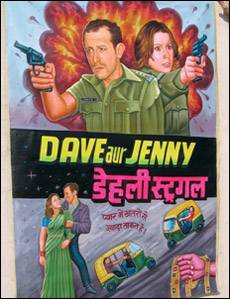
Though we have a new blog entry scheduled for later this week, readers of the Hindustan Times in Delhi (and maybe other cities) got an early glimpse of us in this morning’s HT City. Does this mean we’re officially “iconic”?

davejneny

You can read the story behind the poster — ok, fine, behind the iconic poster — here.

roopak vs. roopak

The new omelette wallah appeared out of nowhere one day. We were walking down the street towards the market, expecting to pass the same omelette wallah who had been selling cooked eggs from his folding table every day since we’d moved to Hauz Khas. But where there had been one omelette wallah, on this day there were two. Both had a table full of eggs, a small stove, and a few canisters of chilis and spices.

Both stared straight ahead. Neither acknowledged the other.

We didn’t think competition could get any more cutthroat than that. Until we found Roopak and Roopak.

roopak2

There on the left, that’s Roopak in Karol Bagh. And there on the right, well, that’s also Roopak, in Karol Bagh. Both sell spices, nuts, dried fruit, chutneys, that sort of thing. Judging from the wear and tear on the signs, both Roopaks look like they’ve been around for a while.

Even in a city where direct competition is shockingly direct, how do two businesses end up with the same name and the same inventory right next door to each other?

Maybe it’s nothing more exciting than a family schism, but I’d like to think this is the second omelette vendor’s brazenness on a massive scale—except it turned out that Karol Bagh was big enough for the both of them. Whereas the second omelette vendor disappeared a few days after he arrived, the original Roopak and the new Roopak have maintained their cold war for years. Imagine the scene every morning: the two owners arriving to open the shutters, each angrily unlocking and lifting and slamming with all the ritual stomping and preening and chest puffing of the flag lowering at Wagah.

One thing I’d like to know: which Roopak came first?

the mystery of Khan Market

We could never believe the rumors, despite the variety of sources who assured us it was fact: Khan Market is, everyone told us, the most expensive shopping real estate in the world.

kersy83
Photo by Kersy83

When we finally decided to research it, we uncovered a truth that was slightly less grand but no less implausible: Khan Market is actually the 16th most expensive shopping real estate in the world, according to Cushman and Wakefield, with a rent of $280 per square foot in 2007. It’s more expensive than the most expensive shopping districts in Moscow, Beijing, Oslo, and São Paulo, and only 14% less expensive than Orchard Road in Singapore.

Singapore’s Orchard Road is incessantly mobbed, lined by the world’s most modern malls, and filled with luxury and excitement. It’s easy to imagine its revenue driving real estate prices into the sky. As for Khan Market—the Delhi economy works in mysterious ways, true, but it’s hard to imagine Khan Market generating the kind of revenue that puts it on par with Orchard Road, even with its reputation as Delhi’s most cosmopolitan shopping area.

elluliini
Photo by elluliini

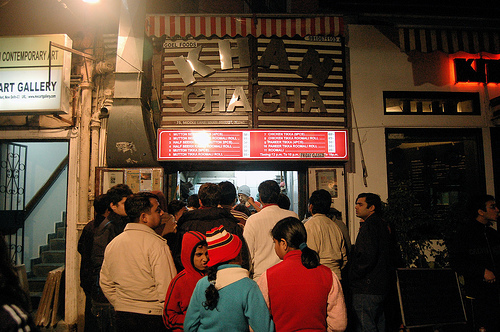
Khan Market is an elongated U-shaped collection of buildings, with storefronts running around the U and an underdeveloped inner alley dividing the middle. Its main entrance is flanked by magazine vendors, an electronics and music store, and a crowded and chaotic bookseller. A steady stream of tourists gape at the inner alley, rich foreign mothers wearing jeans and salwar shirts steer their children towards Chokola, and young men in pink polo shirts with popped collars head towards the sunglasses stores. Many of Khan Market’s tenants—appliance stores, plastics stores, butchers, chemists, stationary stores—are indistinguishable from those in every other market but for marginally inflated prices.

There are a number of clothing boutiques and upscale restaurants in the inner alley, but there are just as many drooping, dust-covered power cables and tourists crowded around open manholes watching men clear sewer blockages by hand. There is a McDonalds and a Subway, a few coffee shops, and a few luxury housewares stores, but Delhi’s Louis Vuittons, Christian Diors, Fendis, and Armanis are all ten miles down the road at the Emporio Mall in Vasant Kunj. There are vegetable sellers and imported grocery stores selling the same stuff found at every other import grocery store, for only slightly more money. Khan Market is crowded on the weekends, but no more so than any other market.

engineer
Photo by engineer

It’s a nice market, but it’s not nearly as nice as one would expect the 16th most expensive real estate in the world to be. It’s not selling particularly high-ticket items or generating unusually high volume—a latte at this Cafe Coffee Day costs the same as a latte in every other Cafe Coffee Day. With the exception of tailors who speak perfect English and design shirts and suits for Western tastes at Western prices, its selection isn’t terribly unique. So how can it be the 16th most expensive real estate in the world?

fluxsingh
Photo by fluxsingh

Khan Market certainly has its reputation working for it—it was, along with INA Market, one of the few places where one could buy imported goods in the decades before liberalization. Combine that with its location near many exclusive neighborhoods with heavy expat presences, Khan Market was probably where the rich and foreign used to spend their leisure time, before the air-conditioned malls began springing up and legalized imports rendered under-the-table cheddar cheese smuggling obsolete.

alvaro_macedo

So did reputation alone land Khan Market on Cushman & Wakefield’s list? Or is it somehow possible that the vegetable sellers and restaurants and butchers, despite the fact that they charge pretty much the same as every other upscale market, really are paying some of the world’s highest rent?

ajit the driver

Every morning I’d call the local taxi stand for my ride to Gurgaon. And every morning they’d send a different driver to pick me up. One of them was Ajay. Another one was Ajit.

Ajit was wild, square-jawed, terrifying behind the wheel, with a perpetual scowl on his twenty-year-old face. He spent his first day as my driver shouting gleefully at me the entire ride home: “Me you Hindi! You me English! Straight! Seedha! Left! Baayein! Right! Daayein! You request me every day, I you Hindi you me English! You my only friend!”

When we would reach a breakthrough in vocabulary—“Cow! Guy!”—he would get excited and begin dancing in his seat, taking both hands off the wheel to point upwards in punctuation of his hip thrusts, closing his eyes in ecstasy and throwing his head back and somehow managing to open his eyes and grab the wheel and slam on the brakes at exactly the right instant to avoid a herd of guyain trotting casually down the road.

One day, half-drunk on some after-work beers, I got the bright idea to teach him curse words. “Choothia! Bastard!” I told him. “Lund! Dick! Gaand meh le lo! Kiss my ass!”

Ajit laughed and howled and danced and screamed and repeated my words in deeply-accented shrieks, each new abuse eliciting an equally elaborate reaction from him. And then, suddenly, he grew quiet and contemplative. He turned to me, looking me in the eyes as I sat in the back seat with the car still barreling down MG Road. “You, you wife. Lie bed?”

I knew what he was getting at. I also knew that he took Jenny on errands from time to time, and I was uncomfortable with the idea of him glowering at her in the rear-view mirror with this prurient fact confirmed in his mind. I played dumb, hoping he’d get the hint. “Kya? Huh? I don’t understand. Tati! Shit!”

Ajit refused to be drawn back into the vocabulary lesson. He screwed up his face in concentration, searching his mind for a phrase he desperately wanted to find. “You, wife! Bed! Lie bed? You—” And then he made a gesture I didn’t recognize but understood immediately, pounding his hands together with an unmistakable crudeness of rhythm. “You, wife?”

What else could I say? “I suppose so, yes.”

Ajit howled and danced his victory dance, honking and weaving and pointing his fingers towards the heavens in celebration of my good fortune.

a tale of two tailors

I always brought my shirts to Tej & Co. Drapers and Tailors, until the Monday morning when the proprietor (Mr. Tej?) denied that I’d given him my shirt on Saturday afternoon.

tej

I had to return to his store every day for the next four days, engaging in increasingly acrimonious accusations (“You stole my shirt!” “You lie!”) until he finally enlisted the owner of Bhagwan Fancy Store three storefronts down (Mr. Bhagwan?) to translate and mediate.

I described the shirt. Mr. Tej denied he’d ever seen it. We went back and forth until Mr. Bhagwan suggested that I look around the store and satisfy myself that my shirt wasn’t there.

I found my shirt in the first bag I opened.

While Mr. Tej scowled and looked away, Mr. Bhagwan grinned broadly—he knew he’d just acquired a new customer.

bhagwan

an important time to give

Our most life-changing experiences in India were our visits to Pardada Pardadi Educational Society, a school for girls in rural Uttar Pradesh, India’s most populous state and one of its poorest. We saw first-hand the difference the school makes in its students: while two of its girls were leading us around their village, showing us their brick homes and their family’s goats, talking with confidence and poise to us despite the fact that we were both foreign and, in Dave’s case, male, we spotted two girls who weren’t students at the school: wearing dirty clothes and peeking around a wall, they hid shyly whenever we turned our heads towards them.

It was a staggering difference: it was clear which girls would have the skills and confidence to resist the status quo and drive change in their communities, and which ones were going to be bullied by the patriarchy into another childhood marriage and more of the same.

Dave with students

Pardada Pardadi provides free education and vocational training to 1,000 rural village girls in Anupshahar, Uttar Pradesh. Its mission is to create a generation of self-reliant and economically independent girls who will break the cycle of poverty in the region. By teaching vocational skills and depositing 10 rupees in a girl’s account for every day she attends school, Pardada Pardadi ensures its students graduate with the education, the power, and the means they needs to transform their lives.

We’ve talked about Pardada Pardadi before — the good they’re doing (sending two students who’d never been beyond Delhi all the way to California) and the challenges they’re up against (like Ruksana, who had to quit school to get married at the age of thirteen). For the girls who don’t go to Pardada Pardadi, the facts are heartbreaking.

We’re bringing them up again today because they’ve been chosen to participate in the Global Open Access Challenge 2009, which gives them the chance to gain a permanent spot within GlobalGiving, an online marketplace for philanthropy that helps individual and corporate donors find causes they believe in. To be eligible for the permanent spot, which will make a huge difference for their future finances, Pardada Pardadi has one month starting today — until September 18th –- to raise $4,000 from at least 50 unique donors.

Pardada Pardadi is doing great things in India. We support them in many ways: Jenny was employed by them, we volunteer for them, we’ve raised money for them (and many of you, we’re proud to say, donated). This opportunity is one of their biggest yet, which is why we’re writing about it. We encourage you to read about the impact they’re making and then, if you believe in their cause, donate to them via Global Giving.

Based on the rules of the Global Open Access Challenge 2009,they have one month to raise $4,000 from at least 50 donors. Please be one of them! Give now.

See pictures from our visit to Pardada Pardadi.

girls

Update: Pardada Pardadi did it!  They have now earned a permanent spot on Global Giving.  A huge thanks to everyone who gave and spread the word.

the economy of our empties

Unlikely economies exist around everything in India. Including empty liquor bottles.

I’m not talking about recycling—the economic forces that transformed our empty plastic water bottles into full plastic cooking oil bottles are interesting, but fairly straightforward. I’m talking instead about the afterlife of our empty liquor bottles, which we were told is driven by a different imperative than cutting corporate costs: it’s driven by people’s desire to show off their wealth without actually spending it.

Back in college in the upstate New York, our only use for empty bottles was displaying them in our dorm room to signify how cool we were vis-à-vis how much we drank. If I’d known then about the peculiar demand in India, I might have gone into the export business, because empty liquor bottles, we were told, are bought by certain Delhiites for a very clever reason: so they can pour cheap swill into fancy bottles that flatter their guests into thinking they’re being served the good stuff.

The guest’s eyes pop when he sees the green Johnnie Walker label; presumably he’s too bedazzled to notice that the first sip is making his eyes water and tear.

Liquor is big in India, and foreign whiskey is especially coveted. India drinks 40% more whiskey than the US and the roads leading to and from the tech hubs like Gurgaon are lined with ads showing how classy, refined, and sophisticated you could be if only you drank the right whiskey. Everyone is aspirational, but not everyone can afford it. Which is why we one day discovered that our trash was quite literally someone else’s treasure.

We were recreational bottle emptiers in Delhi, reliable for producing a bottle of wine a week and a bottle of harder stuff once a month or so. We’d put all our empties on the shared terrace along with the rest of our garbage for Sheila, the building’s maid, to remove in the morning. One day, while hanging our laundry, we stumbled upon a cache of our bottles hidden under a ledge, behind some bricks. Sheila had been stashing them.

Our neighbor Amba, who helped us understand so many of our neighborhood’s mysteries, told us why. Our trash was Sheila’s revenue stream, Amba told us. The 300 rupees a month ($6) each of the four flats paid her was well supplemented by the money she made going through our bags and selling the good stuff to the kabadiwallahs who bicycled around every morning, shouting in slow Hindi to announce their presence and drum up customers and wake up anyone who wanted to sleep past eight AM.

Sheila was stashing the bottles, Amba said, because the more she sold at one time, the better the price she’d get for each one. Obviously Sheila had recognized our consumption patterns and was holding out for us to fulfill them; or maybe she knew Christmas was coming and that our holiday party would be a party for her as well.

“You didn’t peel off the labels before you threw them out, did you?” Amba asked. “If you did, she couldn’t have resold them.”

We actually found a liquor bottle wallah in one of our aimless walk around the city, sitting in what appeared to be a market devoted to buying and selling waste products (newspapers, rags) somewhere near South Moti Bagh market. He was surrounded at his table by empty bottles of booze: haphazard piles that once contained cheap vodka, rows of former mid-range rum, and, in the spot of honor, well-preserved bottles for whiskey, shielded from the sun, labels intact and clean, often complete with the fancy printed cardboard tube in which they were originally sold.

I especially hope that Sheila negotiated for the full value of that empty 18-year-old Glenfiddich single malt I brought in from the duty-free. Because somebody at the demand end of the empty bottle economy would pay a lot of money to serve 200-rupee plonk from it next time his father-in-law paid a surprise visit.