You can view even more photos here.

Posted in outside of Delhi
Tagged backpacking, beach, bus, bus driver, dave, fish, fishermen, india, kerala, Kovalam, nature, Park, Periyar, pictures from kerala, pictures from south india, pictures from tamil nadu, South, tamil nadu, vacation

Nighttime at the CNG pumps: a sight we saw all too often because the route to our flat went right by the gas station. So close that we could practically feel our pillows on our weary heads, but too far for walking to make any sense (never mind the traffic and lack of sidewalks on Aurbindo Marg), all we could do is get out and watch. We can’t stay seated and doze — the fuel intake is hidden in a panel under our seat.
So we stand, and wait, and try not to fall asleep, and get stared at while we take pictures to pass the time.
The best advice we can give to anyone attempting to travel Delhi by autorickshaw is this: ignore the Lonely Planet. While the book usually offers good information, in this instance it fails utterly in its exhortation to only travel in autos that agree to use the meter. The official meter rate, fixed by the State Transport Authority at 4.5 rupees for every kilometer after the first, is less than half of what you can reasonably expect to pay.
Any auto driver who agrees to go by the meter is probably planning to take you from GK I to GK II via the Taj Mahal.
Because the meter is out of the question, every autorickshaw journey begins with fare negotiations. That’s easy to overcome if you know where you are, where you’re going, and the market equilibrium rate for getting there; but for our first few rides in Delhi, the fairness of our fare was entirely up to the honor of our driver, and how adept we were at fooling him into thinking we knew what we were doing.
We know now that no auto ride should ever cost more than 100 rupees, provided you’re sticking to South or Central Delhi. (Nobody knows how much it costs to go to North Delhi because, as far as I know, nobody has ever gone there.) I was not armed with that knowledge on my second day in Delhi, before Jenny had arrived, when I put my fledgling bargaining skills to the test and negotiated a ride from Connaught Place to GK II for 180 rupees, basking in pride during the entire ride in having talked the guy down from the 200 he quoted.
Any auto driver who finds a tourist that ignorant of the market values is going to try to push him for all he’s worth. When we reached my destination, I handed the driver two bills and asked for change. The driver turned around in his seat and started begging me to let him keep the whole 200. And I mean begging—pleading, moaning, eyes rolling and tearing, hands clasped in front of him as he invoked his gods and his children and his poverty and my wealth, all for that extra 20 rupees.
But I set my jaw and stood firm and got my change; and I felt proud that I hadn’t let the guy swindle me out of my hard-earned money. My first major test of my will in India, and I totally won.
Posted in living in Delhi
Tagged autorickshaw, autos, avoiding theft delhi, cheat, Delhi, don't get swindled delhi, how to hail an autorickshaw india, india, negotiate, rickshaw, rupee, swindle, travel
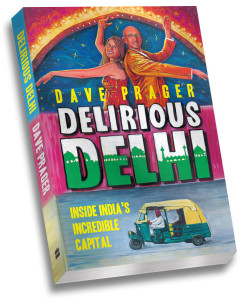
It’s finally official. The blue ink is dry and the envelope is closed and the contract is airmailing its way to Harper Collins. Now all that awaits is a manuscript.
The book will be part memoir and part guidebook: an in-depth exploration of the Delhi we lived, the lessons we learned, and the funny things that happened to us. It’ll be like this blog, only much longer, much more detailed, and much funnier.
Writing has begun, and will continue for the next six months. We expect to release the book next April July, just in time to channel the excitement of Delhi’s Commonwealth Games into fame and fortune.
If you want updates about the book’s progress and an invitation to the big release party next April July, send your email address to ourdelhistruggle AT gmail dot com. You can also follow us on Twitter: mmmmdave and JennySteeves.
This blog will be an integral part of the writing process. We’ll rely on readers’ opinions and insights to add detail to the book. Right now, for instance, we’re writing the section on getting around Delhi, and all the white-knuckled moments we’ve had in the back of an autorickshaw. Our question to you: what was your scariest auto-related experience?
We’re certainly not the first commentators to observe this scourge. You see them everywhere you go in Delhi, and you smell them everywhere they’ve been.
I don’t believe the reason is a lack of public conveniences so much as their inaccessibility, situated as they are in neighborhood markets; most of the peeing I noticed takes place on Delhi’s broad, featureless boulevards lined by cement walls that segregate those who live inside from those they want to keep out. These roads are plied by men who travel long distances and don’t have time to negotiate neighborhoods in search of public toilets. Thus, with the sheer volume of men on the roads, your journey from any Point A to any Point B will inevitably pass dozens of Point Ps along the way.
I’m a critic of this practice, as most men would claim to be if you asked them. And like most men, I suspect, I’m also indulgent in it, having peed on the side of a Delhi road exactly one time: commuting in the office cab with my coworkers, we decided to celebrate the fact of a Friday night with beer and booze on the ride home. And somewhere in the wilds of Vasant Kunj, nature called, and we all spilled out of the cab and on to the ground.
But even if each one of the male half of the 16 million Delhiites were like me, peeing once a year in a moment of desperation, that’s still 21,949 men peeing on the road any given day. And if the problem is even slightly more habitual, with each man averaging 10 times a year, then you’ve suddenly got 219,490 men urinating on just 25,000 kilometers of road every day. That’s one man per hundred meters. Suddenly you realize this fixture of the urban landscape is less about manners and more about inward-focused urban planning that leaves street-sides featureless and anonymous—good for nothing but passing by and peeing on.
There are two techniques to dissuade men from peeing on a wall: using shame, and using divinity. Our downstairs neighbor, Benoy, a crazy old man with wild white hair who constantly told us that his fellow countrymen “can’t be trusted,” would shout from his terrace at men peeing on the street below until they pinched off, zipped up, and moved on; rumor has it that he would sometimes chase after them down the road. Our other neighbor, Amba, relied on her gift for aphorism: she would sidle up to a leaky fellow and ask, “If you do it in the road, what is the difference between you and a stray dog?” These men, too, would stop and go somewhere else.
The other way to stop the urinaters is to cement tile portraits of Hanuman or Krishna or Sai Baba or Jesus into the wall. No man will pee on another man’s god.
(You can see pictures of this practice here, here, and here; this is one picture we forgot to take.)
It goes without saying, of course, that we never saw any women peeing on the street. Modesty forbids it: no matter how bad a woman has to go, she had to hold it until she is somewhere decent. As always, life is much worse for the female.
Today is Dave’s Dad’s sixtieth birthday. Since we’ve known for a while that we would be in Asia during his big day, we decided to celebrate by asking everyone we met while traveling through India and Nepal last month to wish him happy birthday. Enjoy!
(And we know that the lyrics of Bilo Rani aren’t exactly what you’d sing to your papa, but 1) he doesn’t understand the lyrics and neither do we, and 2) it’s got a great beat. We asked our friends if they knew any Hindi songs that were actually about one’s father, and they suggested this slightly creepy piece. Creepiness begins at 0:30.)
Posted in outside of Delhi
Tagged birthday, Delhi, guilt for missing the big day, Gurgaon, india, kathmandu, kochi, kollam, kovalum, nepal, patan, south india
Before we left Delhi, Jenny and I did our best to make it to our favorite restaurants one last time. Not Karim’s, because the first time is the best and it trends towards mediocre the more often you visit. I’m talking about the mall for Jenny’s favorite paneer tikka (yes, her favorite was at the mall); Sagar’s and Saravana Bhavan for dosas and uttapams; Flavors for pizza; and Roshan di Kulfi, all the way up in Karol Bagh, for breakfast, snacks, and dessert all in one sitting.
Jenny and I can’t remember if we discovered RdK ourselves our were led there by our good friends at Eating Out In Delhi. Either way, we know from Hemanshu’s blog that Roshan di Kulfi has been a Karol Bagh favorite for decades. It’s one of those places where the crowd spills out the door and if you want a seat, you have to hover over people who look like they’re finishing so you can snatch it up the moment they stand.
“Kulfi” is ice cream, Indian style. “Roshan di” means, well, I’m going to assume it means “Delicious gooey noodles that we put on top of”.

RdK’s specialty is kulfi falooda, which is ice cream with sweet rose-water noodles on top, plus bits of almond and pistachio for good measure. It’s something better tasted than described.
But RdK goes beyond dessert — or, rather, it’s got stuff that comes before dessert. We ordered chole bhatura, a Punjabi chickpea dish most often served for breakfast, and raj kachori, which is a big ball of pastry filled with all sorts of stuff and covered with all sorts of sauce.


A ball of stuff and sauce: we can’t get more specific (and it doesn’t get much better) than that.


Posted in living in Delhi, pictures of Delhi
Tagged breakfast in delhi, chhole bhatura in delhi, delhi restaurant recommendation, dessert in delhi, ice cream in india, indian breakfast, indian sweets, karol bagh, karol bagh restaurant recommendation, raj kachori in delhi, roshan di kulfi in delhi, roshan di kulfi in karol bagh
|