Gorditas in Delhi! Gorditas in Delhi!
The Caravan is a storied literary and political magazine based here in Delhi. I recently wrote an article for them previewing the joy, the wonder, the culinary ecstasy that India has in store when Taco Bell opens up. You should run out and buy the magazine (you can find it in Khan Market, among other places); but if you’re outside of Delhi, I’ve posted a PDF. Or you can read the article, which begins after the image below.

Taco Bell: The Arrival
Considering the epicurean dilemma of Mexican-American fast food in India
by Dave Prager | published February 2009 by The Caravan
“Remember what I told you, Dave?” My grandfather always cackles when we drive past a Taco Bell. Grandpops is ninety, wizened, but nevertheless sharp enough to mock me even as he drives his Buick down the interstate.
“Remember what I told you? ‘This one looks like the baby threw up! And that one looks like the baby went to the bathroom!’ Remember?”
“I remember, Grandpops,” I always frown, always slouching a little, always hurt that he could say such cruel things about the food I love so very much. Of course I remember: I was fourteen. Grandma and Grandpops were taking me out to dinner. Against their protestations, I’d chosen Taco Bell, eagerly ordering what I always ordered: a Bean Burrito without onions, a Crunchy Taco, and a Chili-Cheese Burrito. My grandparents had nothing to say about the taco, but they exploded in disgusted glee as I unwrapped and unrolled my two burritos to douse their gooey greenish innards with salsa.
I remember chewing in sullen silence as my grandfather quipped his now-eternal phrase; it’s hard to enjoy food that people are pointing at. But even then, I had to admit that they were right: as India is about to find out, aesthetics are not exactly Taco Bell’s strong point.
————
Taco Bell is one of the flagship properties of Yum Brands, the company that has perpetrated KFC and Pizza Hut upon India with so much success. In a few short months, they’ll open their first Taco Bell in Bangalore. For many Indians, this will be their first experience with Mexican food.
Taco Bell is to Mexican food, however, what Starbucks is to a Paris coffeehouse: a uniquely American derivative that has evolved to resemble its inspiration in name only. You can trace its pedigree back to Mexico, sure, but what Taco Bell serves today is a mutt: Mexican food crossbred with generations of focus groups, cost-cutting innovation, and manufacturing techniques to breed a beast far removed from the original. A Taco Bell taco, with its crispy corn shell containing ground beef, lettuce, tomato, and cheese, is a remarkable feat of American engineering: the product of decades of research that have squeezed every spare cent of material and every extra second of labor out of creating it.
Taco Bell has defined itself by its quest to lower costs. It introduced its K-minus program in the 1990s, “K” standing for kitchen and “minus” standing for subtracting as much of it from a restaurant as possible. After all, when your economy scales across 5,600 stores, 175,000 employees, and millions of tacos, a penny saved is millions earned. So cooking is a corporate-level concern: food is prepared at centralized processing facilities and delivered to restaurants in forms engineered to limit on-site labor to unpacking, heating, or assembling.
Take Taco Bell’s signature seasoned ground beef, which arrives at a store pre-cooked in an industrial-sized plastic bag. An employee heats the bag in a bed of hot water, empties it into a hopper, and then dispenses the beef using a specially-engineered trowel that scoops exactly 1.5 ounces of beef no matter how vigorously or casually the employee wields it. Taco Bell also has special portion-control devices for sour cream, guacamole, and other liquids, and strict guidelines for items that are applied manually, like cheese and lettuce.
Your meal is assembled with time and precision as benchmarks, not presentation. Which means that sometimes your burrito looks like the baby threw up or went to the bathroom; but even if the melted cheese gives a slightly mucousy sheen to your Chalupa Supreme, you’re still tasting a proportion of beef to sour cream to tomatoes to three kinds of cheese precisely calibrated for maximum flavor at minimum cost.
And it really does taste good.
———-
Fast food occupies a far different role in American culture than in Indian culture. In India, fast food is a symbol of aspiration, and is priced and patronized accordingly. In America, fast food is priced to the low end of the market and pitched to appeal to everyone. My Indian coworkers proudly tell me of taking their dates to McDonalds; my American friends would have been horrified.
Most Americans are connected with the fast food industry as both patrons and cogs in the machine: a job at a fast food restaurant is a rite of passage for the upper-middle class on down. My wife cooked Pizza Hut pizzas as a teen, and I manned the cash register at a Denver-area burger establishment until I was fired for unsanitary orthodontic practices. (Don’t ask.) Once you’re older, fast food is either a diet staple or a guilty pleasure, depending on your socio-economic status. It’s accessible to all palates and affordable by all classes.
Because of the ubiquity and uniformity of fast food restaurants, and especially because of the relentless global march of brands like McDonalds, fast food is a part of America that neatly symbolizes the whole. The phrase “mcjob” entered the Merriam-Webster dictionary in 2003 defined as “a low-paying job that requires little skill and provides little opportunity for advancement”. The prefix “mc” can be added to any word to evoke pejorative associations of cheapness, blandness, homogeneity, and lack of authenticity; critics deride people who live in McMansions and worship in McChurches (and vote for McCain).
But even within fast food culture, Taco Bell occupies a strange niche. While Subway is McDonalds for sandwiches, and KFC is McDonalds for chicken, Taco Bell is not McDonalds for Mexican food. Taco Bell skews its marketing towards an aspect of American culture that’s less spoken of then McDonald’s family image but certainly just as pervasive: drunk diners who enjoy gastrointestinal discomfort.
Taco Bell is at its best after eleven PM, when you’re on your way home from being out with your friends. And Taco Bell’s advertising embraces that, calling it “the Fourth Meal,” prodding you to “make your after-party sizzle” with a Crunchwrap Supreme. Combined with its reputation for spiciness, Taco Bell’s role in fast food culture is similar to curry vindaloo in the UK: you eat it when you’re in an abused state, literally gleeful in the knowledge that it’s going to burn coming out in the morning. (It’s a macho thing, I guess.)
“The one thing that comes to mind at three AM after a night of drinking,” says Craig Pullins, a Chicagoan currently living in Delhi (and as eagerly awaiting Taco Bell as I), “is a Chicken Grilled Stuft Burrito.”
“Goes right in, comes right out,” adds Jennifer Jordan Keeler, a 29-year-old illustrator from Denver.
“I love tacos,” says 30-year-old Christie Clifford, a video editor from New York City. “I love everything about them and Taco Bell has the cheapest tacos around. They may be dog meat, but they’re cheap.”
I relate these sentiments to highlight the odd relationship Americans have with Taco Bell: we say negative things, but we say it with fondness, nostalgia, and a faraway twinkle in our eyes. In spite of her opinion of the food quality, Christie and I and our other friends spent countless evenings happily patronizing a Brooklyn Taco Bell in our weekly pre-bowling ritual.
———-
In India, Taco Bell will join a rapidly crowding fast food market aimed at the middle class. Perhaps because of the competition the corporate group expects, their executives were suspicious and secretive with me, refusing to confirm even mundane when’s and where’s, much less engage in dialogue about the challenges of marketing ethnic food to an audience unfamiliar with that ethnicity. Aparna Chopra, Marketing Head of Taco Bell India, was audibly uncomfortable with me on the phone, finally agreeing to let me submit my queries in writing for clearance through her superiors.
Her response to my eight questions (“Do you think the average Indian is aware of what tacos or burritos are?” “Ground beef is a big part of Taco Bell in the US. How will you replace it in India?”) was coldly corporate. “Thanks for mailing your questions. We have discussed the same internally, and we don’t wish to respond to media queries with details at this stage.”
And so I’m limited to speculation about the status of Taco Bell India, as anticipation grows in my heart and my stomach rumbles nostalgically for a Baja Gordita. In some nondescript industrial area of Bangalore, I can only assume, a Taco Bell kitchen has been assembled in a stainless-steel clean room as big as an airplane hanger. A dozen men in white coats silently observe an eighteen-year-old trainee construct a Cheesy Double Lamb Burrito or a Paneer Enchirito, making notes on their clipboards, preparing for the glorious day when Indian teens will drag their grandparents into the restaurants in magnificent anticipation and chew in shamed silence as their grandparents laugh and point. But fret not, my young Indian brothers—it doesn’t matter what it looks like. Because it really does taste good. Especially after 11 PM.

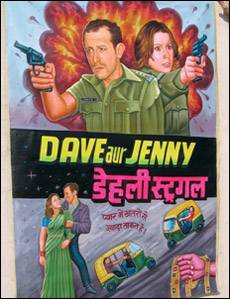
(I love the illustration!)