Are India’s malls influencing India’s marriages?

“The malls are changing the culture,” our friend Monali told us a few months ago. We’d asked her to describe some of the changes she’d seen in India over the last few decades. This is a question we’ve asked many of our Indian friends; hers was an answer we hadn’t yet heard.

Saket Citywalk Mall in Delhi. Photo by Flickr user nithinkd.

We’d already learned that Delhi’s social life used to revolve almost exclusively around the home. Jenny’s boss Renuka told us of growing up in a Delhi in which there were almost no restaurants outside the fancy hotels, which meant that most gatherings of friends and family took place in each others’ homes. In this situation, children were never far from the watchful eyes of parents and neighbors.

Times have changed, obviously. As the 800+ Café Coffee Day outlets now open across India will attest.

Café Coffee Day in Mumbai. Photo by Flickr user ianjacobs.

And all those coffee shops, restaurants, and malls have made it easier for teenagers to do teenage things without that historically intense parental supervision. Especially the malls, as Monali told us. So now, with teenagers given widespread access to venues for hanging out on their own terms, a sea change could be cresting:

  1. Boys and girls hang out.
  2. They go on dates.
  3. They fall in love.
  4. They fall out of love.
  5. They fall in love again. (In other words, relationships are made and unmade in accordance with the fleeting whims of fickle teens — that is, independent of parental influences.)
  6. Which means teenagers grow accustomed to asserting control over their love lives.
  7. Which means they push back on traditional parental authority in this realm.
  8. Which means that India finds itself on the path to American-style marriage. (And, inevitably, American-style divorce rates.)

There have been many stories about the repercussions on India’s traditional family structure of children now routinely out-earning their parents. With such economic independence, it’s said, the decision-making role of the patriarch is significantly diminished. (And this goes double for women.)

But Jenny and I have only seen this shift documented upon the point of the child entering the workforce — which is, of course, after the child’s schooling. But if Monali and that conjecture above is correct, then the malls are breeding independence into teens during the schooling years.

Which means there are now two forces at work: economic independence in the twenties that builds upon social independence in the teens. So what kind of change will this bring?

pune under siege: a gorgeous indian sci-fi music video

A few months ago, I read Cyberabad Days by Ian McDonald, a collection of short science fiction stories set in the India of 2047. It explores and India of robots and avatars and biryani and chai, of border wars and water rajas, of holographic djinns, of arranged marriage and Nepali child goddesses, of inscrutable Indian politics simultaneously transformed and unchanged by fantastic technology.

It’s far too rare to see India interpreted through the lens of genre — I can only think of Cyberabad Days, Delhi Noir, and Conan O’Brien. Fortunately, BoingBoing recently posted another example: a District 9-esque music video for the band You Say Party. Gorgeous shots of what looks like Pune shattered by menacing mosquito-masked brownshirts chasing a girl and her Macguffin.

If you want to go deeper, here’s an interview with the director, and an interview with the artist who designed the costumes.

Does anybody have any other examples of India through the lens of genre? And I’m not talking about Outsourced.

Bye-bye, Blueline! Next: a golden age for Delhi buses?

Towards the end of my parents’ two-week visit with us in Delhi, my mom decided that she wanted to go to Aurobindo Market. Not a challenging task, on the face of it: a short walk comprised of two right turns and two left turns. My mother was certainly both physically and mentally capable of accomplishing it by herself. But I refused to let her go alone.

Because to get to Aurobindo Market, she would have had to cross Aurobindo Marg. And on Aurobindo Marg, there were Blueline buses.


Photo by The Delhi Walla, Mayank Austen Soofi.

The Blueline is tragically and justifiably notorious. The 1,600 buses running on 142 routes killed over 115 people in 2008 and over 1,000 people during the first ten years of this century.


Photo by The Delhi Walla, Mayank Austen Soofi.

I first became obsessed with the Blueline when I researched why they were killing so many people: not because the drivers are bloodthirsty madmen, but because the economics behind the system created deadly incentives for the drivers. (Each driver rents his bus for the day, which means he generates profits only after he’s picked up enough passengers to cover his costs. So he has to drive as aggressive as possible not just to make money, but to stay ahead of the competing Blueline drivers on the same route, who are each trying their damnedest to overtake him and scoop up his awaiting passengers.)


Neither owner nor driver have much incentive to invest in the upkeep of their vehicle. Photo by The Delhi Walla, Mayank Austen Soofi.

And while my mother and I had a lovely time shopping together at Midland Books in Aurobindo Market, the Delhi government has been working frantically to eliminate the careening deathtraps that made me accompany her to begin with. Not because they are against sons politely helping mothers cross the street, but because the city will be a far safer place without them.

Laws alone weren’t enough, of course. Every Blueline driver knew and feared the penalties of rash driving: not just legal deterrence, but angry mobs that routinely attack drivers who don’t frantically abscond the scene of an accident. Laws and vengeance haven’t impacted safety, they’ve just encouraged Blueline owners to legally insulate themselves from the actions of the drivers to whom they rent their buses.


Photo by The Delhi Walla, Mayank Austen Soofi.

The solution, Delhi’s government realized, was to eliminate the owner/renter framework of busing and replace it with an employer/employee relationship.

This meant decoupling profits from passengers.


Photo by The Delhi Walla, Mayank Austen Soofi.

The city has been working on this for years. The Bluelines were first supposed to be phased out in July of 2009. But every time the city made a move, the “Federation of Blueline Buses Operators” got the courts to make a counter-move. Now, though, it finally seems like the Blueline is destined for the rustheap of history. After some frantic legal back-and-forth in recent weeks — the city eliminated the Blueline, the courts reinstated it, the city eliminated it, the courts reinstated it — the latest decree looks like it’s going to stick.

Delhi High Court on Monday declined to restrain a government notification to phase out the capital’s Blueline buses notorious for their reckless drivers.

So what about all the commuters who rely on the Blueline to get around? Good news: all those fancy new buses the city bought for the Commonwealth Games are about to hit the streets:

According to senior DTC officials, about 1,400 buses, which were deployed on the Commonwealth Games duty to ferry athletes, delegates, officials, media and security personnel to the Games Village and the venues, will be back on road for ordinary people from October 24.

And that’s just from the public sector. The private sector is getting involved, too, including SpiceJet and Kingfisher.

According to the plan, the Delhi Transport Corporation (DTC) is to run 60 percent of the buses while in the rest 40 percent, the entry of corporate houses is permitted.

But wait — won’t those new bus companies operate under the same old profit-per-passenger incentives? The crumbling Bluelines might be replaced by shining new Tata Motors coaches, but won’t the drivers still be racing down the roads? Will the only improvement be that the people who get nailed don’t have to worry about rust stains on their clothes?

No. There’s more to it. This isn’t just a change of ownership. The city is actually changing the economics of running a bus company.

The Delhi government will provide the companies Rs.27-42 as earning per kilometre even when the service runs into losses, but it will take the ticketing amount.

These are very different incentives. From the narrow standpoint of the bus/passenger relationship, they’re probably not perfect incentives. (One could imagine bus owners encouraging their drivers to take meandering trips to run up the mileage reimbursement while picking up no passengers at all.)

But from the broader perspective of making the city safer and the commute more reliable, this framework is a huge improvement. Especially when one learns that the drivers themselves will be city employees, and the buses will be monitored by GPS.


Photo by The Delhi Walla, Mayank Austen Soofi.

All of which means that when we go back to Delhi in February for the book release events (we’re in talks for at least nine parties in six Indian cities!), it might be safe to cross the street. In fact, given that most of these new coaches are-conditioned, we might even travel to our events by bus.

in Saket, the impossibility of unsanctioned chickpeas

Two weeks ago, Jenny and I attended the local premiere of Rajinikanth’s spectacular and ridiculous new movie, Endhiran. This was our first Rajinikanth experience, but we were quickly initiated into the ritual: cheering and confetti when Rajini makes his entrance, whistles and hoots when the leading lady appears, and applause and shouting and screaming in direct proportion to the creativity of the violence of each scene.


It’s also called “Robot.” Go see it!

Jenny and I attended this showing because we’re exceedingly nostalgic for India right now. And our experience with Endhiran did indeed bring back memories of good old Saket PVR, where we saw Om Shanti Om, Jab We Met, and, alas, Marigold, that east-meets-west, Salman-Khan-meets-the-blond-from-Heroes flop that is easily one of the worst movies ever made.


Don’t. Just don’t.

The audience at our Denver showing of Endhiran was as participatory as they are in Delhi. And the intermission was similarly jarring. But one significant aspect of Delhi movie-going did not make it across the Atlantic: the theater security. Here, the usher simply took our ticket and let us pass, as they do in most American theaters.

In Delhi, the ushers search you before letting you in. And they search you good.

We assume that Delhi’s ushers were originally deputized with patron-groping powers in order to prevent cinemaphobic terrorists from recreating scenes from Inglourious Basterds. But it seems that their mission has crept from stopping bombs to stopping bon-bons: while Delhi’s theater ushers may be protecting their patrons, they’re equally aggressive in protecting their snack bars’ bottom lines.

In America, Jenny and I usually attend movies with sandwiches, sodas, and bags of already-microwaved popcorn stuffed into her purse. That’s because theaters here believe it’s a battle not worth fighting: anyone cheap enough to sneak food into a theater would never pay five dollars for thirty cents’ worth of carbonated corn syrup anyway.

But in Delhi, anything entering a theater was deemed game for inspection. First they ran their hands up and down the contours of our bodies; then they manhandled the contents of our pockets; and then, having violating our persons, it was time for our possessions. And when they opened Jenny’s purse on that lamentable Delhi evening when we decided to subject ourselves to Marigold—our first visit to a movie theater in India—they immediately spotted our digital camera.

The men who craft security policy for PVR have determined that cameras are just as forbidden as bombs.

And though no rational human would ever want to pirate Marigold, rules are rules, and the busy hands guarding Saket PVR would not let us proceed with a camera in our possession. Our only option was to avail the services of the vendors selling water bottles and mobile phone talk time outside of the theater. We handed one our camera and he handed us a claim receipt, which is how our camera was spared the wretchedness of enduring Marigold.

Lucky camera.

We walked back into the theater. The ushers repeated their desecration of our bodies and Jenny’s purse. But this time they dug deeper and discovered what had been hidden beneath our camera: a bottle of water, a bar of chocolate, and a bag of Haldiram’s roasted chickpeas.


Al Qaeda could not carry this into a theater, either.

The ushers looked up at us from our cache of culinary contraband. Their faces showed neither anger nor disdain, but bewilderment: why would we even attempt to bring food into a theater? Didn’t we know we’d be searched? Didn’t we know we’d be discovered? Didn’t we know that the same rules empowering ushers to save lives also extend to preventing unauthorized snacking?

And so we were again turned away. And while we should have realized that Fate was trying to tell us something (specifically, that Fate was shouting at us in 48-point type: “DON’T SEE THIS AWFUL MOVIE!”), we’d paid our money, and we were going to see all the movie.

But we’d also paid for these chickpeas. And we thought we could still salvage them. As I abandoned our chocolate and our water in the market, Jenny surreptitiously folded the Haldiram’s bag and hid it in the sleeve of her sweatshirt. And then she folded her sweatshirt into a ball. And then we approached the ushers once more.

They found the chickpeas immediately. This time, as they looked up at us, I’m pretty sure they were trying not to laugh.

Jenny guiltily handed over the bag. Only then were we finally allowed to proceed into the theater—where, for the next two hours, Jenny and I endured Ali Larter overacting an affirmation of every conceivable negative American stereotype. She was immoral, hyper-sexual, rude, uncultured, uncouth, uneducated, underdressed, loud, loutish, lewd, and capable of downing an entire bottle of vodka in a single night—which she did. Which caused her to pass out on Chowpatty Beach. Good thing for her that Salman Khan had convinced himself that she was a diamond hidden under all that make-up and loose morality. He decided to stand guard over her until morning, presumably not to protect her honor so much as to protect Mumbai from being wantonly ravaged by this insatiable American caricature. And when the sun rose, he began to transform her into a proper and honorable woman.


Don’t get us wrong: we didn’t hate the movie because it offended us as Americans. We hated it because it offended us as human beings with active brain cells.

We emerged from the theater almost grateful for the nausea the movie left us with, because at least it masked our hunger. We’d refused to buy concessions, of course. Which was too bad, because it would have been great to have had popcorn to throw at the screen.

how to enjoy Delhi during the Commonwealth Games (despite what the media says)

According to the press, any foreign visitor at the Commonwealth Games will inevitably sit in a puddle of red betel spit, and then  contract dengue, and then die in a bridge collapse (while, back at their hotel room, a dog is casually tracking paw prints across their mattress).

As two people who lived in Delhi, we can tell you this: the media tends to exaggerate.

For international events like the Commonwealth Games, the media normally provides foreign visitors with practical travel tips. But since they’re too busy hyperventilating about the Impending CWG Apocalypse, that responsibility defaults to us.

And this is an important responsibility. When Jenny and I first stepped into Indira Gandhi International Airport, we were slathered in sunblock and clutching the Lonely Planet like the bible, but we were completely ignorant of the city’s unique character. So, for the benefit of those few tourists not frightened away by the terrified bleating of the global press, we present a few tips for making the most of delightful Delhi: what we know now that would have helped back then.

==============

Packaged stuff has a price on it. It will come to pass in Delhi that you will get thirsty. When that happens, you will buy a drink. And every so often, someone will hand you a bottle and tell you it costs 100 rupees.

We Westerners are used to being overcharged in airports, stadiums, and tourist areas where competition is limited and prices jacked up. We Westerners are also accustomed to prices being set by Management, and thus closed to both customer negotiation and merchant discretion. In Delhi, though, where neither the former nor the latter are usually the case, savvy vendors have learned of our tourist expectations. And they try to use them to their advantage.

And so you may one day ask a vendor, “Pray tell, how much for this large bottle of Aquafina water, kind sir?” (You’ll of course be speaking with the exaggerated politeness for which Western travelers are known the world over.)

“20 rupees,” the honest vendor will reply.

“100 rupees,” the sly vendor will whisper, hoping you will believe him.

And at first, Jenny and I did. In our culture, prices are inviolable and gouging is expected in tourist areas. So, finding ourselves thirsty at Qutub Minar or the Red Fort, we’d shrug and hand over whatever was asked. Until we learned about the MRP.

And now you, Delhi traveler-to-be, know about the MRP, too: packaged goods are usually printed with the Maximum Retail Price.

An honest vendor will charge at or below the MRP. If you encounter a sly vendor attempting a 100-rupee gambit, just politely examine the bottle for the MRP, point it out, and smile. He’ll adjust his price accordingly.

==============

Smiling should be your default response. Hidden in our first travel tip was our second: smile, relax, and go with it.

Foreigners are, well, foreign in Delhi. So sometimes you’ll get stared at. Sometimes you’ll get cheated. Sometimes you’ll get pushed to the front of a queue even though a dozen equally-worthy people are in line in front of you. Sometimes someone will ask to shake your hand for no reason. Sometimes someone will shove a baby in your arms and pose you for a photo.

In many of these cases, you will feel uncomfortable. You’ll want to cross your arms, furrow your brow, and scowl your worst.

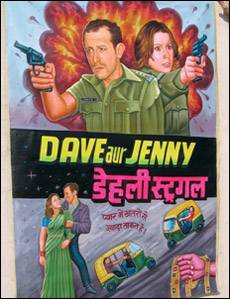
Don’t. No matter what happens, smile. Relax. Have fun! Go with it. Nothing bad will happen to you when you do, but you will miss many great experiences if you don’t. Jenny and I made a rule when we moved to India: no matter what we were presented with, we would smile and go for it. Which is how we got our famous Bollywood painting. Which is how Jenny rode with Delhi’s only female autorickshaw driver. Which is how I held a cobra.
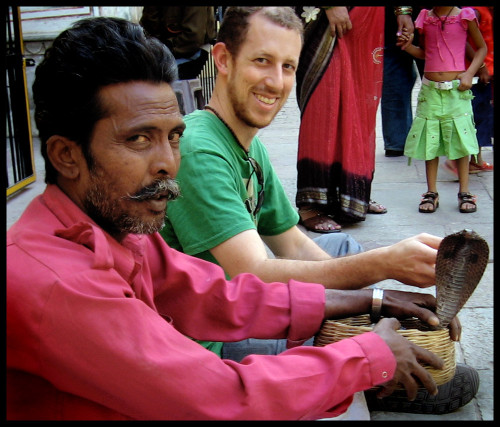
No matter what happens to you in Delhi, smile and go with it. You’ll have much more fun that way.

==============

Try the sidewalk chai. Delhi is paradise for street food. It’s also heaven for Escherichia coli. To balance the former with the latter, you may want to avoid the gol gappas — but make sure not to miss the sidewalk chai. Pick a vendor who has other customers, and as long as you see it boiled before your eyes, you have nothing to worry about. Give the guy five rupees per cup. He may or may not give you change. (Usually chai is only three or four rupees, but the two extra rupees mean a lot more to him than they do to you.)

==============

Ask to take pictures. The subjects that Jenny and I photographed the most were things most Indians wouldn’t think twice about: vegetable peddlers, sidewalk barbers, and sari-clad aunties riding scooters side-saddle with more dignity than we could ever hope to muster.

And we know that our photo shoots were as baffling to our subjects as it would be if a tourist burst into Starbucks and started snapping pictures of the baristas back home.

Which is why our early photos are filled with people looking at us with surprise, with confusion, or even with aggression.

Then we learned the trick: before you take a picture, ask permission. That means make eye contact, raise your camera, and smile. If they say no, respect them. If they say yes, do your thing, and then show them the picture once you’ve snapped it. It’s a moment of bonding that both you and your subject will enjoy—and you’d be surprised who has an email address and would like a copy.
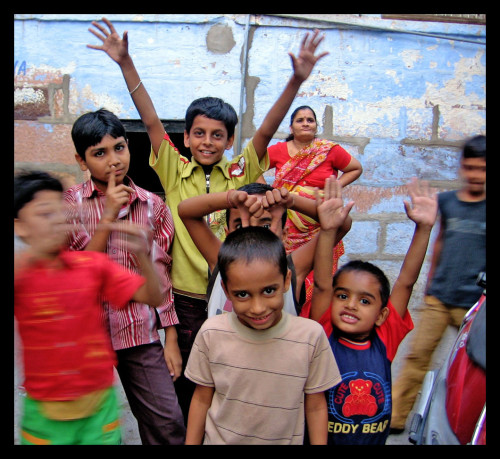
img_6739

==============

Three Hindi words for autorickshaw drivers. Bas—pronounced “bus”—means stop. Seedha—pronounced “seeida”—means go straight. And finally, kitne? means “how much?” You probably won’t understand the driver’s answer when you poke your head under the canopy and ask him, but that’s not why you ask in Hindi. You ask in Hindi to make him doubt you’re a tourist fresh off the plane; that way, he’ll be far less likely to try the ol’ three-hundred-rupees-to-Connaught-Place trick.

(And if a driver ever does quote you some ridiculous fare, remember the lessons from above. Smile and politely disagree. If he doesn’t change his price, walk away. You’d be surprised how reasonable he’ll a driver becomes when he sees your back receding.)

Here are many more tips for taking autorickshaws in Delhi. And here’s a bonus: for the ultimate weapon in negotiation, learn how to say bhaiya.

==============

Drivers don’t always know where they’re going. And that doesn’t matter in the slightest. They’ll still get you there.

==============

Don’t be afraid to take cycle rickshaws. Cycle rickshaws are weird for westerners. It’s challenging for us to accept another human being working so hard for so little to enable our own laziness. But if there’s one thing a rickshaw puller hates more than pulling customers, it’s not pulling customers. This is how they earn their living, and they want your money.

It’s a bit more challenging to negotiate a fare with bicycle rickshaw drivers, because they usually speak less English than the autorickshaw drivers. If you discover there’s been a disagreement with the price, think about your health insurance package and then think about his, and fork over a reasonable difference.

==============

Don’t miss! The Dilli Haat shopping bazaar (you can bargain, despite what they say; and they use purified water, so you can try the gol gappas.) Appams with hot coconut milk at Saravana Bhawan. Kulfi falooda at Roshan di Kulfi. The lovely ruins at Hauz Khas Village. The Sunday book market. (Or did they shut it down?) The Nehru Place computer market (but not on a Sunday). The old city, the old city, the old city: throw out your Lonely Planet and get as lost as you can. You won’t regret it.

==============

If you want to do something nice. Donate to Pardada Pardadi or Udayan Care. They’ll put it to good use.

==============

There are many, many more Delhi travel tips. Too much for this humble article. Perhaps some of our readers will submit their tips below…?

If you enjoy this snapshot of Delhi, good news: we have a book about our Delhi experiences coming out in January!  It’s a witty travel memoir of expat life in this delirious metropolis. Do one thing: send us your email address or follow us on Twitter so we can invite you to the Indian and American release parties!

three great things happening in Delhi right now

If those nine photos were the worst the BBC could come up with, then things are probably a lot better than they say. But it’s hard to argue with a steamroller of negative hype; the best one can do is change the subject. Which is what we hope to do by pointing out three terrific things that are happening in Delhi right now.

Words
First is the release of Mayank Austen Soofi’s three books this week. Writing as The Delhi Walla, Mayank is the best Delhi blogger in the business. He’s dedicated himself to telling the stories of one percent of each of Delhi’s 13 million residents, one person at a time. He finds interesting people, takes interesting pictures, and writes interesting stories about them. And the glorious people at Harper Collins India (the same glorious people who are publishing our book) recognized his genius and are releasing three volumes of his work:

We highly encourage you to rush out and buy them. They showcase Delhi from the highest and the lowest, from the richest to the poorest, with a sharp photographer’s eye and a true journalist’s knack for spotting the story that everyone else walks right past. While our own writing is dedicated to looking around and remarking upon what we see, Mayank does the opposite: he walks right up to people and asks them what’s really going on. And what he learns is always fascinating.

Art
A new art exhibition opens this weekend at the Lokayata Gallery in Hauz Khas Village. Here’s how they describe it: “It’s the golden autumn again. And Delhi is celebrating the season in a special way. With eight member artists, the Mirror Group presents its 14th exhibition — ‘MIRROR’. ‘MIRROR’ reflects our life, time and culture. Not just the flat-glossy surface, but the depths of it. Come experience the manifestations through paintings, sculptures, photography and various other media.”

We recommend this exhibit because one of the artists is Dipankar Paul, an extremely talented painter and one of our very good friends in Delhi. (He’s the one who taught us “Not your price, not my price.”) His work is terrific, and if all the other art in the exhibit is up to his standard, it’s going to be a very good show indeed. It starts today and continues through October 1st from 11 AM to 7 PM at Lokayata in Haus Khas Village.

Inspiration
Long-time readers of this blog will remember Rags to Pads, a fundraising effort Jenny and I put together to help address two problems at once: to improve sanitation and reduce disease in rural Uttar Pradesh, and to create job opportunities for women in a region where there are hardly any. We raised over $10,000 to help Pardada Pardadi Educational Society (Jenny’s former employer and our recommended NGO) purchase a machine for manufacturing menstrual pads, thus creating a business opportunity for the graduates for the school AND providing a market-driven alternative to current habits out there. It’s been going extremely well:

A few months ago, Rags to Pads was featured on National Public Radio. And now we’ve learned that Rags to Pads is being used as a model for an India-wide initiative!

The Union health ministry launched a Rs 150-crore scheme last month to promote menstrual health among rural adolescent girls. Unavailability and high costs of sanitary napkins deter menstrual hygiene in rural India. The scheme aims to provide one pack of six sanitary napkins at Re 1 to girls in the below poverty-line category. Those above the poverty line will get the pack for Rs 5.

…In Anupshaher in Uttar Pradesh, a girls’ school run by the nonprofit Pardada Pardadi Educational Society has installed a low-cost sanitary napkin unit. It employs its former students to run the unit, and sells a pack of 10 napkins to students at Rs 5. Members of the students’ families have also started to order. Now with the government scheme, these groups hope to expand their reach.

We’re honored to have played a part in kick-starting this effort, and we want to once again thank all our readers who donated as well! This is really good news.

=================

So, the Games are a week away. Put down the newspaper, because the headlines aren’t going to make you feel any better. Go read Mayank’s books, see Dipankar’s art, and revel in progress being made. There’s good news in Delhi, even if nobody is talking about it.

And when the Games start, don’t be surprised if things aren’t as bad as they say. They usually aren’t.

the sublime awesomeness of Tamil action

It was my boss Murali who first said to me the name “Rajinikanth”.

Murali is a natural storyteller. He’s utterly captivating, Murali, with one of those personalities that immediately commands any room into which he steps. Some of us tend to be indistinguishable from the wallpaper, but Murali is of the kind with an invisible spotlight trained on him at all times. So to see Murali get a faraway look in his eyes when speaking of a film hero — that man must be spellbinding indeed.

And what Murali told me about Rajinikanth was nothing short of unbelievable: something about shooting at a bad guy, realizing there were actually two bad guys, and then throwing a knife to split the speeding bullet into two pieces that each perfectly pierce the hearts of both bad guys.

While it may not have been that exact scenario, it was certainly in that general spirit. And whatever it was, my coworkers nodded in agreement at the assessment that Rajinikanth lived on a plane above us mortals. Oh, they knew of Rajinikanth. Everyone knew Rajinikanth. Except us Americans.

And we Americans are missing out.

After this conversation, I googled the name. The portrait I found didn’t seem particularly transcendent: a slightly pudgy man with an admittedly impressive mustache. But then I beheld the glory that you will experience in the two clips below. Part one:

Part two (it gets EVEN BETTER):

From there, I descended into the Youtube hole, and a world of Tamil cinema embraced me into its overdubbed bosom. Rajinikanth may be singularly glorious in Murali’s esteem, dear reader, but other South Indian action heroes are not far behind.

Conclusion: Tamil action cinema is incredible.

I cannot claim to understand who did what first in Tamil cinema. It’s possible that Rajinikanth is the greatest and all else are pretenders. It’s possible that Rajinikanth is the first and everyone else is biting his flow. It’s possible that Rajinikanth got famous copying someone else’s moves. All I know is that it gets better:

And better still:

Dear Indian readers of this blog, if there’s one thing we ignorant Americans know less about than Bollywood cinema, it’s Tamil cinema. In fact, I’m not even sure if Rajinikanth’s oeuvre is properly called “Tamil cinema” — I could be way off. (As the comment below points out, I’ve included at least one Telugu clip above.) What I do know is that I have yet to behold a knife splitting a bullet with my own eyes. I — and all Americans — would be in debt of anyone who could a) explain Rajinikanth and his antecedents to us, and b) embed the knifey-bullety clip below.