did we ever enjoy ‘white privilege’?

A reader name Gayatri recently emailed us this pointed question:

Had a question for you guys. Have you ever been out clubbing in Delhi or to a pub in the evening. Would they let you guys cut the queue and let you enter even if to the rest of the people waiting they’d say the club is full?? :) It kind of co-incides with the privileges to white-folk in India. If you guys have a story regarding – think it could be funny, especially with the humor you two have. :) Hope to see both of you in September!

We’d be lying if we didn’t admit skin-based advantages are bestowed on foreigners in India. Auto drivers, for instance, would hone in on us at the expense of everyone else waving their arms at them. (And they’d give us choice grumbles when we’d refuse to cut ahead of those who’d been bypassed their rightful ride.) The sidewalk chaiwallah near my office would always boil a fresh batch for me, even as he poured from a premade kettle for the factory workers who arrived the same time as I did. And while the guards at Saket Citywalk would grope us for poorly-hidden bombs just like every Indian shopper — as if Al Qaeda’s training manuals advised keeping their explosives in their front pockets — their hands always seemed to linger more tenderly with us.

Wait, that’s not a good thing.
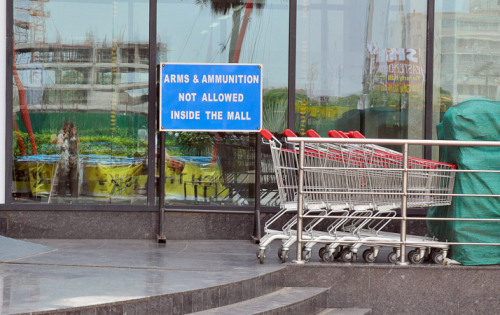
Also, Al Qaeda always obeys signs. Image by Flickr user 3_second_memory.

So we don’t deny that white people are given deference in India. But Jenny and I will insist that we never actively took advantage of it. Especially when it came to queues.

In fact, there were many times when our foreign-ness made us easy beacons for queue abuse. Our American standards of personal space always meant three or four fellows could slip into queue in front of us between the moment our eyes began to blink and the moment the blink was completed. If we weren’t constantly crotch-checking the people ahead of us, we learned, we might as well be moving backwards.
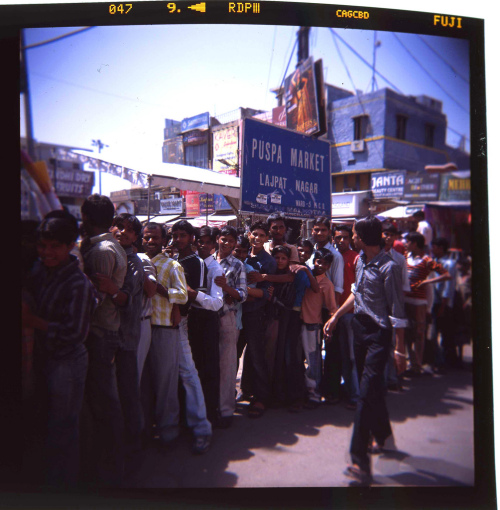
Image by Flickr user Loulou H.

And there was certainly no advantage for us at tourist sites — we’d have to elbow our way up to the ticket counter just like everyone else, jamming our fistful of bills under the metal grating along with all the others, waving the sweet scent of sweaty rupees under the ticket taker’s nose until his eyes met ours and our transaction was complete.

We certainly could have bulldozed queues and hopped unrightful autos like the worst of the tourists. Such modern expressions of the Imperialist mindset are impassively tolerated by the citizens of our host country; Indians are far more polite to Western rudeness than we Westerners would be to such behavior back home. But Jenny and I saw ourselves as ambassadors, and we fashioned our queuing behavior accordingly.

In fact, we recall a time when our fellow back-of-the-queuers tried to invoke our “white privilege” for us. This was at the conclusion of our birdwatching trip to Bhatarpur, when we decided to catch the late afternoon train back to Delhi rather stay another night and leave as scheduled in the morning. Arriving at the train station, we dutifully joined the 20-person queue; but, being off the tourist track as we were (Bharatpur gets its share of Westerners, but most have arranged their tickets in advance), we were quickly noticed.
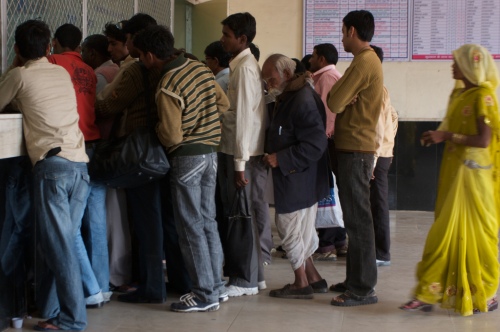
“Ticket Queue – Bharatpur Junction Railway Station – India” by Flickr user string_bass_dave. (Who isn’t me.)

“You please go,” said the man directly in front of us, gesturing to the head of the line. Other nearby members of the queue signaled their agreement. But Jenny and I shook our heads and smiled in polite refusal. They insisted again. We refused again. They gestured more adamantly, insisting that our ticketing needs outweighed theirs; we refused more theatrically, insisting that progressive values can be no better illustrated than via a multiracial ticket queue.

Our egalitarian insistence won the day. Although twenty minutes later, when we reached the window and discovered we’d been in the wrong line the whole time, we kinda wished it hadn’t.

———–

Incidentally, when Gayatri said, “Hope to see both of you in September!”, she was talking about our book release party. She knows about it because she’s on our mailing list (and following us on Twitter).

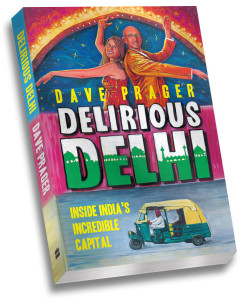
We’re expecting the big event about a month before the Commonwealth Games. We already know the official title, which we’ll reveal, along with the cover design, soon. (The title of our book is NOT “Our Delhi Struggle” — as we’ve mentioned before, we regret that name, and we’re not going to make the same mistake.)

Beyond Delhi, we’re hoping for release events in Mumbai, Pune, Kolkata, Bangalore, Chennai, and so on. You, dear reader, have direct influence in the matter: email us to join our mailing list, and then pledge in the comments below that you’ll attend an event in your city. Our publisher will surely take note.
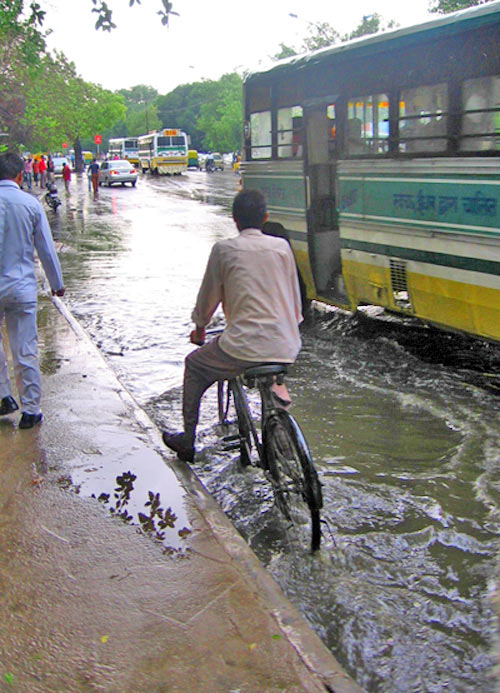
great new animation from WebChutney

Before Jenny found her job at Pardada Pardadi, she worked briefly at WebChutney, one of Delhi’s top online marketing agencies. (And one of the best-named agencies in the world.) They just came out with this great animation for Airtel. Even though we don’t understand the dialogue, we recognize top-notch art when we see it. It’s so good that translation isn’t necessary to get the joke.

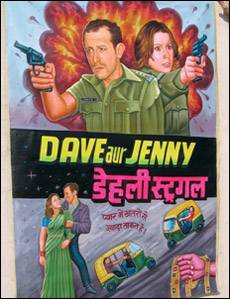
Great job, WebChutney! If you’ve got any free time, maybe you can make an animation for our book? Just imagine how much fun you could have animating two Americans taking autorickshaws, buying vegetables, and working at computers. (Or if you want something more exciting, you could take inspiration from our poster…)

Delhi’s deadly Blueline comes to… New York City?

About a year ago, I wrote an essay explaining why Delhi’s Blueline bus fleet (the privately-owned menace that scores a yearly death count rivaling a Stallone movie) was so deadly. It was economics, I theorized: each bus driver is in competition with every other driver on his route, which means his biggest incentive is to pass the bus in front of him; reckless driving and shattered lives inevitably follow. But for the many areas of Delhi not served by the Metro and underserved by public buses, there’s no other economical option.

This system is not unique to Delhi.

A recent New York Times article showed that Delhi’s Blueline is simply one (admittedly extreme) example of a worldwide municipal phenomenon. And this pattern seems to spontaneously replicate itself wherever a few initial conditions come into existence: high population density, poor public transit, private leeway to address public failings, and weak government oversight. Including, as it turns out, New York City.

Yup, I used the same picture last time, too.

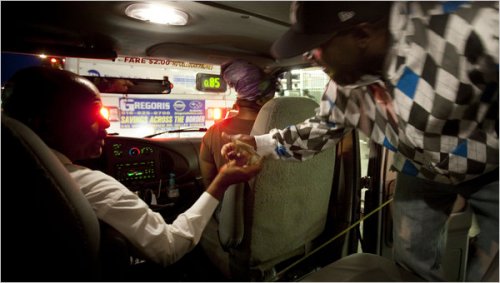
The Times article was about the rise in competition, violence, and recklessness among the private vans that ferry passengers to and from New York neighborhoods that mass transit doesn’t quite satisfy. As in Delhi, the city nominally regulates this system: the routes are predetermined, licenses are required, and rules do exist. But like Delhi, the system has evolved faster than it can be controlled — and it’s begun to assemble itself into the shape and structure that Delhi has taken to the extreme.

Commuter vans are a familiar sight in many city neighborhoods, linking parts of Brooklyn, Queens and the Bronx not served by subway lines to subway stations and also to the financial district in Manhattan and to a large mall in Nassau County. The routes, which are defined by the city’s Transportation Department, are meant to supplement the public transit system, not compete with it, though that is not always the case.

There are nearly 300 van drivers in New York who abide by the rules, paying thousands of dollars a year in licensing fees and insurance. They are outnumbered by hundreds of drivers who work the same routes, but have no permits and no insurance, and whose numbers have increased as the economy has soured.

Picture from the New York Times.

I rarely saw these vans when I lived in New York; I was always lucky enough to live near the subway. The one time I distinctly remember seeing them was in 2004, on a crowded strip of Flatbush Avenue, far beyond the parts of Flatbush I normally traveled. We’d just moved back from London, and I was driving to return the U-Haul Jenny and I had rented to move out of storage. The reason these deep Brooklyn vans stuck in my mind is because they appeared almost identical to what we’d seen on a visit to Cairo a few months prior to that moment. In both Cairo and now in New York, the vans idled curbside, half-full of passengers, with competing drivers shouting in rapid-fire slang the names of their destinations. I couldn’t make sense of what they were shouting — like in Cairo, and like I’d come to see in Delhi, the system had evolved its own vernacular.

To support this point, I just read this article about Cairo’s “microbus” system. If you change “microbus” for “Blueline” they might as well be talking about Delhi:

Microbus drivers! The very words elicits disapproving reactions from taxi drivers, private car drivers, pedestrians and the municipal authorities, police and the traffic authority. The reactions range from suspicion to open hostility and even envy. Taxi drivers complain that microbus drivers compete to pick up passengers, speed, and therefore are among the leading causes of accidents. Microbus drivers generally constitute a major menace to public well-being and safety in their view.

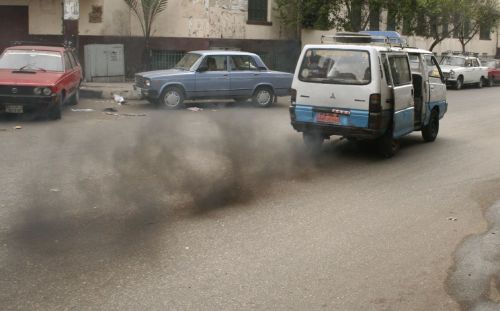
A microbus in Cairo. Image by Flickr user richardavis.

Cairo, Delhi, New York — if I’ve come across these systems in my own travels, then they surely must be assembling anywhere there are lots of people, few transit options, and limited government intervention into private solutions. These are spontaneously identical structures, these disparate fledgling Bluelines; the desires of commuters and of drivers independently assemble into mirror systems. And they set in motion predictable effects. From the New York Times:

Anthony Henry’s commuter van rolled west along Merrick Boulevard in Queens, packed nearly to capacity with nine passengers. It was 6:50 on a Friday morning, and the path ahead of him was clear until suddenly it wasn’t: A van with a wobbly left rear tire, illegally plying the same route, burst in from a side street and barely cleared a car parked at the corner to pull ahead of Mr. Henry.

“Look at this guy right there, picking up my passengers,” Mr. Henry, 47, said, clicking his tongue as the van swooped to the curb and scooped up two people waiting. “It’s a war out there.”

Compare that to the article about Cairo:

Last month there was a particularly nasty accident on the Corniche at one of the main entrances to the suburb of Maadi, eight kilometres south of Cairo. Survivors said they had asked the driver several times to slow down. Belongings were strewn across the street. Mercifully, the death toll was not high, but two lives were lost, and several passengers sustained serious injuries after the bus swerved off the road. Few emerged from the incident unscathed. Survivors said the driver took the curve too fast, trying to race ahead of another microbus alongside.

In each city, each driver on the route is in competition with every other driver on the route. Sound familiar? The Times’ article hints at the danger, destruction, and fatalities New York’s version could eventually come to:

… Beyond a financial threat, their legal competitors say the unlicensed van drivers are a growing safety menace. “They’ll run red lights, they’ll drive against traffic, they’ll cut you off.”

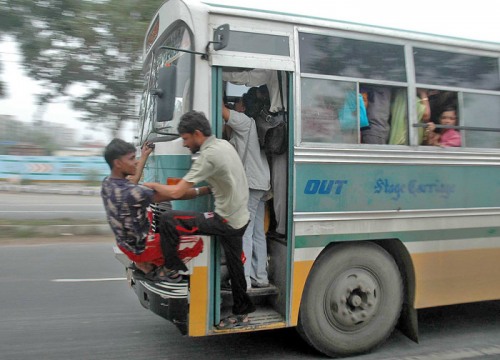
A Blueline during rush hour. Image by Flickr user parveennegi1979.

When I wrote my essay last year, Delhi was pledging to eliminate the Blueline in time for the Commonwealth Games. A quick look into the status of that pledge reveals setbacks, if not outright failure. It’s not surprising: the same pressures that drive Delhi’s death toll have also made a few men extremely rich, and busting a cartel is difficult even in the best of circumstances.

There’s a lesson here. Order has to be imposed before the system moves to the next phase: consolidation of power.

In the meantime, it’ll be interesting to see if New York’s media evolves a response to this stimulus to mirror the way Delhi’s media has. This, too, is a self-replicating pattern of response: outrage stokes sales. If New York City were to continue in Delhi’s extreme direction, you could expect the New York Post to start publishing a dramatic daily death count of its own.

Pakistan’s film poster painters are suffering, too

As regular readers know, Jenny and I hunted down a former Bollywood poster painter near Old Delhi, commissioned him to paint what we humbly consider the world’s most amazing painting, and more or less made both ourselves and Vijay Singh, the artist, marginally famous. (In fact, I was just Googling to support that statement, and I came up with an article written about him four days ago! There’s also this radio interview.)

But even as NPR reports that major corporations are horking Vijay’s Bollywood aesthetic, it’s important to bear in mind that while one Bollywood artist may be experience a resurgence, many more have faded into the wake of multiplex cinemas and digitally-printed movie posters. And now we learn that it’s not just in India — in Pakistan, too, the art form is dying.

Royal Park, a place in Lahore still known for the film business, used to have many workshops where seasoned commercial artists like S Rahi, M Younas, J Arfi, Sarwar and others worked and taught students, Mani explains. “There were a number of cinemas around the area of Royal Park. Some of them have turned into commercial theatres and others into parking lots or restaurants. 12 years ago, around 100 established artists were working on film hoardings and they had many students too but you can hardly find any such artists now,” he said.

A sad situation. Perhaps some bloggers in Lahore can track down one of these artists, commission a painting, and start a parallel resurgence?

swimming in Delhi

Delhi is hot. Not just record highs, but lows notable for their record highness. (“The city recoded its highest minimum temperature for June in over 40 years”, gasps the HT.) And when it gets that hot — when Hauz Khas reservoir starts to look refreshing — thoughts turn towards Delhi’s rarest of commodities: the swimming pool.


This is Hauz Khas Reservoir. After ten minutes in an autorickshaw on the BRT, you’ll want to dive in.

There were many times in our Delhi experience when our melting brains coagulated around swimming as our only salvation. At those times, our thoughts turned immediately to the US Embassy: inside its thick walls, past its mustachioed guards, a full-sized swimming pool beckoned, complete with screaming children and floating toys and, presumably, genuine imported Rocky Mountain springwater. But that pool is reserved for employees of our government, their families, and those few civilians for whom access to the Budweiser and hot dogs of Delhi’s Phoenix-on-the Yamuna is worth the $1,400 a year for membership.

Our budget did not allow for such luxuries.

Which meant that for us, relief was hard to come by. Even cold showers weren’t an option — not when our water was stored in a black plastic roof-top tank. During the early afternoon sun, our showers were as hot as we were.

Hope arose early into our first Delhi summer. As the true definition of “hot” asserted itself in all its sweat-spewing intensity, rumors of an aquatic Brigadoon began to reach our ears. It appeared but for a few hours every Sunday night, the whispers said: the Park Hotel’s public pool party. Our dripping minds would latch on to the vision, and our perspiring hands would reach to phone an AC cab — but we’d never make the call. Because it was, after all, The Park Hotel; surely a minimum bicep size was required for entry to the spring at which Delhi’s fawning nymphs frolicked.

Some things in life are reserved for the pretty people. And even though my bare back left grease stains on the sofa, at least my ego remained solid, if not slightly gelatinous. But fear not, fellow proles! For those of us whose silhouettes would never be mistaken for Salman Khan’s, most five-star hotels have pools! And they offer daily guest passes!

(But only if you have five-star money.)

On one particularly desperate Saturday, Jenny and I splurged and plunged. Ignoring the glaring inequities of swimming in a landlocked city with chronic water shortages, we handed over what most Delhiites would regard as a terrific weekly salary in return for a few blissful hours getting sunburned beneath the waters of the Intercontinental. We felt nothing but guilt, rest assured; blissful, sweet, cooling, chlorinated guilt.

(A few weeks later, we spent an hour casing the pool at the Hyatt, noting the number of swimmers against the attentiveness of the attendants; and while we both agree its quite possible to wander past reception, change in the bathroom, and swim without paying, we were never so desperate as to try.)

According to the Times of India, there are actually 125 licensed swimming pools in Delhi. A few of them are run by the city, including the pool at Siri Fort, the sports complex near our Hauz Khas flat. The paper says that up to 100 members and paying guests can sign up in advance for each of the pool’s eleven one-hour daily swimming shifts — a brief-but-glorious respite for 0.0078% of Delhi’s population.

But despite the fact that Siri Fort’s pool was both within walking distance and far more affordable than any other option, we never went. That’s because we knew that there would be boys at the complex. Boys, and men who retain the maturity of boys. Combine that inevitability with the presumed rarity of female foreigners wearing swimsuits, and Jenny would have had to endure the poolside equivalent of her walk up the minaret stairs at Jama Masjid: a gauntlet of ocular groping.

A hot shower at home was actually the least uncomfortable choice. Although if we’d been in Delhi this summer, we might have changed our minds.

18 and out? Not in India. (A study of family life.)

At ninety years old, my grandfather was on his own. His nearest child, my aunt, was 120 miles away. He cooked for himself, he cleaned, he paid his bills, he drove himself to breakfast with his buddies every morning, and he beat me at cards every single time. And while my family certainly wanted him to move closer to one of us—he refused to leave the town in which he’d lived all his life, even though his last kid moved away in 1976—we all admired his independence.

His independence horrified my Indian friends.

While Ganga and I worked hard, Grandpops watched over us. Click for a bigger picture. To explain the pose: I’d asked Grandpops to pretend he was a rapper, and this was his response.

I’d see shocked condemnation in their eyes when I’d tell my Indian colleagues about Grandpops. What is wrong with the Prager family, they’d obviously think, that we’d so coldly abandon our patriarch? And what kind of family would ever let a grandparent live alone in the first place?

This leads to another of the cultural variances this blog dutifully documents: in America, family life generally has an expiration date. In India, family life generally takes precedence over everything.

For most Americans, this expiration date is the light at the end of our tumultuous teenage tunnel. Our 18th birthday pulses in our adolescent minds, because that’s the accepted age at which we either set out for university or set out on our own. In my family, 16 meant it was time for a job, 18 meant it was time for college, and 22 was the first day of the rest of our lives (“You’re off the payroll,” as my dad always put it.)

This isn’t unusual: most American families break up by the time the kid is old enough to drink. Some see their kids move to condos in the same city; others, like our parents, watched their kids run off to Boston, San Francisco, Washington DC, and India. My grandfather’s children scattered across the country in a similar manner. Even when my brother briefly moved home after university, the first thing he did was find his own place. Living at home is not in our cultural vernacular.

In India, the opposite: families generally stick together until marriage or economics force them apart. Houses typically contain multiple generations of multiple branches. If the American narrative is “18 and out”, the Indian narrative is three patrilineal generations under one roof, with the eldest son regularly consulting architects for new floors to house additional wings of uncles.

Most of our unmarried friends and coworkers lived with their parents, and most expected to remain with them until a job moved them to a different city or, in girls’ cases, a marriage moved them into a different family’s orbit. A few coworkers lived with their parents in the far outskirts of Delhi, despite the 2-3 hour commute this obliged them in each direction. The few bachelors or bachelorettes we knew who lived on their own did so only because their families were in Orissa or West Bengal; only a tiny fraction of our friends or coworkers lived on their own even though their parents were also in Delhi.

Observing this, we developed generalizations: in India, family comes before self. In America, self comes before family. In India, parents make decisions on the child’s behalf long after he or she has embarked on his or her career; in America, the child’s struggle for independence begins the moment they enter the teenage years.

In the long run, this means that Americans make decisions with little but advice from their parents, for better or (often) for worse, while Indians spend their first three decades knowing their holiday plans, career decisions, and sometimes even wardrobe choices are subject to parental veto. The most extreme example of this deference to ancestry is in marriage, of course: very few American children would ever allow themselves to be sat down, handed a cup of tea, and informed of their recent betrothal. Americans usually marry regardless of their parental approval—indeed, when parents express reservations about a marriage, that usually just strengthens the resolve of the children to go through with it.

Our divorce rate attests to this.

In India, the consequences of disobeying are staggering. We knew one thirty-something girl who was in love with a guy—heads-over-heels, stand-up-in-a-restaurant-and-shout-it in love—and the guy reciprocated. But her family didn’t approve. And when she made her wishes known to her parents, she was given a simple choice: the man or the family. She could not be part of both.

In America, self is more important than family. Everyone in my family wanted Grandpops to move closer to them, but none of us were willing to give up our own lives to live with him in Connecticut. In India, where our friend had no choice but to break off her relationship with this man she loved, family is more powerful than anything.

three hospital visits that (surprisingly) never happened

Our first brush with danger came from plugging things in. Electrical plugs in India are two-pronged or three-pronged, and thin-pronged or thick-pronged. Some outlets can accommodate both thick prongs and thin prongs, and very special outlets can accept almost everything: thin three-pronged plugs, extra-thin two- pronged plugs, and American-style plugs to boot.


Such a marvel of engineering!

This variety of sockets was confusing to us, leading to a surprising amount of time wasted shoving large prongs into small holes. But even more confusing was the inner shield in these outlets. This spring-driven shield presumably protected empty sockets from prodding baby fingers; they lifted only when a three pronged-plug was stuck into it.

So what to do when trying to stick a two-pronged mobile charger into a three-pronged socket?


See the shield? See the problem?

For our first few weeks in India, we jammed toothpicks and pencils into the third hole to lift the shield. (And we were never electrocuted even once!) Eventually, though, we discovered the deft wrist motion that enabled our two-pronged chargers to slide in where they didn’t belong: an initial approach at an acute angle to reach under the shield, and then the rapid lift-and-shove to stick the prongs in before the shield slammed shut.

Which gives you a method for telling tourists from locals: ask them to plug in your charger.

* * *

Light bulbs were our second challenge. Bulbs in India didn’t screw in—instead, we had to push them into the socket against the pressure of a surprisingly resistant spring, and then maintain the force as we twisted the bulb to slip the prongs into the grooves.

Officially known as the bayonet mount (as opposed to the Edison screws Americans are used to), this supposedly-simple technique terrified us every time because the spring was always so strong. We’d have to push on the bulb itself with far more pressure than a glass dome should be capable of sustaining. Half our dead bulbs never got replaced for fear of squeezing too hard, shattering the bulb, shredding our hand, plunging our fingers into the socket, and electrocuting ourselves in tragedy made hilariously ironic by how flippantly we stuck toothpicks and pencils into electrical outlets without incident.

* * *

A less ironic death for us would be a cooking gas mishap. Gas for our counter-top burners came from two heavy iron canisters locked on our terrace. Each canister contained about two months’ worth of fuel, which meant that we’d invariably run out with our dinner half-cooked on the stove.


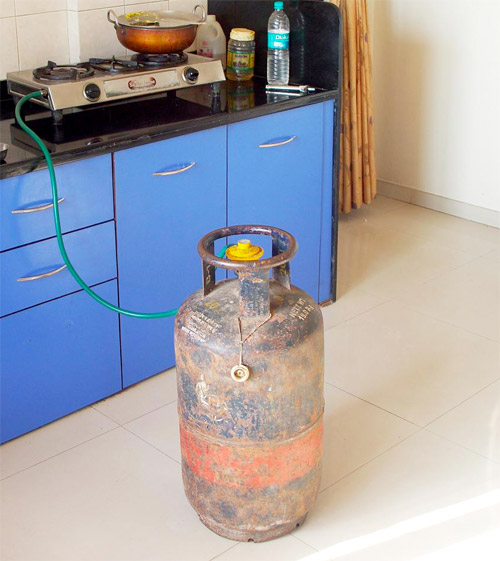
Ours was like this, except the canisters were outside. This photo by Flickr user überkenny.

There were just a couple valves and knobs that required turning when it was time to switch canisters, but the technique confounded me every time. I’d struggle, grunt, sweat, curse, smell leaking gas, panic, and finally ask our elderly neighbor for help.

Our elderly neighbor would have it switched within seconds.

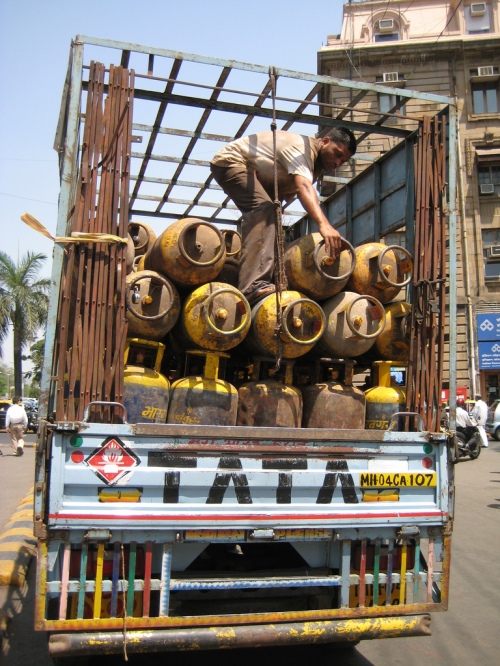
Still, you can’t say I didn’t try. But I was frightened by the explosive potential just waiting to be unleashed by my clumsy American fingers. I treated the iron canisters as porcelain vases, terrified of their delicacy until the day Jenny saw how workers unload them from the truck: they threw the tanks to the ground, where they’d land on their sides with enough momentum to roll down to where they were being delivered.


Photo by Flickr user miselenaeous.

Canisters that rugged surely wouldn’t blow up just from changing the valve. So the next time I had to switch canisters, I put all my strength into it. But the problem persisted—I couldn’t get the valve to close. The valve must have been jammed, or perhaps it was rusted shut. So after a few more minutes of unrequited shoving, I finally called my elderly neighbor to get his opinion on the matter.

He took the valve in his hands and it was attached not ten seconds later. Nothing was harmed, except my ego.