Rags to Pads featured on NPR!

Back in summer 2008, Jenny and I raised money to help Pardada Pardadi buy a machine that manufactures menstrual pads. Pardada Pardadi, as many of you remember, is the charity that Jenny worked for: they run a school for poor girls out in rural Uttar Pradesh. But their area has few economic opportunities for its graduates. Our fundraiser was meant to solve this problem and address a serious health problem at the same time:

Pardada Pardadi is located in an area of Uttar Pradesh so poor that many women can’t afford pads during their period. So they typically use rags torn off old saris to staunch their flow — a practice that risks terrible infection every period from puberty to menopause.

We are raising $5000 to help Pardada Pardadi buy a machine that makes sanitary pads and support two of the school’s graduates as they start a pad-making business. The goal is to create a self-sustaining business that sells pads at around 25 rupees for packs of ten — simultaneously bringing an affordable and sanitary option to women on their periods while creating economic opportunities for women in an area that has next to none.

We raised over $5000, with many donations coming from readers of this blog. That money was matched by a grant from the DuPont corporation. The machines were purchased, the business was created — and now the story has been picked up by NPR! Read their article here.

We’re very proud to have played  apart in creating this opportunity. If you’re interested in Pardada Pardadi’s broader mission (like preventing the marriage of 13-year-old girls), we encourage you to donate.

ideas for India’s future

Jogging through the sweaty streets of Singapore with this talk on my iPod, I surprised the mynah birds with a few shouts of agreement to what Nandan Nilekani has to say in the video below. It’s well worth fifteen minutes of your time.

If you would rather read than listen, you can find a transcript here.

why we’re scared of the water

Most American travelers pass through the jet bridge with refrains of “Don’t drink the water!” ringing in our ears. It’s the advice we receive every time we cross our national borders—advice that’s given all the more emphatically the further east we travel, but still sometimes offered by elderly relatives even for a simple Canadian day-trip. And we take the advice seriously: we pledge our allegiance to bottled water, we distrust the efficacy of water filters to tame the toughest bacteria, and a single droplet of municipal water on a freshly-cleaned glass is enough to make us send it back for a fresh one.

Beached bottles accompanying the skeletal remnants of our Karim’s tandoori bakra.

Even in Singapore, I admit that Jenny and I did research before quenching our thirsts; and we always pointedly assure all our foreign visitors of the safety of our tap water before they (still suspiciously) drink their first glass.

The source of this paranoia is not some patriotic restriction to water that has been filtered through purifying membranes made of American flags and apple pies. It stems instead from the American traveler’s deepest fear: getting sick in a foreign country. And while you might think we want to avoid getting sick because of the amount of money we spend on our plane tickets, the paucity of vacation time awarded to the average American worker, or our intrinsic distrust of any medical system not our own, the underlying foundation of this fear is actually far more fundamental:

(1) Drinking foreign water could lead to

(2) Getting sick in a foreign country, which might then force us to

(3) Use a foreign bathroom.

This is the sum of all American tourists fears: the receptacle that awaits if the uncontrollable urge hits far from the hotel lobby. Not unsanitary conditions, mind you (bus station bathrooms are the same all across the world), but the very concept of squat toilets, and the mere thought of a bathroom lacking toilet paper.

Mystery solved: Americans avoid indigenous water because nothing scares us more than unfamiliar bathroom technology. No matter how hot the Delhi day, no matter how cold the Coke in the glistening glass before us, we’ll still push it away if we spot even a single ice cube floating in it. Because in our paranoid tourist minds, that single ice cube is a direct bacterial link to a back alley squat toilet—and, worse, that little plastic water bucket that we don’t know how to use and by god, we don’t want to.

where our water came from

One of the uncountable ways in which we were lucky Delhiites was our water supply: it was almost always reliable. Our toilets almost always flushed, our showers almost always flowed, and the musical electric water filter our landlord installed (which alternated between a tinny children’s song and an 8-bit version of Für Elise as it operated) almost always dispensed water free of waterborne threats.

The water itself came into our flat by way of a giant black plastic tank built above the servant’s toilet on the roof, two stories above our heads and nearly high enough to generate pressure sufficient for a satisfying shower.


(Here’s me celebrating Republic Day by failing to fly a kite. At upper right: our precious water.)

Each flat in our building had its own black tank for its own individual household water supply. Our tank was fitted with devices that automatically activated pumps whenever the water dropped below a certain level. In theory, this meant we never had to flip the switch that activated the pump manually. That switch, located on the same panel as the switch for our kitchen light, was the reason we got to meet one of our downstairs neighbors when we first moved in: a few hours after I ignorantly pressed it and forgot about it, our doorbell was urgently rung by a woman who first introduced herself and then, shouting over the sound of falling water, pointed out that our tank was overflowing and creating a swimming pool on our roof. I quickly switched off the manual pump, and then taped the switch down so I’d never make that mistake again.

Every so often, our automatic pump sensor would fail, and our morning would begin in the cruelest possible way: stepping sleepily into the shower, shampooing up our hair, and staring in horror as the flow ceased just when it became time to rinse. Two things would ensue: we’d finish our shower with ice-cold drinking water from the refrigerator, and then we’d call the landlord to request a technician.

The problem was almost always the sensor. The technician would scale the tank, lift the cover off its roof, and pull out some sort of mineral-encrusted doodad dangling off of wires directly into the water. It was nearly always the case that the minerals encrusting it had grown too thick, and the technician would scrape off what we hoped was just calcium to re-expose the bare metal.

Naturally he’d remove just enough so to ensure the device would function for a month or two before failing again and necessitating another service call.

On one service call, when the technician’s scraping failed to fix the sensor, my curiosity led me to follow him down to a shed behind our bungalow, beyond the driveway, past a locked gate that I’d never seen opened. The technician unlocked the gate and opened the shed, which was empty but for a few items on the shelves and some wooden planks on the ground. Squatting, he lifted the planks to reveal a cobwebbed black hole in which our entire building’s water supply was collected from the municipal mains. It was in this black hole where our water waited until  dwindling water levels above required it to be pumped.

I was horrified by its accessibility to spiders.

As the technician went about scraping another sensor, with shavings falling gently into the black water below, I made a note to thank my landlord for installing that musical water filter — clearly, that strange Beethoven-playing device was the only thing standing between us and drinking pump-masticated arachnid bits.

food! dave and jenny in Time Out Delhi

This month’s Time Out Delhi‘s cover story is all about the favorite foods of Delhi’s various ethnic/foreign communities. Where do the Afghans eat? Where do the Parsis eat? And where do the Americans eat? To answer that last question, Time Out turned to Jenny and I. We’re proud to be part of their excellent collection of articles, which opened us up to dozens of new eating ideas that we can’t wait to try. Especially the Gujarati article… man, am I hungry right now.

We do need to correct a slight misquote in the article about Karim’s. Though we think that Karim’s is the favorite restaurant of Americans in general and we do like it, it isn’t necessarily our favorite place, especially not after this experience. But I’m not sure which restaurant I’d claim is our favorite… Saravana Bhavan for South Indian for sure, but we can put a dozen North Indian restaurants on our short list. Thinking back, though, no food stands out more than that which Ganga made. I’m getting nostalgic just looking at that picture.

Click the image below for a bigger version, or read the article on their website.

the padlock

The entry to our building in Delhi was watched twenty-four hours a day by a daytime guard and a nighttime guard, both of whom sat under the tree just beyond our entryway on a plastic chair ripped out of a 1970s bus station waiting room.

But our neighbors in our building clearly worried that the guards might fall asleep or perhaps look the other way while would-be burglars snuck in to murder the lot of us. That’s why our building was protected at night by a secondary means of security: a big ol’ metal padlock on a big ol’ iron gate.

The padlock was affixed to the inside of the gate promptly at eleven every night. Hanging it on the inside was convenient for the neighbor in charge of locking it; but for Jenny and I, who often stayed out later than our entryway’s curfew, the padlock was usually an almost insurmountable obstacle between us and a good night’s sleep.

Arriving home later than the point at which the night had officially been deemed too dangerous to leave our stairwell unprotected, we’d be forced to reach through the bars and contort our wrists in an effort to insert our key upside-down and backwards, the iron bars making deep rusty grooves in our cheeks as we pressed forward to see the tiny hole for which we were blindly shuffling.

Difficult enough to open when sober, that padlock was even worse after a festive night on the town.

One evening when I was out of the city for work, Jenny arrived home at two in the morning. It was two hours later than she’d intended to stay out, but the friendly chap who’d offered a ride home from the party ended up holding her hostage during an emergency trip to West Delhi: just as they’d driven out of the parking lot, one of the other passengers received word that his mother was “refusing to eat until he came home”, and this passive-aggressive parenting was apparently so urgent that dropping Jenny off at our house two miles away from the venue was time the driver simply couldn’t waste.

Nor would the hyper-chivalrous driver pull over and let Jenny find an auto—“Not at this time of night!”

So Jenny was forced to endure a miserable midnight driving well beyond Dwarka. When she finally reached home hoping for nothing more than to fall into bed, that’s of course when the padlock mistook her key for a burglar’s lockpick and refused to accept it. As the neighborhood guard slept behind her and, presumably, criminals of all manner prowled about looking for innocent maidens just like Jenny, the lock simply wouldn’t open. The stairwell was well protected, yes — but locked outside of the building, Jenny was exposed to the elements and the evil of the night.

A small price to pay for peace of mind against the dangers of the Delhi night, right?

Our neighbor Amba was very kind to answer Jenny’s panicked two AM call.

girl stars

We’ve mentioned our involvement with Pardada Pardadi before: they’re the girls’ school for which we’ve raised money, ran campaigns, built websites, and, in Jenny’s case, worked for in the Delhi office. Our experiences with them in the villages near Anupshahr helped us grasp a bit of the challenges that girls in this area have to overcome just to go to school and not get married in their early teens.

Which is why we enjoyed this video so much. It’s not only inspiring, it’s entertaining and funny and really well-shot.

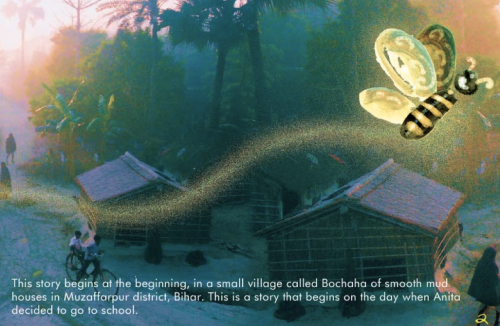
This video is part of the Girl Stars campaign from Going To School India. There are fourteen other videos just like it, plus beautiful books based on the movies.

It’s rare to see such a broad campaign of such beauty and purpose. Spread the word!