great news, India: Taco Bell has arrived!

Update: thanks to Rakesh for sending in a billboard sighting! It’s posted below…

I remember exactly where I was when I first heard that Taco Bell was coming to India. I was sitting with my coworkers in our DLF Cyber City office, describing one of the seven wonders of American culture: two AM taco runs. “It’s not exactly Mexican food,” I told them, my eyes watering with nostalgia. “In fact, it’s not exactly food. But I miss it intensely.”

One of my coworkers piped up. “I heard they were opening a Taco Bell in India soon!”

A dash to the internet confirmed it. I pledged right then and there that I would be the very first person to eat at India’s very first Taco Bell. Unfortunately, although Taco Bell announced their plans to open way back in 2006, it still hadn’t arrived by the time I left the country.

But now, ladies and gentlemen, the greatest day in India’s history has finally arrived, albeit too late for me: Taco Bell has opened in Bangalore.

If you’re unsure about what Taco Bell holds in store for you, I published an essay in The Caravan magazine last year explaining the joy and glory of hyper-manufactured carbohydrates. Give it a read.

“Taco Bell is to Mexican food, however, what Starbucks is to a Paris coffeehouse: a uniquely American derivative that has evolved to resemble its inspiration in name only. You can trace its pedigree back to Mexico, sure, but what Taco Bell serves today is a mutt: Mexican food crossbred with generations of focus groups, cost-cutting innovation, and manufacturing techniques to breed a beast far removed from the original. A Taco Bell taco, with its crispy corn shell containing ground beef, lettuce, tomato, and cheese, is a remarkable feat of American engineering: the product of decades of research that have squeezed every spare cent of material and every extra second of labor out of creating it.” Read more…

I can’t find any pictures or reviews of the new Mantri Square franchise. If you’re in Bangalore, I implore you: take some pictures! Try a taco! Tell us what you think!

UPDATE 24 MARCH: Twitterer Rakesh spotted this ad above the streets of Bangalore:

Am I crazy, or is that a reference to illegal immigration in America? This might not be totally politically correct…

an awesome clip without context

Take the burly brawl from the Matrix Reloaded and the bad guy from No Country For Old Men, and then throw in… Voltron? Though we have no idea what movie this is from, this scene is spectacular.

death of a median, part II: where iron fences fail

In our last post, we documented the death of an Aurobindo Marg median at the feet of pedestrians: those who walk and scuff are, for Delhi’s municipal infrastructure, the harbinger of death.

And the city knows it: its city planners and traffic engineers, toiling in futility in some governmental sub-basement, are fully aware that the longer they can keep feet off of where feet don’t belong, the further their infrastructure investments will stretch.

But there’s a right way and a wrong way to protect the life of the infrastructure. The right way is to give pedestrians better options, because few people would risk crossing busy streets if there were safer alternatives. The wrong way is to arbitrarily cut pedestrians off from where they want to go, as Jenny and I discovered one lovely evening after indulging in Rajasthani handicrafts and Kashimiri tea at Dilli Haat. Upon exiting to Aurobindo Marg, we learned the hard way that the city had attempted to extend the life of a bit of infrastructure—and, perhaps, of a few citizens as a secondary consideration—by installing a jagged iron fence across the median to prevent people from crossing the street.

(This isn’t the actual fence, but it’s the same style. Photo by ex_pandora on Flickr.)

The problem was, Jenny and I always capped off our trips to Dilli Haat with a heart-stopping game of Aurobindo Frogger. That’s because if we picked up our autorickshaw at INA Market, just across the road on the southbound side, it was a straight shot home. But from the Dilli Haat side of the street, we faced an extra twenty rupees fare and fifteen minutes navigating the back streets behind Dilli Haat, merging on to the Ring Road, and joining the off-ramp crawl towards southbound Aurobindo Marg.

Twenty rupees and fifteen minutes: always worth playing chicken with a Blueline bus.

And we weren’t the only ones frustrated by this new blight on our commute. A constant stream of commuters debarked from buses on the sidewalk outside of Dilli Haat, many of them accustomed to crossing the street to continue their journey from the opposite bus stop at INA Market. Like us, these commuters stared unhappily short at the new fence. And like us, they looked around to consider their options, which were few: there were no nearby pedestrian bridges, no underpasses, no gaps in the new fence, and angry-looking points on top of each picket.

Some people sighed and began trudging to a distant overpass.

Some people cursed and counted their change to see if they could afford another northbound bus to a different transfer point.

And some people risked life and limb and groin as they climbed over the fence’s sharp pickets anyway.

In all cases, faces showed frustration bound to manifest in destruction. Sure enough, our return trip home from Dilli Haat was much easier a few weeks later, thanks to a freshly-torn gap in the fence. We joined a group of commuters that dashed across the traffic, squeezed through the hole, and sprinted to safety in front of INA.

(Also not our picture, but you get the idea: there’s safety in numbers when crossing the street, if for no other reason than the fact you’d rather be the last bowling pin than the first. Photo by Joshuacw on Flickr.)

The city is right to protect its investments in infrastructure and its citizens from becoming further sad notches on the Blueline’s belt. But pedestrians as a collective do not take kindly to arbitrary dead-ends. The aggregated incentives of fifteen minutes and twenty rupees, multiplied across thousands of people who want to save the money, is far more powerful than a mere iron fence.

Pedestrian deterrence only works in two instances: if alternatives are provided, or behavior is enforced. Had the city built a pedestrian bridge, or an underpass, or even just a gap in the fence where those truly determined to cross could squeeze through, that fence would not have been uprooted and twisted the next time we saw it, and the median would still be protected from the inevitable.

But if alternatives are not provided, enforcement is the only option. Take the rinky-dink medians that divide Delhi’s Bus Rapid Transit lanes; a few inches high and wide, they would be but a distant memory if it weren’t for the men in uniform standing astride them and glaring at anyone who tries to cross. It worked wonders for that one stretch of road, at least; and if men with mustaches and guns were spaced every twenty feet along every single road in the city, the municipal infrastructure would last a whole lot longer.

Impractical, obviously. But probably cheaper than repairing medians (and fences) every few months.

(Again, not our picture. I don’t think we’d be brave enough to put so many cops in one frame. Photo by praja_subba1 on Flickr.)

death of a median, part I: an ode to Aurobindo Marg

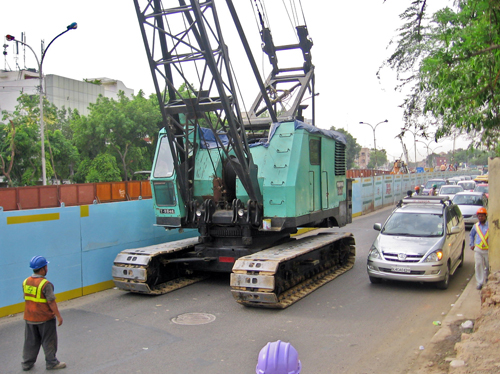
Good news for the street whose traffic stole so much of our life in Delhi: Aurobindo Marg is about to be whole again. Its lanes were squeezed by construction barriers and rerouted practically onto sidewalks for the entire time we lived just off of this South Delhi artery, resulting in eternal jams, unwalkable sidewalks, uncrossable streets, and epic construction machinery thundering casually down the road just steps from our front door.

Now, finally, two-and-a-half years after Metro construction necessitated this nightmare, Aurobindo Marg is about to return to the glory we never knew. Those two-and-a-half years have been tough, though—not just for commuters, but for the poor road itself.

Shortly after we moved to Hauz Khas, the city built impressive new medians down the middle of our nearby stretch of this once-spacious boulevard. These concrete islands, raised a full foot off the ground, were necessary because the old medians had worn to rubble in a dozen spots where cars would routinely make illegal U-turns. (I’d curse the cars that blocked traffic as they crossed over them, even as I’d silently hope my driver would follow their lead and shave precious tens of seconds off my commute home.) The new medians made traffic flow much smoother: they were so high that only pedestrians could cross them.

Which is, unfortunately, exactly what destroyed them.

They’re not wearing steel-toed boots or dragging active jackhammers behind them. They’re just walking. But that’s all they need to do: they walk across the median, and they tramp footprints in the dust. Enough footprints coalesce into a path, which catches the eye of subsequent pedestrians looking for a place to cross. But among those subsequent pedestrians—(and this is where the median starts to shudder, this is where Aurobindo Marg experiences the first of what’s to befall its beautiful new medians)—are pedestrians pushing bicycles.

Don’t blame the bicyclists. They don’t mean to. But it’s been a long day at work and an even longer ride home, and these old bikes are heavy; they’re trying their best to lift their bikes up and over the median, but every so often they catch one of their metal pedals or drag the teeth of their gears. Which nicks the cement.

It’s nothing! A grain of sand! The median is still good as new!

Except the path has been tramped down, so this is where people think to cross. So one bicyclist is followed by another. Nicks coagulate into notches. Notches coalesce into ruts. Ruts amalgamate into grooves wide enough to roll bicycle wheels through. And while the grooves are made wider and deeper, the material being ejected from them is collecting into a little pile of rubble. That gets bigger. And as the groove is graduating into a fissure, so too is the pile moving towards becoming a ramp. Just the kind of ramp that a motorcyclist can utilize.

Here he comes now, that first motorcyclist, the beginning of the end on his flashy Hero Honda Hunk. Not even wearing a helmet, this tough guy, although he is wearing sunglasses even though it’s dark out. Ahead of him, traffic is jammed—but jams are for sissies, yaar. Spying the fledgling ramp, he fixes his handsome steel gaze on the car behind him until its driver is awed into stopping. And then he realigns his bike perpendicular to the road and then he slowly, carefully maneuvers up the fledgling ramp, spraying dirt and rocks behind him. Girls want him, guys want to be him, guys like me want him to fall flat on his face. But guys like him never do: he’s made it. And he’s blazed a trail for less cool guys on less macho Hero Hondas models (Glamour? Splendor? Passion Plus? Really?) to follow.

So now this pedestrian crossing that became a bicycle crossing is a motorcycle crossing. By the rules of the Delhi road, the lighter elements must give way. And they do, flowing to the left and right of the motorcycle crossing, where they will create new paths that attract new nicks that erode eventually into further ramps. Three parallel tracks, now, which is just what three-wheeled autorickshaws need to take their turn in the cycle.

Nobody means to destroy anything, and nobody thinks their individual actions have an impact, but when everyone is too impatient—when pedestrians don’t want to walk to the crosswalk, when motorcycles don’t want to drive to the U-turn—the shortest path between two points takes the infrastructure along with it.

We congratulate Aurobindo Marg on its upcoming return to construction-free normalcy. And we look forward to appreciating it in all its grandeur—once those medians are rebuilt again.

feet

We hadn’t lived in India for very long before Jenny had a spiritual revelation. It wasn’t a let’s-go-smoke-hash-with-the-sadhus kind of revelation, nor was it a let’s-dedicate-ourselves-to-free-love-and-yoga-and-live-at-Osho kind of revelation. Instead, her revelation was much more fundamental to a particular Bible story that she’d never fully understood:  “Now I know why Jesus washed those feet!”

The story in the Bible is this: at some point after his last supper, Jesus decided to teach his disciples a lesson. Grabbing a bucket and a bar of soap, he bends down and starts scrubbing his buddies’ feet. They protest and try to dissuade him until he revs up the ol’ parable machine, looks them in the eye, and says, “The servant is not greater than his lord; neither he that is sent greater than he that sent him.”

Though Jenny is not religious, the symbolic lessons of this Sunday School passage had always been clear: the dangers of arrogance, the sin of pride, the imperative of respect that all leaders should have for their followers and all people should have for each other. But what had never been clear to Jenny, from the moment she frowned at that Sunday School text until this very point in her adult life, was this: why would anyone want their feet washed?

Now she knew: as it was in in ancient Jerusalem, so too is it in modern New Delhi: walking around a hot and dusty city in sandals gets your feet really, really dirty.

Calling me to the shower to show off her blackened soles, Jenny explained to me her revelation not about symbolic meaning, but about literal necessity: that Jesus was washing feet because, man, look how dirty feet can actually get!

She was right. Man, was she right.

Then Jenny handed me the bar of soap and gestured spiritually. I thought about the danger of arrogance, the sin of pride, the imperative of respect; and then I handed the soap back to her, headed back to the sofa, put my own filthy feet back up on the coffee table, and went back to watching Friends.

meet Vijay, our Bollywood poster painter

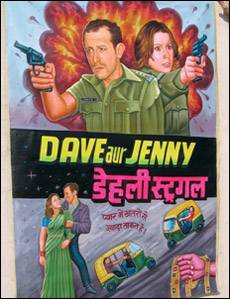
This weekend, NPR’s Studio360 ran an interview with Jenny and I and Vijay, the artist who painted our Bollywood poster. It was really interesting to hear his history and his side of the story. We were especially heartened when he leaped to our defense to dispel the reporter’s half-baked notion that it’s somehow “patronizing” or “maybe just plain wrong” of us to insert ourselves into a symbol of Indian culture. Give it a listen!

self-respect

“My mom has given my matrimonial ad,” my coworker Anurag told me one day. “One of the respondents is an account manager with an ad agency in Mumbai. Drawing seven lahks per annum! That’s double my salary. So I told my mom, ‘I don’t think she’s my type.’”

Not your type…? I was dumbfounded. What could be a more perfect type than a wife who pulls in a boatload of cash?

So I argued with him. I tried to explain the benefits of that arrangement from the perspective of his future financial security, to say nothing of all the extra time he’d get to watch TV. But my arguments of real estate prices, private school tuition, and syndicated sitcoms didn’t make a dent. He wanted to be the breadwinner because, well, that’s what men were supposed to do. “What about my self-respect?”

“My friend,” I said, “you can drive your self-respect around in a gold-plated BMW.”

He laughed. And then: “You have absolutely no male ego. Are all American men like that?”