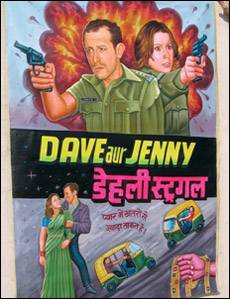
About a year ago, I wrote an essay explaining why Delhi’s Blueline bus fleet (the privately-owned menace that scores a yearly death count rivaling a Stallone movie) was so deadly. It was economics, I theorized: each bus driver is in competition with every other driver on his route, which means his biggest incentive is to pass the bus in front of him; reckless driving and shattered lives inevitably follow. But for the many areas of Delhi not served by the Metro and underserved by public buses, there’s no other economical option.
This system is not unique to Delhi.
A recent New York Times article showed that Delhi’s Blueline is simply one (admittedly extreme) example of a worldwide municipal phenomenon. And this pattern seems to spontaneously replicate itself wherever a few initial conditions come into existence: high population density, poor public transit, private leeway to address public failings, and weak government oversight. Including, as it turns out, New York City.
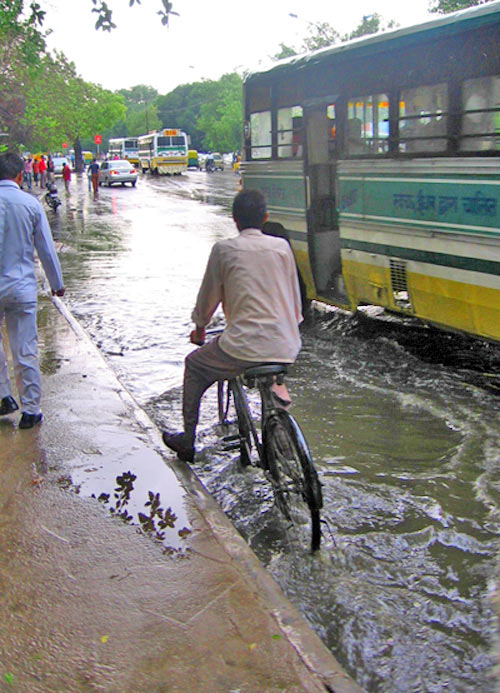
Yup, I used the same picture last time, too.
The Times article was about the rise in competition, violence, and recklessness among the private vans that ferry passengers to and from New York neighborhoods that mass transit doesn’t quite satisfy. As in Delhi, the city nominally regulates this system: the routes are predetermined, licenses are required, and rules do exist. But like Delhi, the system has evolved faster than it can be controlled — and it’s begun to assemble itself into the shape and structure that Delhi has taken to the extreme.
Commuter vans are a familiar sight in many city neighborhoods, linking parts of Brooklyn, Queens and the Bronx not served by subway lines to subway stations and also to the financial district in Manhattan and to a large mall in Nassau County. The routes, which are defined by the city’s Transportation Department, are meant to supplement the public transit system, not compete with it, though that is not always the case.
There are nearly 300 van drivers in New York who abide by the rules, paying thousands of dollars a year in licensing fees and insurance. They are outnumbered by hundreds of drivers who work the same routes, but have no permits and no insurance, and whose numbers have increased as the economy has soured.
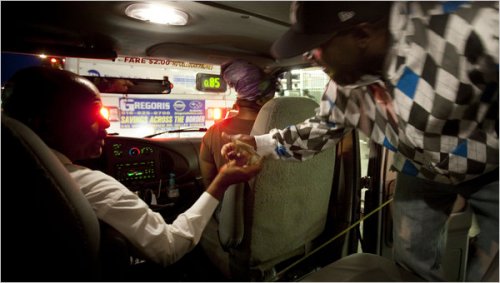
Picture from the New York Times.
I rarely saw these vans when I lived in New York; I was always lucky enough to live near the subway. The one time I distinctly remember seeing them was in 2004, on a crowded strip of Flatbush Avenue, far beyond the parts of Flatbush I normally traveled. We’d just moved back from London, and I was driving to return the U-Haul Jenny and I had rented to move out of storage. The reason these deep Brooklyn vans stuck in my mind is because they appeared almost identical to what we’d seen on a visit to Cairo a few months prior to that moment. In both Cairo and now in New York, the vans idled curbside, half-full of passengers, with competing drivers shouting in rapid-fire slang the names of their destinations. I couldn’t make sense of what they were shouting — like in Cairo, and like I’d come to see in Delhi, the system had evolved its own vernacular.
To support this point, I just read this article about Cairo’s “microbus” system. If you change “microbus” for “Blueline” they might as well be talking about Delhi:
Microbus drivers! The very words elicits disapproving reactions from taxi drivers, private car drivers, pedestrians and the municipal authorities, police and the traffic authority. The reactions range from suspicion to open hostility and even envy. Taxi drivers complain that microbus drivers compete to pick up passengers, speed, and therefore are among the leading causes of accidents. Microbus drivers generally constitute a major menace to public well-being and safety in their view.
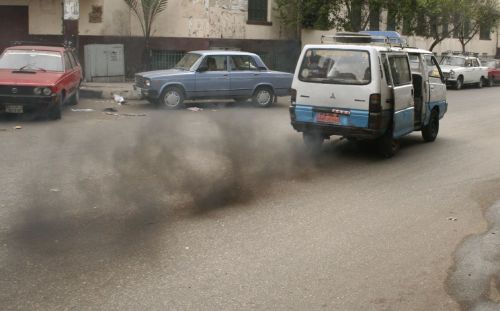
A microbus in Cairo. Image by Flickr user richardavis.
Cairo, Delhi, New York — if I’ve come across these systems in my own travels, then they surely must be assembling anywhere there are lots of people, few transit options, and limited government intervention into private solutions. These are spontaneously identical structures, these disparate fledgling Bluelines; the desires of commuters and of drivers independently assemble into mirror systems. And they set in motion predictable effects. From the New York Times:
Anthony Henry’s commuter van rolled west along Merrick Boulevard in Queens, packed nearly to capacity with nine passengers. It was 6:50 on a Friday morning, and the path ahead of him was clear until suddenly it wasn’t: A van with a wobbly left rear tire, illegally plying the same route, burst in from a side street and barely cleared a car parked at the corner to pull ahead of Mr. Henry.
“Look at this guy right there, picking up my passengers,” Mr. Henry, 47, said, clicking his tongue as the van swooped to the curb and scooped up two people waiting. “It’s a war out there.”
Compare that to the article about Cairo:
Last month there was a particularly nasty accident on the Corniche at one of the main entrances to the suburb of Maadi, eight kilometres south of Cairo. Survivors said they had asked the driver several times to slow down. Belongings were strewn across the street. Mercifully, the death toll was not high, but two lives were lost, and several passengers sustained serious injuries after the bus swerved off the road. Few emerged from the incident unscathed. Survivors said the driver took the curve too fast, trying to race ahead of another microbus alongside.
In each city, each driver on the route is in competition with every other driver on the route. Sound familiar? The Times’ article hints at the danger, destruction, and fatalities New York’s version could eventually come to:
… Beyond a financial threat, their legal competitors say the unlicensed van drivers are a growing safety menace. “They’ll run red lights, they’ll drive against traffic, they’ll cut you off.”
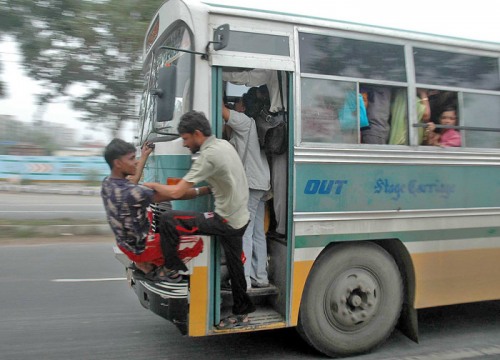
A Blueline during rush hour. Image by Flickr user parveennegi1979.
When I wrote my essay last year, Delhi was pledging to eliminate the Blueline in time for the Commonwealth Games. A quick look into the status of that pledge reveals setbacks, if not outright failure. It’s not surprising: the same pressures that drive Delhi’s death toll have also made a few men extremely rich, and busting a cartel is difficult even in the best of circumstances.
There’s a lesson here. Order has to be imposed before the system moves to the next phase: consolidation of power.
In the meantime, it’ll be interesting to see if New York’s media evolves a response to this stimulus to mirror the way Delhi’s media has. This, too, is a self-replicating pattern of response: outrage stokes sales. If New York City were to continue in Delhi’s extreme direction, you could expect the New York Post to start publishing a dramatic daily death count of its own.