Tag Archives: Delhi

the loneliest walla III: the night watchman

Here is my third essay in this series for The India Tube.

====

The Loneliest Wallah (III): The Night Watchman
by Dave Prager

Originally published on The India Tube


“Up here!” I shout down to the street, waving my phone to get the attention of my party guests. I also get the attention of the neighborhood guard, who looks up from his post across from our flat. He sits next to our street’s iron gate, which is closed because it’s after eleven—the dangers of the Delhi night, you see, can be kept at bay by an unarmed seventeen-year-old guard with a whistle. Which is why this guy is hired by the neighborhood association to sit all night, every night, no matter how cold it may get.

My guests see me and wave back. They file out of their auto and past the guard and into my building. The guard watches the girls pass while I disappear back into the warm yellow light. Then he settles back in his seat, a cracked blue piece of weather-beaten plastic that once stood proudly in a hospital waiting room. He wraps his grey blanket tight against the cold wind, sits under the dim naked light bulb hanging from the tree, and waits for the opportunity to do his job.

His job consists of two tasks: closing the gate at eleven PM, and opening it when cars come by.

I come back to the balcony to guide more friends to the party. The guard has started a fire using scrap newspaper and plastic chai cups as fuel. I watch him stamp his feet and smell the toxic fumes and wonder if he knows they’re toxic. But it probably doesn’t matter to him, because it’s cold in Delhi in the winter, except for in my apartment, where the wine is flowing and the glasses are clinking and the sound of our laughter drifts over the guard’s head and into the night.

Some time later, I return to the balcony once more. The guard is sleeping, his head slumped left and his body cocooned tightly in the blanket, but not for long: my friend pulls his car to the gate and honks twice to rouse him. It’s well after two AM. A stray dog, sleeping nearby, doesn’t even look up.

The guard trudges to the gate. He opens it. He watches the shiny car glide past. He closes the gate. He wraps the blanket around his body. He trudges back to his seat.

Upstairs in my apartment, somebody turns the music louder.

the loneliest walla II: the bank guard

Here’s my second article for the brand new blog/magazine/community called The India Tube.

====

The Loneliest Wallah (II): The Bank Guard
by Dave Prager

Originally published on The India Tube

Last September and October, Delhi became darker and more disgusting. It was an invasion of leafhoppers: fly-esque creatures that feed on the paddy crop in the rural areas around Delhi. They’d been eating good, and heavy rains meant they were drinking good as well; and one day they took to the skies and headed towards Delhi by the billions with the singular goal of smashing themselves against bright lights until they died.

In Delhi’s glass-enclosed ATMs, garishly lit with white florescent to attract light-walleted passers-by, they became the only real company for the stoic and sleepless bank guards.

These guards’ posts became snow globes that someone had shaken (after replacing the snowflakes with squirming black insects). The poor guards stared without expression as bank customers franticly waved their arms to warn the pests off; but the guards didn’t sympathize for entomological discomfort lasting the duration of a single transaction when they were the ones sitting there all night in their florescent cages, the insects crawling on their heads, landing on their mustaches, mating and dying in the air they breathed while thousands more on the outside slammed themselves against the glass walls and fell into piles on the ground, little snowdrifts of black life now lifeless, waiting for the morning sweeper.

It could be worse than being an ATM guard. There is AC in these vestibules, which is nice. There is protection from the sun and the rain and the cold, which is nice. There are people to watch, which is nice.

Every so often a real sight to see comes through the door: like when our friend Trevor, a six-foot-tall black man with long black dreadlocks, wearing a skin-tight tank top, sashayed into our local Citibank ATM lobby on the first day of his visit with us. The guard stood and stared and walked forward for a closer look, as if in a trance, and stood next to Trevor and scrutinized his face for the duration of the transaction. But the sights are fleeting. And any company a guard may have lasts only as long as it takes the machine to validate a PIN.

The ATM guard: he exists because the sum total of the his labor and his cognitive capacity as a human being is valued to be slightly less than the cost of acquiring and installing a security camera. His job is to sit and watch men and women withdraw more money in one go than he might earn in a month.

And, while there are plenty of low-income workers in this city, but few are forced to earn their pay by watching other people count and pocket theirs.

the loneliest walla I: the auto driver

I’ve been doing some writing for a brand new blog/magazine/community called The India Tube. My first essay is now online. More to come!

====

The Loneliest Wallah (I): The Auto Driver
by Dave Prager

Originally published on The India Tube

All the autorickshaws in Delhi appear to have their genesis in the same factory, for all are exactly identical. Before their labor-intensive customization. Variation comes in accouterments added by aesthetically-minded drivers: Shah Rukh and Kareena looking equally sultry in heart-shaped stickers on either side of the rear-view mirror, or life-sized cutouts of scandalously-clad heroines tucked behind the clear vinyl that protects the auto’s side panels and passenger seat from the sweat of a thousand sitters.

More than once I’ve been scared silly by the sudden appearance of a face when I turn my head to see what street I’m on: a starlet I didn’t notice is suddenly pursing her lips at me, a poster positioned there not to promote a movie but to keep a driver company while he spends the night,as auto drivers often do, on the side of the road, bare feet dangling outside, head resting comfortably on a fantasy’s two-dimensional lap.

Imagine if his loneliness was yours: you negotiate fares all day long, but you talk to no one at all. You try to meet a passenger’s eyes in your mirror, but all you see is a set-jaw profile looking anywhere but at you, or a steely glare warning you not look any more.

Confronted with the solitude of the service professional, you too would take refuge in Salman’s biceps or Priyanka’s neckline. Each of them would tell you what you want to hear, if only paper could talk; neither of them will ever ask you to put your eyes back on the road.

two autos queuing for fuel

IMG_8528

Nighttime at the CNG pumps: a sight we saw all too often because the route to our flat went right by the gas station. So close that we could practically feel our pillows on our weary heads, but too far for walking to make any sense (never mind the traffic and lack of sidewalks on Aurbindo Marg), all we could do is get out and watch. We can’t stay seated and doze — the fuel intake is hidden in a panel under our seat.

So we stand, and wait, and try not to fall asleep, and get stared at while we take pictures to pass the time.

autorickshaws in Delhi: some practical advice

The best advice we can give to anyone attempting to travel Delhi by autorickshaw is this: ignore the Lonely Planet. While the book usually offers good information, in this instance it fails utterly in its exhortation to only travel in autos that agree to use the meter. The official meter rate, fixed by the State Transport Authority at 4.5 rupees for every kilometer after the first, is less than half of what you can reasonably expect to pay.

Any auto driver who agrees to go by the meter is probably planning to take you from GK I to GK II via the Taj Mahal.

Because the meter is out of the question, every autorickshaw journey begins with fare negotiations. That’s easy to overcome if you know where you are, where you’re going, and the market equilibrium rate for getting there; but for our first few rides in Delhi, the fairness of our fare was entirely up to the honor of our driver, and how adept we were at fooling him into thinking we knew what we were doing.

We know now that no auto ride should ever cost more than 100 rupees, provided you’re sticking to South or Central Delhi. (Nobody knows how much it costs to go to North Delhi because, as far as I know, nobody has ever gone there.) I was not armed with that knowledge on my second day in Delhi, before Jenny had arrived, when I put my fledgling bargaining skills to the test and negotiated a ride from Connaught Place to GK II for 180 rupees, basking in pride during the entire ride in having talked the guy down from the 200 he quoted.

Any auto driver who finds a tourist that ignorant of the market values is going to try to push him for all he’s worth. When we reached my destination, I handed the driver two bills and asked for change. The driver turned around in his seat and started begging me to let him keep the whole 200. And I mean begging—pleading, moaning, eyes rolling and tearing, hands clasped in front of him as he invoked his gods and his children and his poverty and my wealth, all for that extra 20 rupees.

But I set my jaw and stood firm and got my change; and I felt proud that I hadn’t let the guy swindle me out of my hard-earned money. My first major test of my will in India, and I totally won.

india and nepal say happy birthday dad

Today is Dave’s Dad’s sixtieth birthday. Since we’ve known for a while that we would be in Asia during his big day, we decided to celebrate by asking everyone we met while traveling through India and Nepal last month to wish him happy birthday. Enjoy!

(And we know that the lyrics of Bilo Rani aren’t exactly what you’d sing to your papa, but 1) he doesn’t understand the lyrics and neither do we, and 2) it’s got a great beat. We asked our friends if they knew any Hindi songs that were actually about one’s father, and they suggested this slightly creepy piece. Creepiness begins at 0:30.)

Singapore update #1: here we are

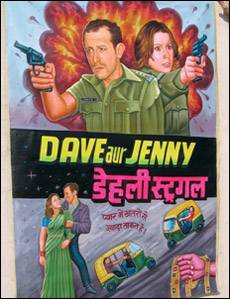
After a month of sweaty bus seats and heat rash and coconut in every entrée and stuffing ourselves silly forty-six cent lunches and Tamil temples and Kerala sunsets and Nepalese hats and ear infections and stolen cameras and recovered cameras and re-stolen cameras and body boarding and five dollar hotels and mosquitoes and relaxation, and a further week of wearing out our welcome in our friends’ spare rooms and eating at our favorite restaurants one last time, we’ve packed our bags and left India with slightly fewer possessions than with which we arrived (not counting the three extra suitcases brought back to the US full of wicker crafts and indigenous arts and massive custom Bollywood posters we didn’t want to drag around Asia with us).

And now we’re in Singapore.

Delhi is still on our minds and in our hearts. Walking around this strange city and seeing its unfamiliar people, we alight on Indian faces; we want to walk up to them and tell them “We lived in India!” and be their friend because we’re seeing Singapore through their eyes as much as our own.

For the next two months, both Jenny and I will be volunteering for a charity here in Singapore as we hunt for jobs that, you know, pay. After a few missteps with the housing the charity provided (including a complete lack of electricity, a complete lack of furnishings aside from two mattresses, and a toilet located behind a locked metal grate in an abandoned adjacent storefront), we’ve managed to find a flat and unpack two of our four giant bags.

Because real estate in Singapore is so expensive, most homeowners tend to rent a room to boarders. So we’re living on the top floor of a government housing complex with Jimmy and Fiona, a Singaporean couple of Chinese descent whose kids have fled the nest to make room for the two of us plus Casey, a Chinese guy who we’ve seen for exactly one minute over the course of the last three days. A retired airport cargo worker, Jimmy drives a taxi when the mood strikes him; other than that, the couple spend their day fawning and fussing over their neighbor’s baby, Peter, who has the largest head we’ve ever seen on a nine-month old.

Jimmy and Fiona are determined to make us feel at home—so much so that they’re nearly smothering us. They follow us around the house, making sure we know where we can find forks and coffee mix and liquor and towels and ordering us with every other breath to make ourselves comfortable. When Jimmy came upon me standing up in front of the TV to watch the news for a minute, he forced me into his easy chair, forced me to recline it, and forced me to lay back; and when I got up after completing the minute I wanted to watch, the look of disappointment on his face stung me. So when we discovered that Fiona was making our bed and doing our laundry after we left for work, we decided not to protest. If they want us to be comfortable that much, who are we to tell them no?