Tag Archives: Gurgaon

india and nepal say happy birthday dad

Today is Dave’s Dad’s sixtieth birthday. Since we’ve known for a while that we would be in Asia during his big day, we decided to celebrate by asking everyone we met while traveling through India and Nepal last month to wish him happy birthday. Enjoy!

(And we know that the lyrics of Bilo Rani aren’t exactly what you’d sing to your papa, but 1) he doesn’t understand the lyrics and neither do we, and 2) it’s got a great beat. We asked our friends if they knew any Hindi songs that were actually about one’s father, and they suggested this slightly creepy piece. Creepiness begins at 0:30.)

Ajay the driver

We did not own a car during our time in Delhi. Autorickshaws sufficed for getting around the city, miserable as they were in the summer sun, stuck in traffic, fumes roiling around us, coughing into our handkerchiefs as we prayed for the light to change. The only automobile need we had was for my daily slog to Gurgaon; so instead of achieving the Indian dream of car ownership, we just outsourced it to the local taxi stand.

I would call them every morning. For the first month or two, I’d have to explain who I was and what I wanted and when I wanted it and where I lived. But soon the rhythm established itself. “This is Mr. David,” I would say. “Pickup, please.” (This phrase became Jenny’s unofficial alarm clock: me bellowing “This is Mis-ter Da-vid!!!” when the voice on the other end didn’t understand, a far worse way to wake up than the car horns or the loud pigeon sex on our air conditioning unit that would have roused her otherwise.)

For the first year, I was picked up by a different driver every day, one of the dozen or so who worked and slept and ate and bathed at the canvas taxi stand on the other side of Aurbindo Marg. The boss, Birender, had a private room with a cot; everyone else slept on mattresses on the common room floor. Some of the drivers spoke no English at all, while one or two were fluent enough that Birender reserved them for tourists taking trips to Rajasthan. If Sanjay was my driver, I knew Birender hadn’t booked any assignments driving foreigners around the Golden Triangle. The oldest driver—I never knew his name—tried and failed for sixteen months to beat me out of 35 Rupees for the incoming border toll Birender never required me to pay. He even tried on my very last evening coming home from work. Persistence!

My rotating cast of drivers ended last November, when I began to get Ajay almost every day. Ajay is 22 and hip. His hair is longish, slicked back, and heavily oiled. He sports an earring in one ear, a mobile phone far more expensive than mine, and a stylish jacket that looks like a name brand until you read what the logo actually says: “Important Brand.”

Ajay was trouble. I don’t think he respected me. He was always late. He would always argue with me about the route, insisting that MG Road was too jammed and that the highway was wide open (and while the highway was indeed smooth sailing, the offramp to Vasant Vihar more than ate up the time we saved)—not because time and jams were his concern, but because I think he felt cooler driving on the highway. He was clearly unhappy to be slogging to and from Gurgaon twice a day (a sentiment I completely understood); I suspect the other drivers foisted the hardship duty on him because he was the youngest.

Usually after a long day’s work, I’d get in the car, pop in a DVD, put on my headphones, and ignore Ajay as he talked on the phone or to himself. (Which he did. A lot.) At first he would surreptitiously put a single earbud headphone into the ear he thought I couldn’t see so he could listen to music off his mobile (my mobile isn’t even color!); but once he realized I didn’t mind, he would just put the mobile on speaker, and the quiet moments my shows were broken by the tinny sounds of Om Shanti Om or Bilo Rani.

Sometimes I’d play music out loud on my laptop. Ajay would sing along after every line, even though he didn’t know the words, and even though he didn’t know English. It’s hard to mimic even simple lyrics to an unfamiliar song in an unfamiliar language, so The Beatles singing “I think you’ll understand” became “Aye tee oo huh nuh stuh”.

One day, during a miserable jam, with Ajay staring glumly ahead, I decided to introduce him to the best my country had to offer. Stretching my Hindi as far as it would go, I told him, “Yeh ghanna subzi acha hai,” which I hope meant “this song is the best.” And then I put on Guns ‘N Roses’ Appetite for Destruction, sat back, and smiled with pride at introducing this fellow to the very greatest rock album America has ever produced.

It was during the lull between Nightrain and Out Ta Get Me when I heard the tinny sounds of Pappu Can’t Dance coming from the front seat: Ajay had turned his mobile as loud as it could go to distract him from the monstrous din coming from the back seat.  I got the hint, put on my headphones, and turned on my DVD. He was much happier to be ignored.

the delhi morning fog

This time of year, getting up early to beat the traffic means you get to enjoy the mist.

On MG Road, the segments of the Metro appear out of the vanishing point, hanging more massively in the sky than they ever seem on a clear day. The air is heavy and still, broken only by brilliant flashes of blue as kingfishers flit across the road. Passing through DLFville, the skyscrapers are hidden from view, an invisible presence somewhere beyond the black silhouette of the electrical towers that abut the street.

It’s beautiful. As long as you’re not on your way into or out of the city. Every morning the newspaper has stories of canceled trains and flights endlessly delayed. The international flights apparently have the equipment and training to land in any conditions; but the domestic flights are forced to circle endlessly, or head to Mumbai for a dozen hours on the tarmac.

fog

This was the scene outside of work this morning: a fire in the distance, beyond which women in colorful clothes materialized out of nothing. A horn honked somewhere, but it was too weak to matter; the heavy air would not allow sound to disturb it. Gurgaon, for the moment, was at peace.

the billboard walkers

My commute through Gurgaon takes me past dozens of massive billboards advertising whiskey, rum, and newspaper contests. (“Want to party with us?” asks the dapper young Bollywood B-listers, giving sultry looks to the passing cows. “Read HT City!”) On each liquor ad, below giant logos, below vagaries about “living the good times” and “making it”, below bikini-clad beachgoers and self-satisfied Saif Ali Khans, presumably to skirt some anti-liquor advertising law, are the words “Music CDs” set in small type. So Bacardi can point to these words and say, “No, we’re just advertising our latest mix!”

The ads themselves are printed on some sort of pliable tarp-like material; after a strong wind, you see the pieces of it hanging off nearby trees, with tatters still clinging to the metal frame supporting the billboard. The billboard frame thus sits empty for a few days until the billboard walkers come: dozens of young men, lithe as spiders, climbing up and down the frame without safety harnesses, somehow hauling up the 2000 square foot ad using ropes, pulleys, and their own sweat. You see them at work in the morning; by the evening, they’re gone, and various brands of whiskey are once again imploring you to enjoy your success by drin— I mean, by listening to their CDs.

poster_guys

your passing glimpse of someone’s tragedy

You see a big yellow steam shovel. You see a crowd. You see a shuttered paan stand: a single square meter of thin corrugated walls that, at three rupees a piece, is some man’s livelihood. This you see from your car as you pass. You twist in your seat and see the rest: the shovel comes down, the paan stand crumples. You see it, but you don’t hear it, because you’re already down the road.

waiting

My drive to work takes me underneath the NH-8 highway in Gurgaon. Traffic on this cantilevered behemoth flows by on cement pillars, toll-paying drivers unaware of the ground-level chaos that segregated from their smooth ride above: cars and rickshaws and cycles and traffic cops and homeless migrants jostling for space and passage and attention, everyone in a hurry and nobody moving at all.

In the cumulative hours I’ve sat at this eternal intersection, I’ve memorized the scene. I know the ripped circus posters; I know the cops with their Rajasthani mustaches curled up their cheeks; and I know the people who call the weedy median home: the old men, the tired women, the energetic children, the girl with the full-length skirt smeared with dirt but not enough dirt to hide the vibrant mustard yellow of the material.

We all share the same daily ritual: I sit in my car, the cops wave at us to wait or wave at us to go, the engines idle, the rickshaws weave through the cars; and the migrants sit and stare or walk through traffic and beg.

Last Wednesday, some new people joined the ritual: a woman, her naked son, and her battered suitcase.

She had the look of a person in transit. Her pale blue outfit shone through the dust that engulfed her suitcase completely. Squatted on the cement wall of the median, she was clearly waiting for someone. Her face spoke anticipation and excitement and even her son, young as he was, seemed to share. His posture was stunning: he sat straight up, a naked three-year-old with the manner of a guard at Buckingham Palace.

I wondered about her as I drove slowly past. What was she waiting for — A bus? A bike? Her taxi-driving son, making it big in the big city? – and how long would she be waiting? I imagined sitting on a pre-arranged corner at a pre-arranged date, waiting for someone, with no mobile to call my ride and no magazine to kill the time, far from home, with no way to know if the ride would be late and nowhere to go if the ride didn’t show. I have forgotten life before cell phones.

Seven hours later, there she was. Still.

I was returning from a celebratory lunch with my boss and my partner. Our bellies were full of what had been their first taste of sushi. Her face hit me. Her face jolted me.

It was the face of a person who’d been squatting in dust and exhaust for seven straight hours. She looked miserable. Her son drooped next to her, a flower that hadn’t been watered. I don’t think she’d moved. How could she had moved? I wouldn’t have moved. If she’d moved, she’d always wonder: had her ride came while she was gone?

The next morning, there she was. Still.

back to Delhi

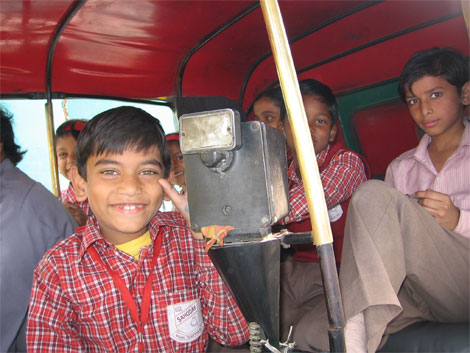
Boys crammed into one auto rickshaw.

We didn’t like Gurgaon immediately. It used to be a sleepy town (Gur means sweet and Gaon means village), but now it’s being re-built up as a new high-tech city in India. There is construction happening all over; it’s dusty, smoggy and the electricity goes out often. We had a market next to our giant housing complex, but we had to call a taxi to go anywhere else. And go where? New Delhi is an hour away (could be as little as 25 mintues or as much as 2 hours depending on  traffic) or to a mall. We made the decision to move to southern Delhi at the expensive of a longer commute for Dave. We love our new apartment. It’s nicest apartment we’ve ever had – though I bet Dave will probably contend 107 Seeley will never be topped.

Now we can walk to several markets and hop into auto rickshaws and go anywhere in Delhi. We are very happy with our decision to move.