Category Archives: outside of Delhi

How National Geographic saw India: May, 1963

A recent weekend holiday took us to the mountains of New Mexico where, among the scrub bush and bear scat, is a cabin built decades ago by Jenny’s friend’s grandfather.  At the time of construction, Grandpa Zahm stocked the cabin with reading material, and its library hasn’t shrunk since. Dusty piles of archaic prose begged to be read: Eisenhower-era National Geographics kept pristine by the arid air, breathlessly taking us to Manchuria, Zanzibar, Rhodesia, and Siam, complete with ads extolling the technological marvel of “long-distance telephoning”.

Among the yellowed pages were some of our favorite places as they were before we knew them. Like the  Singapore River in the 1960s, when the Clarke Quay steps — which are today crowded by the young and hip licking ice cream and watching drunken expats across the river — was a stagnant chaos of fishing boats and standing puddles and floating trash.

We also rediscovered Delhi in the 1980s, immediately after the Asiad Games. No pictures of the Lollipop building, alas, but the article sang the glories of the new flyovers and a presented an image Chandni Chawk so familiar as to be proof that the street is ageless.

And then there was a May, 1963 cover story. “India in Crisis” was the headline, referring to a historical fact of which we were previously unaware: in 1963, apparently, all of India expected to be invaded by the Chinese.

Here’s how the author justified his title:

Even as we talked, Communist Chinese troops forced their way deeper into Ladakh and the North East Frontier Agency, and India’s ill-armed jawans fought desperately to hold the world’s loftiest battlefields. Towns along the Himalayan border blacked out; home-guard forces in Calcutta and New Delhi frantically dug trenches and put up air-raid defenses. India’s cherished neutrality lay shattered—perhaps forever—and the nation was united as never before.

Despite the ominous title, though, the “crisis” question quickly takes a back seat to the author’s deep love of India and its people. Throughout his piece, he wrestles with a  singular question: how do you define India to those who have never experienced it? The article begins with this very challenge:

I met him one night in a Banaras hotel. Quite by chance, we had walked out together onto the darkened veranda after dinner. Now we stood chatting and listening to the nighttime sounds of an Indian city.

He was about eighty—a retired lawyer from Calcutta—dressed in an old-fashioned way and with an old-fashioned manner of speaking. We talked of the difficulty of explaining his country to anyone who had never been there.

“Look here,” he said suddenly. “Suppose all Europe could somehow be united under one government, with one parliament and one prime minister.

“Now, take away two-thirds of Europe’s area and three-quarters of its wealth,” he said “but leave most of its people. Let Spaniards speak Spanish and Bulgars speak Bulgarian. Let Turks mistrust Russians and Russians bluster at Englishmen. In short, leave everything else just as it has always been.

“Now,” he asked in his courtly, rather Victorian manner, “what would you have?”

He paused impressively.

“Why, my dear sir,” he said, “you would have something very like modern India.”

Then he bade me goodnight—“Old men must have their sleep,” he said—and left me alone to ponder his words.

From that introduction, the author journeys across the country. And it was as fascinating for us today as it must have been for subscribers forty-seven years prior. Varanasi, for instance, had fewer space invaders, but was otherwise as we know it.

And while we never made it to Kolkata, we instantly recognize this icon of the city.

And of course, here’s Chandni Chawk in 1963…

…and then as we first encountered it 44 years later.

A few more cars, a few more colors, but otherwise an ageless street indeed.

Throughout the article, the author attempted to understand the country in which he traveled. He summed up his attempts to do so in a way to which we could easily relate: “I was sometimes angered by my own inability to understand one aspect or another of this most complex of all nations.”

Complementing the article was a report from the battlefields of Ladakh, where India was defending its border three miles high in the Himalayas.

The highlight of the article was the quote that introduced the gallery of India’s diverse people. We reprint it below for its poetry and insight, and for how it amplified our longing to return. Soon, India, soon…

India presents a sample of its 440 million faces

People are India’s pride—and problem. The nation’s myriad faces all have mouths to feed and eyes that look questioningly for what the future may bring to a land that mixes automobile factories and wooden plows with jet aircraft and crossbows.

India is atomic physicists at Bombay and Naga tribesmen in Assam. It is ruby-decked maharajas and ragged street sweepers, Oxford-trained philosophers and unlettered farmers. It is tough Sikh soldiers, peace-loving Jain monks, Hindus, Moslems, Zoroastrians, Christians, Buddhists, and Jews. India wears fedora and fez, turban and Gandhi cap, the latest London fashion and the simplest loincloth. It speaks more than 800 languages and dialects, ranging from the Hindi of millions to Assamese tongues used by as few as half a dozen.

Delhi’s deadly Blueline comes to… New York City?

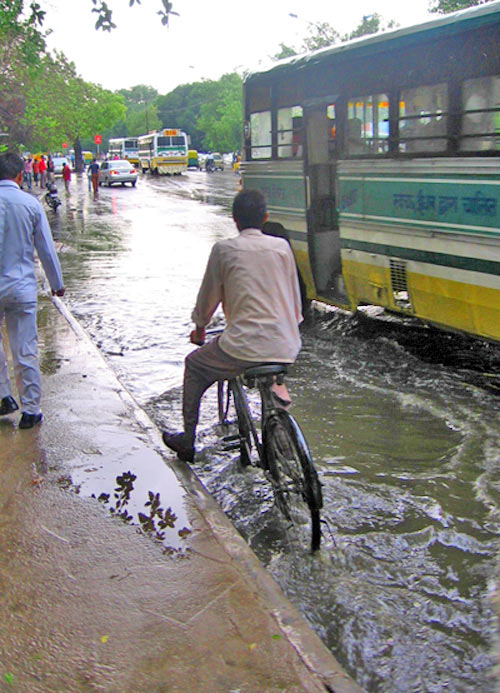
About a year ago, I wrote an essay explaining why Delhi’s Blueline bus fleet (the privately-owned menace that scores a yearly death count rivaling a Stallone movie) was so deadly. It was economics, I theorized: each bus driver is in competition with every other driver on his route, which means his biggest incentive is to pass the bus in front of him; reckless driving and shattered lives inevitably follow. But for the many areas of Delhi not served by the Metro and underserved by public buses, there’s no other economical option.

This system is not unique to Delhi.

A recent New York Times article showed that Delhi’s Blueline is simply one (admittedly extreme) example of a worldwide municipal phenomenon. And this pattern seems to spontaneously replicate itself wherever a few initial conditions come into existence: high population density, poor public transit, private leeway to address public failings, and weak government oversight. Including, as it turns out, New York City.

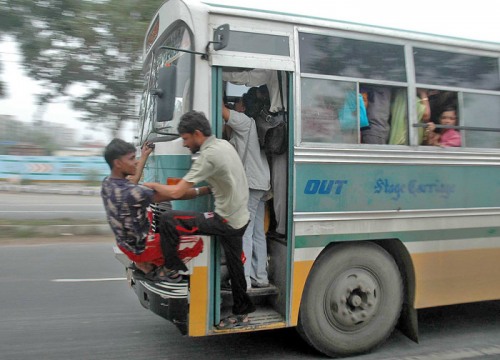
Yup, I used the same picture last time, too.

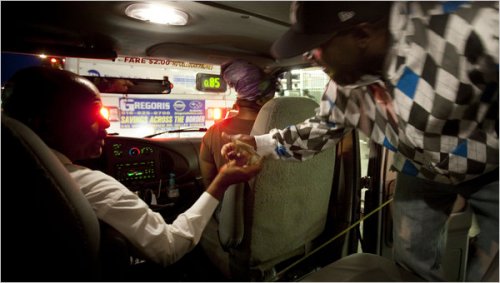
The Times article was about the rise in competition, violence, and recklessness among the private vans that ferry passengers to and from New York neighborhoods that mass transit doesn’t quite satisfy. As in Delhi, the city nominally regulates this system: the routes are predetermined, licenses are required, and rules do exist. But like Delhi, the system has evolved faster than it can be controlled — and it’s begun to assemble itself into the shape and structure that Delhi has taken to the extreme.

Commuter vans are a familiar sight in many city neighborhoods, linking parts of Brooklyn, Queens and the Bronx not served by subway lines to subway stations and also to the financial district in Manhattan and to a large mall in Nassau County. The routes, which are defined by the city’s Transportation Department, are meant to supplement the public transit system, not compete with it, though that is not always the case.

There are nearly 300 van drivers in New York who abide by the rules, paying thousands of dollars a year in licensing fees and insurance. They are outnumbered by hundreds of drivers who work the same routes, but have no permits and no insurance, and whose numbers have increased as the economy has soured.

Picture from the New York Times.

I rarely saw these vans when I lived in New York; I was always lucky enough to live near the subway. The one time I distinctly remember seeing them was in 2004, on a crowded strip of Flatbush Avenue, far beyond the parts of Flatbush I normally traveled. We’d just moved back from London, and I was driving to return the U-Haul Jenny and I had rented to move out of storage. The reason these deep Brooklyn vans stuck in my mind is because they appeared almost identical to what we’d seen on a visit to Cairo a few months prior to that moment. In both Cairo and now in New York, the vans idled curbside, half-full of passengers, with competing drivers shouting in rapid-fire slang the names of their destinations. I couldn’t make sense of what they were shouting — like in Cairo, and like I’d come to see in Delhi, the system had evolved its own vernacular.

To support this point, I just read this article about Cairo’s “microbus” system. If you change “microbus” for “Blueline” they might as well be talking about Delhi:

Microbus drivers! The very words elicits disapproving reactions from taxi drivers, private car drivers, pedestrians and the municipal authorities, police and the traffic authority. The reactions range from suspicion to open hostility and even envy. Taxi drivers complain that microbus drivers compete to pick up passengers, speed, and therefore are among the leading causes of accidents. Microbus drivers generally constitute a major menace to public well-being and safety in their view.

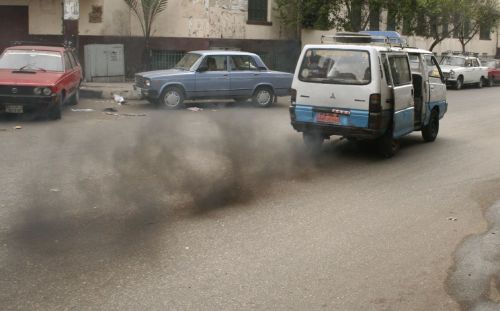
A microbus in Cairo. Image by Flickr user richardavis.

Cairo, Delhi, New York — if I’ve come across these systems in my own travels, then they surely must be assembling anywhere there are lots of people, few transit options, and limited government intervention into private solutions. These are spontaneously identical structures, these disparate fledgling Bluelines; the desires of commuters and of drivers independently assemble into mirror systems. And they set in motion predictable effects. From the New York Times:

Anthony Henry’s commuter van rolled west along Merrick Boulevard in Queens, packed nearly to capacity with nine passengers. It was 6:50 on a Friday morning, and the path ahead of him was clear until suddenly it wasn’t: A van with a wobbly left rear tire, illegally plying the same route, burst in from a side street and barely cleared a car parked at the corner to pull ahead of Mr. Henry.

“Look at this guy right there, picking up my passengers,” Mr. Henry, 47, said, clicking his tongue as the van swooped to the curb and scooped up two people waiting. “It’s a war out there.”

Compare that to the article about Cairo:

Last month there was a particularly nasty accident on the Corniche at one of the main entrances to the suburb of Maadi, eight kilometres south of Cairo. Survivors said they had asked the driver several times to slow down. Belongings were strewn across the street. Mercifully, the death toll was not high, but two lives were lost, and several passengers sustained serious injuries after the bus swerved off the road. Few emerged from the incident unscathed. Survivors said the driver took the curve too fast, trying to race ahead of another microbus alongside.

In each city, each driver on the route is in competition with every other driver on the route. Sound familiar? The Times’ article hints at the danger, destruction, and fatalities New York’s version could eventually come to:

… Beyond a financial threat, their legal competitors say the unlicensed van drivers are a growing safety menace. “They’ll run red lights, they’ll drive against traffic, they’ll cut you off.”

A Blueline during rush hour. Image by Flickr user parveennegi1979.

When I wrote my essay last year, Delhi was pledging to eliminate the Blueline in time for the Commonwealth Games. A quick look into the status of that pledge reveals setbacks, if not outright failure. It’s not surprising: the same pressures that drive Delhi’s death toll have also made a few men extremely rich, and busting a cartel is difficult even in the best of circumstances.

There’s a lesson here. Order has to be imposed before the system moves to the next phase: consolidation of power.

In the meantime, it’ll be interesting to see if New York’s media evolves a response to this stimulus to mirror the way Delhi’s media has. This, too, is a self-replicating pattern of response: outrage stokes sales. If New York City were to continue in Delhi’s extreme direction, you could expect the New York Post to start publishing a dramatic daily death count of its own.

Pakistan’s film poster painters are suffering, too

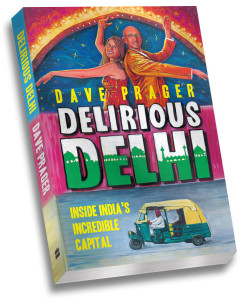
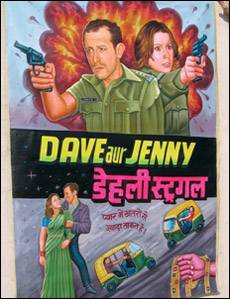
As regular readers know, Jenny and I hunted down a former Bollywood poster painter near Old Delhi, commissioned him to paint what we humbly consider the world’s most amazing painting, and more or less made both ourselves and Vijay Singh, the artist, marginally famous. (In fact, I was just Googling to support that statement, and I came up with an article written about him four days ago! There’s also this radio interview.)

But even as NPR reports that major corporations are horking Vijay’s Bollywood aesthetic, it’s important to bear in mind that while one Bollywood artist may be experience a resurgence, many more have faded into the wake of multiplex cinemas and digitally-printed movie posters. And now we learn that it’s not just in India — in Pakistan, too, the art form is dying.

Royal Park, a place in Lahore still known for the film business, used to have many workshops where seasoned commercial artists like S Rahi, M Younas, J Arfi, Sarwar and others worked and taught students, Mani explains. “There were a number of cinemas around the area of Royal Park. Some of them have turned into commercial theatres and others into parking lots or restaurants. 12 years ago, around 100 established artists were working on film hoardings and they had many students too but you can hardly find any such artists now,” he said.

A sad situation. Perhaps some bloggers in Lahore can track down one of these artists, commission a painting, and start a parallel resurgence?

great news, India: Taco Bell has arrived!

Update: thanks to Rakesh for sending in a billboard sighting! It’s posted below…

I remember exactly where I was when I first heard that Taco Bell was coming to India. I was sitting with my coworkers in our DLF Cyber City office, describing one of the seven wonders of American culture: two AM taco runs. “It’s not exactly Mexican food,” I told them, my eyes watering with nostalgia. “In fact, it’s not exactly food. But I miss it intensely.”

One of my coworkers piped up. “I heard they were opening a Taco Bell in India soon!”

A dash to the internet confirmed it. I pledged right then and there that I would be the very first person to eat at India’s very first Taco Bell. Unfortunately, although Taco Bell announced their plans to open way back in 2006, it still hadn’t arrived by the time I left the country.

But now, ladies and gentlemen, the greatest day in India’s history has finally arrived, albeit too late for me: Taco Bell has opened in Bangalore.

If you’re unsure about what Taco Bell holds in store for you, I published an essay in The Caravan magazine last year explaining the joy and glory of hyper-manufactured carbohydrates. Give it a read.

“Taco Bell is to Mexican food, however, what Starbucks is to a Paris coffeehouse: a uniquely American derivative that has evolved to resemble its inspiration in name only. You can trace its pedigree back to Mexico, sure, but what Taco Bell serves today is a mutt: Mexican food crossbred with generations of focus groups, cost-cutting innovation, and manufacturing techniques to breed a beast far removed from the original. A Taco Bell taco, with its crispy corn shell containing ground beef, lettuce, tomato, and cheese, is a remarkable feat of American engineering: the product of decades of research that have squeezed every spare cent of material and every extra second of labor out of creating it.” Read more…

I can’t find any pictures or reviews of the new Mantri Square franchise. If you’re in Bangalore, I implore you: take some pictures! Try a taco! Tell us what you think!

UPDATE 24 MARCH: Twitterer Rakesh spotted this ad above the streets of Bangalore:

Am I crazy, or is that a reference to illegal immigration in America? This might not be totally politically correct…

here come the touts

On our only visit to Jaipur, Jenny and I suddenly found ourselves swept into a wave of Spanish-speaking tourists. They were exiting a temple, and their guide was exhorting them onward to their next sight; since we were wandering aimlessly at the time, we figured that they might be headed somewhere interesting. So we allowed ourselves to bounce along in their wake, just to see where it would lead us.

Ten steps outside of the temple, the touts attacked.

It was like a goblin charge in Lord of the Rings: the enemy merchants appeared as a horde and rushed into the midst of our adopted group with a divide-and-conquer strategy, each hawker latching onto a tourist and battering him or her with puppets and flutes and other totally-authentic Jaipur knick-knacks until half of them bought something just to be left alone. In the churning waters of the moneyed and the moneyless, the sound of their sales pitches rose into the air.

Their pitches were in Spanish.

“Señor! Señora!” The touts shouted. “Especias! Artesanía! Trabajos manuales! Tengo siete hijos… señor, por favor…!”

The Spaniards pursed their lips and speed-walked towards a group of bicycle rickshaws waiting down the street. The rickshaw pullers had obviously been bribed to move from in front of the temple where the tourists had been dropped off; now they watched from down the street, a distance far enough that the touts had more than enough time to make their sales.

“Señor! Muy bonito brazalete!” One tout began pulling at my shirt, walking backwards alongside me with more deftness than I could walk forwards on the typically-uneven Indian sidewalk. He barraged me in Spanish far superior to that which I’d retained after two semesters studying it in college. “De la fábrica de mi tío. Señor, mira!“

Suddenly it was clear just how well organized Jaipur’s souvenir trade truly was. The touts had clearly been tipped off that Spanish-speaking tourists would be exiting this particular temple at this particular time. The fact that they’d so strategically organized the bicycle rickshaws implied a level of action on intelligence to be envied by militaries around the world.

What’s more,  the fact that they were speaking Spanish suggested that multilingual street peddlers are dispatched in SWAT Team fashion. Buried in a mountain cave somewhere outside of Jaipur, we suspect, there is a gleamingly-futuristic central headquarters, in which street peddler generals plot the movements of tourists on high-tech command-and-control consoles. Their informants are everywhere: chaiwallahs at the train station scrutinize the debarking faces, autorickshaw drivers report on who is dropped off where, and hotel clerks transmit the nationality of the passports they collect when they register. All this information is relayed to central headquarters, where orders are barked based on the latest intelligence. “A Russian couple has been spotted at The Amber Fort! Don’t forget to make vodka jokes! Move, people, MOVE!”

Which is why we have so many sparkly bracelets and soapstone elephants in our possession today: they know that we’re coming. They know where we’re from. The speak our language. They know our next move. Everywhere we go, they’re already there.

photos from Saigon

A few of our favorite shots from our recent weekend in Saigon. I think the third one may be the best photo I’ve ever taken. You can see more on Flickr.

1

6

5

3

4

2

Check out Flickr for the full set! More on India coming this week.

an important time to give

Our most life-changing experiences in India were our visits to Pardada Pardadi Educational Society, a school for girls in rural Uttar Pradesh, India’s most populous state and one of its poorest. We saw first-hand the difference the school makes in its students: while two of its girls were leading us around their village, showing us their brick homes and their family’s goats, talking with confidence and poise to us despite the fact that we were both foreign and, in Dave’s case, male, we spotted two girls who weren’t students at the school: wearing dirty clothes and peeking around a wall, they hid shyly whenever we turned our heads towards them.

It was a staggering difference: it was clear which girls would have the skills and confidence to resist the status quo and drive change in their communities, and which ones were going to be bullied by the patriarchy into another childhood marriage and more of the same.

Dave with students

Pardada Pardadi provides free education and vocational training to 1,000 rural village girls in Anupshahar, Uttar Pradesh. Its mission is to create a generation of self-reliant and economically independent girls who will break the cycle of poverty in the region. By teaching vocational skills and depositing 10 rupees in a girl’s account for every day she attends school, Pardada Pardadi ensures its students graduate with the education, the power, and the means they needs to transform their lives.

We’ve talked about Pardada Pardadi before — the good they’re doing (sending two students who’d never been beyond Delhi all the way to California) and the challenges they’re up against (like Ruksana, who had to quit school to get married at the age of thirteen). For the girls who don’t go to Pardada Pardadi, the facts are heartbreaking.

We’re bringing them up again today because they’ve been chosen to participate in the Global Open Access Challenge 2009, which gives them the chance to gain a permanent spot within GlobalGiving, an online marketplace for philanthropy that helps individual and corporate donors find causes they believe in. To be eligible for the permanent spot, which will make a huge difference for their future finances, Pardada Pardadi has one month starting today — until September 18th –- to raise $4,000 from at least 50 unique donors.

Pardada Pardadi is doing great things in India. We support them in many ways: Jenny was employed by them, we volunteer for them, we’ve raised money for them (and many of you, we’re proud to say, donated). This opportunity is one of their biggest yet, which is why we’re writing about it. We encourage you to read about the impact they’re making and then, if you believe in their cause, donate to them via Global Giving.

Based on the rules of the Global Open Access Challenge 2009,they have one month to raise $4,000 from at least 50 donors. Please be one of them! Give now.

See pictures from our visit to Pardada Pardadi.

girls

Update: Pardada Pardadi did it!  They have now earned a permanent spot on Global Giving.  A huge thanks to everyone who gave and spread the word.

Photos from our South India trip – Part 2

DSCF0434_fixed

Old men in a shop in Madurai

Kochi luncheon

kites

houseboat

Photos from our South India trip – Part 1

DSCF0236_fixed

Kovalam fishermen

Dave the bus driver

You can view even more photos here.

india and nepal say happy birthday dad

Today is Dave’s Dad’s sixtieth birthday. Since we’ve known for a while that we would be in Asia during his big day, we decided to celebrate by asking everyone we met while traveling through India and Nepal last month to wish him happy birthday. Enjoy!

(And we know that the lyrics of Bilo Rani aren’t exactly what you’d sing to your papa, but 1) he doesn’t understand the lyrics and neither do we, and 2) it’s got a great beat. We asked our friends if they knew any Hindi songs that were actually about one’s father, and they suggested this slightly creepy piece. Creepiness begins at 0:30.)