Category Archives: pictures of Delhi

the delhi metro

We rarely ride the Delhi Metro. It mainly serves North Delhi; and while they’re expanding it south all the way to Gurgaon, they’ve got at least eighteen more months of construction before our lives would get any easier. But the few times we’ve ridden it, we’ve been shocked by its cleanliness, its efficiency, and its punctuality. It’s a snapshot of a Delhi-that-never-was, or perhaps a Delhi-that-someday-will-be.

The Metro is the pride of Delhi; its managing director, Dr. Elattuvalapil Sreedharan, is spoken of with universal reverence as a man who can create miracles on time and on budget in a city littered with civic projects gone horribly wrong.

The last time we rode the Metro was in March. It was our first time transferring at Connaught Place (one of the two inter-line transfer points), and it was incredible. The crowd inside the train started pushing out and the crowd outside the train started pushing in far before the doors were open. What ensued was a free-for-all of shoving, of leading with the elbows, of shouldering the person in front of you into the person in front of them, of women using their babies like a quarterback uses his blockers.

We rode the Metro again about two weeks ago. Expecting the transfer at CP to be just as insane, I came armed with the camera. My first thought upon descending the stairs: “There is no way all these people will fit into the train.”

But once we made it down the stairs and into the crowd, we discovered that the Delhi Metro authorities had, in the interim, instilled something in their ridership I’ve never seen in the New York subway: perfect order.

Everyone lined up? Nobody jumping the queue? Adequate space left for people getting off the train?

Where was I, and what had they done to Delhi?

I recorded a video anyway, hoping to capture the chaos I expected once the train doors opened. Instead: behold the most orderly on-boarding I have ever experienced in all my years commuting.

New Delhi: 1. New York: 0.

Karim’s

It’s the breathless refrain every expat asks every other expat in Delhi: “You haven’t been to Karim’s yet?!?”

The unmarked alley entrance means you’ll never stumble upon it. This is the allure of Karim’s: to go there is to discover a secret of the old city.

Some people will tell you it’s the oldest restaurant in Delhi. Other people will tell you that they invented Mughal-style food. The truth doesn’t really matter. Only the food does.

You don’t know what to look at first — the kebab guys, the bread guys, the guys carrying more dishes than seems possible, the motorcycles honking as they weave through what you’d think was the middle of the restaurant, or the proprietors of each of the four dining rooms who, inexplicably, appear to be in competition with each other for your patronage.

Every time we go, we learn a new secret. Last time we learned that the Karim’s Veg dish, with paneer, dates, and some sort of nut-based gravy, is the stuff of dreams. The time before that, we learned that they serve breakfast. This time we learned that the half-inch of oil puddled atop every bowl of stew isn’t supposed to be eaten. It’s there to show you that the food has been cooked so well that the fat has liquefied; the fat itself is meant to be drained into a separate dish.

Our parents are coming in November to visit. In the days they spend with us before embarking on their packaged tour, we’ll make sure they know this secret of the old city; and when they meet up with the rest of their tour group, they’ll be the ones breathlessly asking, “You haven’t been to Karim’s yet?!?”

ceiling fan at Karim’s

Old Delhi at night

Just south of Jama Masjid, this is old Delhi: auto rickshaws and bicycle rickshaws and cars and scooters and people and lights and ads and noise. And above it all, a chaos of wires and pipes and dead kites dangling. Looks best if you see the bigger image.

coconut rava rave

Always a line at Sagar.

Truly an eating paradise.

sealed building on MG Road

the post-apocalyptic commute

What in India do I hate more than MG Road? Nothing. There is nothing in all of India worse than Mehrauli-Gurgaon Road, that ten kilometer stretch of pain upon which I stop-and-go for three hours of my day. MG Road is construction: the Delhi Metro, erecting itself on giant cement pylons, selfishly hogging the center two lanes in the name of urban planning and traffic reduction… what right does a transit system opening in 2010 have to inconvenience me in 2008?

MG Road is also destruction. Once upon a time the road gleamed with shopping malls and furniture stores; but two years ago, the government decided that these were illegal constructions necessary to be sealed. “Sealing” in practice means halfhearted bulldozing — enough to discourage inhabitance while creating the impression that you travel to Gurgaon by way of Beirut.

The government did this to these buildings two years ago, and this is how they left them, and this was my MG Road for my first four months in Delhi: honking and jerking my way past shuttered stores, broken windows, shattered concrete, skewed rebar.

But in February, commerce returned and rebuilding began. Recent workward slogs have beheld a new sight: men with sledgehammers gnawing at the piles of rubble, preparing for a new day when the Metro is complete, the traffic is reduced, the government is supportive, the shops are legal, and customers are extant.

Today MG Road’s endless flows of construction and traffic are brooded over by bored salesgirls staring glumly out of sharply-remodeled stores. Wicker World and Twinkle Sofa Mall have resurrected; but their customers have not. There’s nowhere to park, you see, that isn’t usurped by the glacial flow of cycles and bikes and Toyota Innovas.

Nehru Place

On Sundays, Nehru Place is closed, with the shops shuttered and the plaza empty except for what appears to be two groups of beggars involved in a turf battle. While you see a few women slapping each other at the periphery of the plaza, your attention is drawn to the center, where two stick-thin men in rags writhe and flail and pin each other to the ground, oblivious to the police officer in his khaki uniform who, with the patience and deliberation of a man who has beat beggars a hundred times before and will beat them a hundred times after, pulls a nice long stick off a nearby tree and saunters up to the two men and whacks them and whacks them and you decide that maybe it’s better if you come back to Nehru Place some other day.

On every other day, Nehru Place is Delhi’s main computer market.

From the flyover, Nehru Place is a collection of concrete eighties skyscrapers clustered around a few central plazas. In the buildings themselves, a number of very legitimate businesses (including Microsoft) have very nice offices where they conduct very legitimate business. But on the ground level is India’s IT boom in action: an explosion of brand names, a cacophony of vendors, waves of young men in fashionable shirts, and ancient diesel generators that roar to life every time the power goes down.

The Indian retail economy is structured around clusters, with the best bargains and widest variety to be found in hubs where everyone is selling the same thing. There’s a spice market, an auto parts market, and a wedding invitation market, all of which house vendors resigned to papadum-thin margins in a competitive environment defined by shoppers who know that if one guy doesn’t offer his absolute lowest price, the guy in the next stall selling the exact same thing will.

Nehru Place is Delhi’s retail cluster for computers. Laptop repair specialists next to laptop repair specialists, hardware shops next to hardware shops, and printer cartridge vendors as far as the eye can see.

Everything at Nehru Place seems slightly illegitimate, probably because of the brazenness with which definitively illegitimate business is conducted. The grinning guy in the yellow shirt waves a printed catalog of pirated software at me, promising Microsoft products for the price of a Big Mac. I find him indistinguishable from the other vendors, which makes me suspect everything: are the boxes of printer paper from the back of some truck? Are the ten-dollar computer speakers built using five-dollar parts? Are the HP ink cartridges filled with genuine HP ink, or indeed any ink at all?

All levels of retail sophistication have a presence at Nehru Place, from mom-and-pop-run closets stuffed with 1990’s VGA monitors to gleaming showrooms featuring shiny new brands. I got my Apple power adapter repaired in a shadowy twelve-by-twelve explosion of wires and motherboards and empty cases; the guy who actually did the work was perched in a wooden loft, surrounded by tools, his head mere inches from the ceiling. His effort set me back three dollars, and extended the life of my power adapter exactly one week before it failed for good.

You can’t imagine that this place once didn’t exist. The ancient old man screwdriving logic boards must have learned the trade from his father; the overstuffed cubicles must contain computers dating back to the Raj. Nehru Place is the new subsumed by the old: the greatest advances of humankind brought into a market that feels centuries unchanged.

generator and bikes at Nehru Place

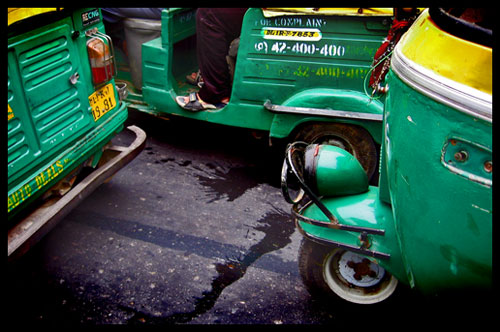
three autos and some street slime