Tag Archives: delhi traffic

death of a median, part II: where iron fences fail

In our last post, we documented the death of an Aurobindo Marg median at the feet of pedestrians: those who walk and scuff are, for Delhi’s municipal infrastructure, the harbinger of death.

And the city knows it: its city planners and traffic engineers, toiling in futility in some governmental sub-basement, are fully aware that the longer they can keep feet off of where feet don’t belong, the further their infrastructure investments will stretch.

But there’s a right way and a wrong way to protect the life of the infrastructure. The right way is to give pedestrians better options, because few people would risk crossing busy streets if there were safer alternatives. The wrong way is to arbitrarily cut pedestrians off from where they want to go, as Jenny and I discovered one lovely evening after indulging in Rajasthani handicrafts and Kashimiri tea at Dilli Haat. Upon exiting to Aurobindo Marg, we learned the hard way that the city had attempted to extend the life of a bit of infrastructure—and, perhaps, of a few citizens as a secondary consideration—by installing a jagged iron fence across the median to prevent people from crossing the street.

(This isn’t the actual fence, but it’s the same style. Photo by ex_pandora on Flickr.)

The problem was, Jenny and I always capped off our trips to Dilli Haat with a heart-stopping game of Aurobindo Frogger. That’s because if we picked up our autorickshaw at INA Market, just across the road on the southbound side, it was a straight shot home. But from the Dilli Haat side of the street, we faced an extra twenty rupees fare and fifteen minutes navigating the back streets behind Dilli Haat, merging on to the Ring Road, and joining the off-ramp crawl towards southbound Aurobindo Marg.

Twenty rupees and fifteen minutes: always worth playing chicken with a Blueline bus.

And we weren’t the only ones frustrated by this new blight on our commute. A constant stream of commuters debarked from buses on the sidewalk outside of Dilli Haat, many of them accustomed to crossing the street to continue their journey from the opposite bus stop at INA Market. Like us, these commuters stared unhappily short at the new fence. And like us, they looked around to consider their options, which were few: there were no nearby pedestrian bridges, no underpasses, no gaps in the new fence, and angry-looking points on top of each picket.

Some people sighed and began trudging to a distant overpass.

Some people cursed and counted their change to see if they could afford another northbound bus to a different transfer point.

And some people risked life and limb and groin as they climbed over the fence’s sharp pickets anyway.

In all cases, faces showed frustration bound to manifest in destruction. Sure enough, our return trip home from Dilli Haat was much easier a few weeks later, thanks to a freshly-torn gap in the fence. We joined a group of commuters that dashed across the traffic, squeezed through the hole, and sprinted to safety in front of INA.

(Also not our picture, but you get the idea: there’s safety in numbers when crossing the street, if for no other reason than the fact you’d rather be the last bowling pin than the first. Photo by Joshuacw on Flickr.)

The city is right to protect its investments in infrastructure and its citizens from becoming further sad notches on the Blueline’s belt. But pedestrians as a collective do not take kindly to arbitrary dead-ends. The aggregated incentives of fifteen minutes and twenty rupees, multiplied across thousands of people who want to save the money, is far more powerful than a mere iron fence.

Pedestrian deterrence only works in two instances: if alternatives are provided, or behavior is enforced. Had the city built a pedestrian bridge, or an underpass, or even just a gap in the fence where those truly determined to cross could squeeze through, that fence would not have been uprooted and twisted the next time we saw it, and the median would still be protected from the inevitable.

But if alternatives are not provided, enforcement is the only option. Take the rinky-dink medians that divide Delhi’s Bus Rapid Transit lanes; a few inches high and wide, they would be but a distant memory if it weren’t for the men in uniform standing astride them and glaring at anyone who tries to cross. It worked wonders for that one stretch of road, at least; and if men with mustaches and guns were spaced every twenty feet along every single road in the city, the municipal infrastructure would last a whole lot longer.

Impractical, obviously. But probably cheaper than repairing medians (and fences) every few months.

(Again, not our picture. I don’t think we’d be brave enough to put so many cops in one frame. Photo by praja_subba1 on Flickr.)
death of a median, part I: an ode to Aurobindo Marg

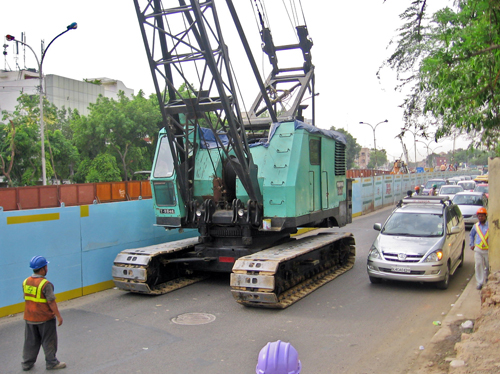
Good news for the street whose traffic stole so much of our life in Delhi: Aurobindo Marg is about to be whole again. Its lanes were squeezed by construction barriers and rerouted practically onto sidewalks for the entire time we lived just off of this South Delhi artery, resulting in eternal jams, unwalkable sidewalks, uncrossable streets, and epic construction machinery thundering casually down the road just steps from our front door.

Now, finally, two-and-a-half years after Metro construction necessitated this nightmare, Aurobindo Marg is about to return to the glory we never knew. Those two-and-a-half years have been tough, though—not just for commuters, but for the poor road itself.

Shortly after we moved to Hauz Khas, the city built impressive new medians down the middle of our nearby stretch of this once-spacious boulevard. These concrete islands, raised a full foot off the ground, were necessary because the old medians had worn to rubble in a dozen spots where cars would routinely make illegal U-turns. (I’d curse the cars that blocked traffic as they crossed over them, even as I’d silently hope my driver would follow their lead and shave precious tens of seconds off my commute home.) The new medians made traffic flow much smoother: they were so high that only pedestrians could cross them.

Which is, unfortunately, exactly what destroyed them.

They’re not wearing steel-toed boots or dragging active jackhammers behind them. They’re just walking. But that’s all they need to do: they walk across the median, and they tramp footprints in the dust. Enough footprints coalesce into a path, which catches the eye of subsequent pedestrians looking for a place to cross. But among those subsequent pedestrians—(and this is where the median starts to shudder, this is where Aurobindo Marg experiences the first of what’s to befall its beautiful new medians)—are pedestrians pushing bicycles.

Don’t blame the bicyclists. They don’t mean to. But it’s been a long day at work and an even longer ride home, and these old bikes are heavy; they’re trying their best to lift their bikes up and over the median, but every so often they catch one of their metal pedals or drag the teeth of their gears. Which nicks the cement.

It’s nothing! A grain of sand! The median is still good as new!

Except the path has been tramped down, so this is where people think to cross. So one bicyclist is followed by another. Nicks coagulate into notches. Notches coalesce into ruts. Ruts amalgamate into grooves wide enough to roll bicycle wheels through. And while the grooves are made wider and deeper, the material being ejected from them is collecting into a little pile of rubble. That gets bigger. And as the groove is graduating into a fissure, so too is the pile moving towards becoming a ramp. Just the kind of ramp that a motorcyclist can utilize.

Here he comes now, that first motorcyclist, the beginning of the end on his flashy Hero Honda Hunk. Not even wearing a helmet, this tough guy, although he is wearing sunglasses even though it’s dark out. Ahead of him, traffic is jammed—but jams are for sissies, yaar. Spying the fledgling ramp, he fixes his handsome steel gaze on the car behind him until its driver is awed into stopping. And then he realigns his bike perpendicular to the road and then he slowly, carefully maneuvers up the fledgling ramp, spraying dirt and rocks behind him. Girls want him, guys want to be him, guys like me want him to fall flat on his face. But guys like him never do: he’s made it. And he’s blazed a trail for less cool guys on less macho Hero Hondas models (Glamour? Splendor? Passion Plus? Really?) to follow.

So now this pedestrian crossing that became a bicycle crossing is a motorcycle crossing. By the rules of the Delhi road, the lighter elements must give way. And they do, flowing to the left and right of the motorcycle crossing, where they will create new paths that attract new nicks that erode eventually into further ramps. Three parallel tracks, now, which is just what three-wheeled autorickshaws need to take their turn in the cycle.

Nobody means to destroy anything, and nobody thinks their individual actions have an impact, but when everyone is too impatient—when pedestrians don’t want to walk to the crosswalk, when motorcycles don’t want to drive to the U-turn—the shortest path between two points takes the infrastructure along with it.

We congratulate Aurobindo Marg on its upcoming return to construction-free normalcy. And we look forward to appreciating it in all its grandeur—once those medians are rebuilt again.

the selfish solution to gridlock

The laws of physics suggest that two cars cannot possibly occupy the same point in space. But Delhi drivers regularly give it a shot anyway. Coming from opposite directions, two cars will both try to pass through the same intersection at the same time, sometimes ignoring traffic signals but often having none to ignore. Either way, when they meet in the middle, motion ceases. Gestures ensue.

Behind them, cars immediately begin to route around the obstruction. Which is fine—unless the subsequent cars meet and halt just like the initial cars. Suddenly the intersection becomes a jumble of too many cars occupying not enough space, with more cars halting and more cars still coming. Seconds later, autorickshaws and motorcycles eat up the space on the periphery, and the worst has happened: total gridlock.

Despite everyone’s best efforts to clear things up by honking their horns, nobody is going anywhere.

In the absence of traffic police to disentangle the mess, it seems like a hopeless situation. Unless everyone backs up as a unified collective, we’re all stuck. Self-interest got us into this mess; only collectivism can get is out.

Except in Delhi, self-interest suddenly solves the problem it created. In this city, there’s little incentive to obey traffic laws because there’s no one around to enforce them; but the system actually works even when the worst repercussion of the asphalt free-for-all comes to a head.

In these cases, heads begin to appear between the hoods and trunks.

Motivated by a meeting they wish to keep, men wade into the fray, examining the crystalline structure of the traffic, looking for gaps, irregularities, wiggle room. Because there’s always wiggle room. Six inches here, a foot there, and this makes all the difference. It’s reverse Tetris: move one this way, move another that way, and suddenly some cars are free.

The amazing thing is this: these men don’t coordinate their actions. They don’t formulate strategies. In fact, they probably think they’re working against each other—as passengers in trapped cars, they care about helping the other cars move only insofar as it helps get their own car on its way.

That was my motivation, at any rate, when I played gridlock warden at a t-shaped intersection a quarter-mile north of Hauz Khas Market. It was a standard scenario: two cars met froze in an intersection and others quickly clotted around them. My auto driver tried to work the periphery, but another car had the same idea coming from another direction, and soon we were boxed in.

Five minutes passed, and then ten. The honking did nothing. I considered paying the driver and walking beyond the jam, but I felt some sense bizarre of solidarity with him: I got him into this, I decided, and I was going to get him out.

I exited my auto and surveyed the situation. Possibilities materialized in my head. I mapped out moves like a game of chess—“If this car goes here, and that car goes there…”—and then I took action, standing in front of this car and pointing him that way, then standing in the hole he left until my auto driver could slip into it. Around me, other heads had appeared in the traffic, and the hole one of them created for their own car cascaded back to me. Using my gestures to move some cars and my body to block others, I worked us through the jam—me grinning, my driver grinning, other drivers staring, and still other drivers following behind my auto as he followed the path I blazed out of the jam.

As we pulled away, other cars followed us into the sweet freedom experienced only by bodies in motion. Until the next stoplight, at least.

the monsoon exists (and it’s early)

I didn’t really believe the monsoon existed in Delhi. (For some reason, I also didn’t believe Delhi had a winter either; but it was so cold in December that Dave had to buy me a long, puffy jacket when he went back to New York.)

But I can now say I have seen, felt, and itched the fact that Monsoon Wedding isn’t an oxymoron movie title.

According to the news, the monsoon is here early, and it’s killing people. So what’s it like?

1) Delhi is a very dirty city. I always bemoaned the lack of rain to wash the streets clean. Well, now it’s all just mud.

2) Mosquitoes! I haven’t seen many since last fall, but they have hatched. It’s still hot, so when I got home I changed into shorts and a tank top and then ate my dinner watching the Discovery Channel. Thirty minutes later I was shocked when I went to the bathroom and looked at myself in the mirror and found all my exposed skin covered in bites. Seeing them made the itch begin. I’m now dressed in a long sleeved shirt, pants and socks. Eh, I’m getting overheated.

3) Despite all this rain, life goes on. Motorcycles are a cheap and convenient means of transportation in India, and if you are used to commuting on your motorcycle with your wife sitting side-saddle behind you while wearing a sari, there’s really nothing much you can do about the rain. You just zoom along with the rain pouring on you, sloshing through puddles, and hope you dry before you have to go somewhere again.