Good news for the street whose traffic stole so much of our life in Delhi: Aurobindo Marg is about to be whole again. Its lanes were squeezed by construction barriers and rerouted practically onto sidewalks for the entire time we lived just off of this South Delhi artery, resulting in eternal jams, unwalkable sidewalks, uncrossable streets, and epic construction machinery thundering casually down the road just steps from our front door.
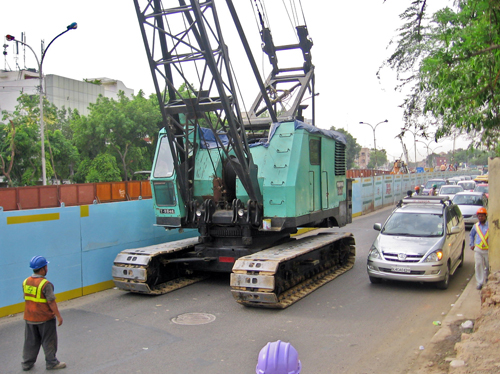
Now, finally, two-and-a-half years after Metro construction necessitated this nightmare, Aurobindo Marg is about to return to the glory we never knew. Those two-and-a-half years have been tough, though—not just for commuters, but for the poor road itself.
Shortly after we moved to Hauz Khas, the city built impressive new medians down the middle of our nearby stretch of this once-spacious boulevard. These concrete islands, raised a full foot off the ground, were necessary because the old medians had worn to rubble in a dozen spots where cars would routinely make illegal U-turns. (I’d curse the cars that blocked traffic as they crossed over them, even as I’d silently hope my driver would follow their lead and shave precious tens of seconds off my commute home.) The new medians made traffic flow much smoother: they were so high that only pedestrians could cross them.
Which is, unfortunately, exactly what destroyed them.
They’re not wearing steel-toed boots or dragging active jackhammers behind them. They’re just walking. But that’s all they need to do: they walk across the median, and they tramp footprints in the dust. Enough footprints coalesce into a path, which catches the eye of subsequent pedestrians looking for a place to cross. But among those subsequent pedestrians—(and this is where the median starts to shudder, this is where Aurobindo Marg experiences the first of what’s to befall its beautiful new medians)—are pedestrians pushing bicycles.
Don’t blame the bicyclists. They don’t mean to. But it’s been a long day at work and an even longer ride home, and these old bikes are heavy; they’re trying their best to lift their bikes up and over the median, but every so often they catch one of their metal pedals or drag the teeth of their gears. Which nicks the cement.
It’s nothing! A grain of sand! The median is still good as new!
Except the path has been tramped down, so this is where people think to cross. So one bicyclist is followed by another. Nicks coagulate into notches. Notches coalesce into ruts. Ruts amalgamate into grooves wide enough to roll bicycle wheels through. And while the grooves are made wider and deeper, the material being ejected from them is collecting into a little pile of rubble. That gets bigger. And as the groove is graduating into a fissure, so too is the pile moving towards becoming a ramp. Just the kind of ramp that a motorcyclist can utilize.
Here he comes now, that first motorcyclist, the beginning of the end on his flashy Hero Honda Hunk. Not even wearing a helmet, this tough guy, although he is wearing sunglasses even though it’s dark out. Ahead of him, traffic is jammed—but jams are for sissies, yaar. Spying the fledgling ramp, he fixes his handsome steel gaze on the car behind him until its driver is awed into stopping. And then he realigns his bike perpendicular to the road and then he slowly, carefully maneuvers up the fledgling ramp, spraying dirt and rocks behind him. Girls want him, guys want to be him, guys like me want him to fall flat on his face. But guys like him never do: he’s made it. And he’s blazed a trail for less cool guys on less macho Hero Hondas models (Glamour? Splendor? Passion Plus? Really?) to follow.
So now this pedestrian crossing that became a bicycle crossing is a motorcycle crossing. By the rules of the Delhi road, the lighter elements must give way. And they do, flowing to the left and right of the motorcycle crossing, where they will create new paths that attract new nicks that erode eventually into further ramps. Three parallel tracks, now, which is just what three-wheeled autorickshaws need to take their turn in the cycle.
Nobody means to destroy anything, and nobody thinks their individual actions have an impact, but when everyone is too impatient—when pedestrians don’t want to walk to the crosswalk, when motorcycles don’t want to drive to the U-turn—the shortest path between two points takes the infrastructure along with it.
We congratulate Aurobindo Marg on its upcoming return to construction-free normalcy. And we look forward to appreciating it in all its grandeur—once those medians are rebuilt again.