Tag Archives: our delhi struggle

A book. Not THE book, but A book…

I don’t want to begin this essay with a revelation that the publication date for my book has been pushed back again.

So I won’t. Instead, I’ll share this picture with you.

That’s a book. And my writing is contained therein. Close enough, right?

Sure. To North India, With Love is a great book. Published by ThingsAsian Press and edited by Nabanita Dutt, it is a travel book — but not in the Lonely Planet sense. It doesn’t catalog restaurants or hotels or tourist traps; instead, it presents snapshots of moments. It’s a collection of about 40 short essays that together paint an affectionate portrait of North India, presenting experiences that have mattered to the travelers who came before you. And it couples those experiences with just enough information for you to run off to Dehradun or Allahabad or Old Delhi and create an experience of your own.

If you’re in the US, you can buy it on Amazon; hopefully it’s available in Indian bookstores as well. Three of my essays have been re-edited and republished in this book. These include the story of Ruksana, my experience with Karim’s tandoori bakra, and a retelling of the story of our famous Bollywood poster. Here’s an excerpt:

I came back the next weekend with my father and the money for the deposit. Manesh wasn’t there. This time, we sat at the rickshaw stand with a drunk mechanic who kept telling us, “I speak English tutti-frutti,” and “Vijay is my brother,” and “You want some whiskey?” Finally Vijay and Ranjeet, his English-speaking partner, pulled up. We discussed again the poster while the drunken mechanic danced around, sent a peon for soda, and interrupted us with “Vijay famous artist!” and “My cousin-brother!” and yet more “You want whiskey?”

Jenny and I had anticipated a small poster, perhaps two feet in length — after all, our main goal was to reprint it on a postcard. Vijay, however, insisted that his work could be no less than five feet tall. We agreed, the peon returned, and we celebrated with Pepsi and whiskey. As we were walking out, the mechanic turned to me to whisper conspiratorially, “I speak English tutti-frutti.”

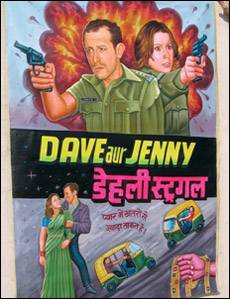
You can read the full essay on the ThingsAsian site. And you can see a picture of the poster that I’m talking about in this unrelated article that appeared in the Gujarati newspaper, Divya Bhaksar. Here’s how it looked in print:

After the article came out, the author assured us that it was saying nice things. But is it? As bad as our Hindi is, our Gujarati is worse. Does it complement our writing style? Does it repeat that last February’s denunciation of our imperial arrogance? Does it accuse us a pivotal role in the 2G scam?

Nope. Nice things. We know that thanks to my coworker Pankaj’s friend Vimal, who relieved our fears (Thanks, Vimal!) with an abridged translation that I’ll paste below:

Delhi through the eyes of a Foreigner

One American couple came for 3 years to stay in Dil walon ki Delhi, and what they saw here it is.

The author starts off by writing Osho Rajneesh’s saying: “the best way to hide anything from a person’s eyes is to place it in front of his eyes.” He talks about India in the same way: child beggars pulling arms of the people on the streets, a bridegrooms procession in midst afternoon with the mercury soaring at 42 degrees Celsius, blaring loud speakers in the night enough to tear one’s ear drums, crazy honking vehicles, little boys serving tea in dirty clothes, pirated dvds and cds selling in the open, choked-full buses and trains, cars parked in no parking zones, etc.

Then he goes on to say: Lets meet Dave & Jenny, who came to Delhi in Nov 07. They did not come to see the Taj, but for the work project and to work for an NGO, and chose to see Delhi through their eyes, rather than using a conducted tour.

He talks about their blog and reproduces the same. He begins with the matrimonial ad in Mumbai, and then goes on to their trip to Daryaganj to make a film poster for themselves. How they managed to find Vijay and how Vijay was surprised they managed to find him. Vijay printing a 6 foot poster instead of a 2 foot poster requested by them and how thrilled they were. The poster is reproduced along with the article.

He also narrates how “do one thing” fascinated and amazed Dave and Jenny.

It’s nice to be appreciated. And that warm feeling of appreciation gives me the fortitude to sigh and bare to you the pain I mentioned at the beginning: our book release has indeed been pushed back to April, and possibly later. Apparently there are simply too many books about Delhi on the market right now, thanks to the tourists who failed to materialize during the Commonwealth Games.

Which means the release parties will be postponed. Which means we won’t be visiting Delhi in February. Which means our memories of the hot winter carrot halwa steaming outside the Jama Masjid will, for now, remain just that.

Sigh.

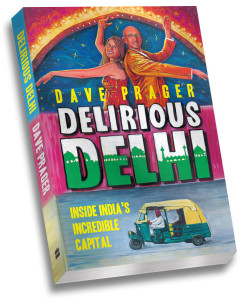
The good news is that we should be revealing the cover soon. We haven’t seen it yet ourselves, but we do know that the publisher was at one time talking to Vijay the Bollywood poster painter about doing the art. And if that’s indeed the case, then here’s a sneak peak at the source material we provided him:

Hopefully Vijay can once again do us justice.

(And if this picture at all convinces you that I’m capable of writing 250 entertaining pages about life in Delhi, then make sure you email us to join our book mailing list. We’re in discussions for something like nine release events in six Indian cities, and we’ll be inviting everyone on the list. Whether it takes place in April or July or sometime in the 23rd Century, you don’t want to miss out.)

food! dave and jenny in Time Out Delhi

This month’s Time Out Delhi‘s cover story is all about the favorite foods of Delhi’s various ethnic/foreign communities. Where do the Afghans eat? Where do the Parsis eat? And where do the Americans eat? To answer that last question, Time Out turned to Jenny and I. We’re proud to be part of their excellent collection of articles, which opened us up to dozens of new eating ideas that we can’t wait to try. Especially the Gujarati article… man, am I hungry right now.

We do need to correct a slight misquote in the article about Karim’s. Though we think that Karim’s is the favorite restaurant of Americans in general and we do like it, it isn’t necessarily our favorite place, especially not after this experience. But I’m not sure which restaurant I’d claim is our favorite… Saravana Bhavan for South Indian for sure, but we can put a dozen North Indian restaurants on our short list. Thinking back, though, no food stands out more than that which Ganga made. I’m getting nostalgic just looking at that picture.

Click the image below for a bigger version, or read the article on their website.

one hundred and eight thousand words later…

The manuscript is finally finished. Ten months after I started writing it, three months after I quit my job to work on it full time, and two weeks after I locked myself in the spare bedroom for a marathon of fourteen-hour writing days, it is done.

The book is a humorous travel memoir of expat life in Delhi — an all-encompassing look at the city from the perspective of two New Yorkers who get to know Delhi even as the city changes before their eyes. The final manuscript is twelve chapters and 108,033 words long — and lest you think it’s 300 pages of long-winded babble, here’s the statistic I’m most pleased about: 55,969 words were cut in the writing and editing process.

If all goes well, it’ll be hitting stores in India at the in the summer of 2011, published by HarperCollins India. We’re still looking for our US and worldwide publishers — let us know if you have any contacts.

Until then, we’ll continue to post new essays this blog, of course, as well as our Twitter account. And make sure you send us your email address! We’ll make sure you get announcements, news, and invitations to the launch parties.

Here’s an excerpt from Chapter 5, which is about our favorite subject: food. Enjoy!

One item of mine that my coworkers would never want to share was the carrot sticks I’d snack on to avoid the temptation of pre-lunch raids into my tiffin. Sometimes I’d coerce my coworkers Anurag or Soumya into eating one by telling them that, “In America, it’s considered an insult to my ancestors if you refuse to eat my vegetables.” They’d reluctantly agree and then scrunch their faces as they chewed. “Who eats raw carrots?” they’d ask me.

But raw carrots genuinely tasted better in India; in fact, all fruits and vegetables did. In the States, fruits and vegetables are bred to meet Americans’ demand for unnatural perfection: consumers prize produce that looks uniform and shining as if they rolled off a factory floor, with taste as a secondary consideration. We have huge white onions weighing a pound each but bland enough to eat like apples, consummate pink tomatoes with flawless skin and tasteless flesh, and green peppers that form rows of identical spheres but taste indistinguishable from celery. In Indian vegetable markets, the imperfection of unmediated nature is on full display: the vegetables are smaller, uglier, and more frequently blemished than those in America, but they’re far more flavorful. The tomatoes may be splashed with green and yellow patches, but they crunch deliciously in a salad. The onions may be smaller than softballs, but no American onion was ever sharp enough to make me cry when I cut it. And even the everyday green peppers—called “capsicum” in the local markets—were so full of flavor as to almost taste spicy.

it’s official: Our Delhi Struggle will be a book!

It’s finally official. The blue ink is dry and the envelope is closed and the contract is airmailing its way to Harper Collins. Now all that awaits is a manuscript.

The book will be part memoir and part guidebook: an in-depth exploration of the Delhi we lived, the lessons we learned, and the funny things that happened to us. It’ll be like this blog, only much longer, much more detailed, and much funnier.

Writing has begun, and will continue for the next six months. We expect to release the book next April July, just in time to channel the excitement of Delhi’s Commonwealth Games into fame and fortune.

If you want updates about the book’s progress and an invitation to the big release party next April July, send your email address to ourdelhistruggle AT gmail dot com. You can also follow us on Twitter: mmmmdave and JennySteeves.

This blog will be an integral part of the writing process. We’ll rely on readers’ opinions and insights to add detail to the book. Right now, for instance, we’re writing the section on getting around Delhi, and all the white-knuckled moments we’ve had in the back of an autorickshaw. Our question to you: what was your scariest auto-related experience?

taco bell in India

Gorditas in Delhi! Gorditas in Delhi!

The Caravan is a storied literary and political magazine based here in Delhi. I recently wrote an article for them previewing the joy, the wonder, the culinary ecstasy that India has in store when Taco Bell opens up. You should run out and buy the magazine (you can find it in Khan Market, among other places); but if you’re outside of Delhi, I’ve posted a PDF. Or you can read the article, which begins after the image below.

tacobell-1

Taco Bell: The Arrival

Considering the epicurean dilemma of Mexican-American fast food in India

by Dave Prager | published February 2009 by The Caravan

“Remember what I told you, Dave?” My grandfather always cackles when we drive past a Taco Bell. Grandpops is ninety, wizened, but nevertheless sharp enough to mock me even as he drives his Buick down the interstate.

“Remember what I told you? ‘This one looks like the baby threw up! And that one looks like the baby went to the bathroom!’ Remember?”

“I remember, Grandpops,” I always frown, always slouching a little, always hurt that he could say such cruel things about the food I love so very much. Of course I remember: I was fourteen. Grandma and Grandpops were taking me out to dinner. Against their protestations, I’d chosen Taco Bell, eagerly ordering what I always ordered: a Bean Burrito without onions, a Crunchy Taco, and a Chili-Cheese Burrito. My grandparents had nothing to say about the taco, but they exploded in disgusted glee as I unwrapped and unrolled my two burritos to douse their gooey greenish innards with salsa.

I remember chewing in sullen silence as my grandfather quipped his now-eternal phrase; it’s hard to enjoy food that people are pointing at. But even then, I had to admit that they were right: as India is about to find out, aesthetics are not exactly Taco Bell’s strong point.

————

Taco Bell is one of the flagship properties of Yum Brands, the company that has perpetrated KFC and Pizza Hut upon India with so much success. In a few short months, they’ll open their first Taco Bell in Bangalore. For many Indians, this will be their first experience with Mexican food.

Taco Bell is to Mexican food, however, what Starbucks is to a Paris coffeehouse: a uniquely American derivative that has evolved to resemble its inspiration in name only. You can trace its pedigree back to Mexico, sure, but what Taco Bell serves today is a mutt: Mexican food crossbred with generations of focus groups, cost-cutting innovation, and manufacturing techniques to breed a beast far removed from the original. A Taco Bell taco, with its crispy corn shell containing ground beef, lettuce, tomato, and cheese, is a remarkable feat of American engineering: the product of decades of research that have squeezed every spare cent of material and every extra second of labor out of creating it.

Taco Bell has defined itself by its quest to lower costs. It introduced its K-minus program in the 1990s, “K” standing for kitchen and “minus” standing for subtracting as much of it from a restaurant as possible. After all, when your economy scales across 5,600 stores, 175,000 employees, and millions of tacos, a penny saved is millions earned. So cooking is a corporate-level concern: food is prepared at centralized processing facilities and delivered to restaurants in forms engineered to limit on-site labor to unpacking, heating, or assembling.

Take Taco Bell’s signature seasoned ground beef, which arrives at a store pre-cooked in an industrial-sized plastic bag. An employee heats the bag in a bed of hot water, empties it into a hopper, and then dispenses the beef using a specially-engineered trowel that scoops exactly 1.5 ounces of beef no matter how vigorously or casually the employee wields it. Taco Bell also has special portion-control devices for sour cream, guacamole, and other liquids, and strict guidelines for items that are applied manually, like cheese and lettuce.

Your meal is assembled with time and precision as benchmarks, not presentation. Which means that sometimes your burrito looks like the baby threw up or went to the bathroom; but even if the melted cheese gives a slightly mucousy sheen to your Chalupa Supreme, you’re still tasting a proportion of beef to sour cream to tomatoes to three kinds of cheese precisely calibrated for maximum flavor at minimum cost.

And it really does taste good.

———-

Fast food occupies a far different role in American culture than in Indian culture. In India, fast food is a symbol of aspiration, and is priced and patronized accordingly. In America, fast food is priced to the low end of the market and pitched to appeal to everyone. My Indian coworkers proudly tell me of taking their dates to McDonalds; my American friends would have been horrified.

Most Americans are connected with the fast food industry as both patrons and cogs in the machine: a job at a fast food restaurant is a rite of passage for the upper-middle class on down. My wife cooked Pizza Hut pizzas as a teen, and I manned the cash register at a Denver-area burger establishment until I was fired for unsanitary orthodontic practices. (Don’t ask.) Once you’re older, fast food is either a diet staple or a guilty pleasure, depending on your socio-economic status. It’s accessible to all palates and affordable by all classes.

Because of the ubiquity and uniformity of fast food restaurants, and especially because of the relentless global march of brands like McDonalds, fast food is a part of America that neatly symbolizes the whole. The phrase “mcjob” entered the Merriam-Webster dictionary in 2003 defined as “a low-paying job that requires little skill and provides little opportunity for advancement”. The prefix “mc” can be added to any word to evoke pejorative associations of cheapness, blandness, homogeneity, and lack of authenticity; critics deride people who live in McMansions and worship in McChurches (and vote for McCain).

But even within fast food culture, Taco Bell occupies a strange niche. While Subway is McDonalds for sandwiches, and KFC is McDonalds for chicken, Taco Bell is not McDonalds for Mexican food. Taco Bell skews its marketing towards an aspect of American culture that’s less spoken of then McDonald’s family image but certainly just as pervasive: drunk diners who enjoy gastrointestinal discomfort.

Taco Bell is at its best after eleven PM, when you’re on your way home from being out with your friends. And Taco Bell’s advertising embraces that, calling it “the Fourth Meal,” prodding you to “make your after-party sizzle” with a Crunchwrap Supreme. Combined with its reputation for spiciness, Taco Bell’s role in fast food culture is similar to curry vindaloo in the UK: you eat it when you’re in an abused state, literally gleeful in the knowledge that it’s going to burn coming out in the morning. (It’s a macho thing, I guess.)

“The one thing that comes to mind at three AM after a night of drinking,” says Craig Pullins, a Chicagoan currently living in Delhi (and as eagerly awaiting Taco Bell as I), “is a Chicken Grilled Stuft Burrito.”

“Goes right in, comes right out,” adds Jennifer Jordan Keeler, a 29-year-old illustrator from Denver.

“I love tacos,” says 30-year-old Christie Clifford, a video editor from New York City. “I love everything about them and Taco Bell has the cheapest tacos around. They may be dog meat, but they’re cheap.”

I relate these sentiments to highlight the odd relationship Americans have with Taco Bell: we say negative things, but we say it with fondness, nostalgia, and a faraway twinkle in our eyes. In spite of her opinion of the food quality, Christie and I and our other friends spent countless evenings happily patronizing a Brooklyn Taco Bell in our weekly pre-bowling ritual.

———-

In India, Taco Bell will join a rapidly crowding fast food market aimed at the middle class. Perhaps because of the competition the corporate group expects, their executives were suspicious and secretive with me, refusing to confirm even mundane when’s and where’s, much less engage in dialogue about the challenges of marketing ethnic food to an audience unfamiliar with that ethnicity. Aparna Chopra, Marketing Head of Taco Bell India, was audibly uncomfortable with me on the phone, finally agreeing to let me submit my queries in writing for clearance through her superiors.

Her response to my eight questions (“Do you think the average Indian is aware of what tacos or burritos are?” “Ground beef is a big part of Taco Bell in the US. How will you replace it in India?”) was coldly corporate. “Thanks for mailing your questions. We have discussed the same internally, and we don’t wish to respond to media queries with details at this stage.”

And so I’m limited to speculation about the status of Taco Bell India, as anticipation grows in my heart and my stomach rumbles nostalgically for a Baja Gordita. In some nondescript industrial area of Bangalore, I can only assume, a Taco Bell kitchen has been assembled in a stainless-steel clean room as big as an airplane hanger. A dozen men in white coats silently observe an eighteen-year-old trainee construct a Cheesy Double Lamb Burrito or a Paneer Enchirito, making notes on their clipboards, preparing for the glorious day when Indian teens will drag their grandparents into the restaurants in magnificent anticipation and chew in shamed silence as their grandparents laugh and point. But fret not, my young Indian brothers—it doesn’t matter what it looks like. Because it really does taste good. Especially after 11 PM.

illustration

(I love the illustration!)