Our Delhi Struggle

Entries tagged as ‘poverty’

the story of Ruksana

July 1, 2008 · 20 Comments

We recently met a girl who was married at thirteen.

We heard the first half of her story while driving out to rural Uttar Pradesh, four hours east of New Delhi, with Sam Singh, founder of the Pardada Pardadi School for Girls. One day four years ago, Sam told us, he arrived at his school to discover his students and faculty buzzing with rumor: Ruksana was getting married. Thirteen-year-old Ruksana.

Sam called Ruksana (not her real name) into his office and learned that the rumors were true. Her grandmother had arranged everything. In one week, Ruksana would quit school to become wife to a forty-year-old street barber from a neighboring village.

Ruksana grandmother cared for her because Ruksana’s mother was mentally retarded and completely unstable (“She runs around the village naked,” as Sam put it). Ruksana’s father was a rapist.

Sam went to see Ruksana’s grandmother. “Why are you marrying off such a young girl? Why are you throwing her future away? What can we do to prevent this?”

Nothing. The grandmother was in ill health, and had nothing to leave her ward. The moment she died, the grandmother feared, Ruksana would have no choice but prostitution. Marriage, even to such an undesirable partner, was the best choice for her granddaughter’s future.

Sam’s protests were futile. “You want to help her?” the grandmother demanded. “You adopt her or you marry her.”

Sam, of course, could do neither.

When I was thirteen, I was an eighth-grader at Madison Middle School in Albuquerque, New Mexico. We had a swimming pool and a black poodle named Gypsy. I was on the yearbook committee. I was reading Roots. To amuse my friends, I’d get packages of crackers from the cafeteria, smash in their wrappers, pour the crumbs into my mouth, and then shower my friends with cracker dust when I talked. I loved how they always hid Wilson’s face on Home Improvement.

When Ruksana was thirteen, she had her first child.

Sam hadn’t thought about Ruksana in a long time – as sad as her story was, she was just one of many sad stories. Spurred by our questions, though, he made some calls and arranged for us to meet her in the home of a prominent village lawyer.

In the four intervening years, Ruksana’s husband had left her. Her grandmother, still alive, still terribly frail, still terrified for the future of her young granddaughter, had recently arranged another marriage. Ruksana, when asked, admitted she didn’t know who he was or what he did.

Sam presented her with an option. He knew of an organization teaching vocational skills to young Muslim girls – located, unfortunately, in Goa, far away on India’s west coast. Ruksana could leave her grandmother for Goa and for a slightly better future, if her grandmother could bear the humiliation of canceling the marriage arrangement and the possibility of never seeing granddaughter or her great-grandson again, and if Ruksana would agree to the prospect of a future far away from everything she’s ever known.

Ruksana smiled bashfully, her eyes cast downward, as the adults discussed her fate. Her son sat quietly on her lap for a time; when he squirmed too much, she put him down and he stood patiently at her feet. Dave and I watched in silence as the two rich and prominent men, one dressed in Western clothes and another in fine white robes, berated and pleaded and cajoled the grandmother, explaining the possibilities that awaited Ruksana if she left, and the misery that was sure to find her if she stayed.

Sam finally asked Ruksana what she wanted to do. Ruksana glanced at her grandmother. A negative twitch of her grandmother’s head sealed Ruksana’s fate: she would stay, and she would get married, for the second time, at seventeen years old.


Categories: 1
Tagged: , , , , ,

Hamilton Court: Gurgaon, the New York Times, and us (again)

June 9, 2008 · 6 Comments

For the second time since we’ve arrived, the New York Times has profiled a part of India that is also part of our lives. The first time was when the Times discussed the power and infrastructure issues facing Gurgaon, the tech hub to the southwest of Delhi, illustrating their story with photos of the building in which I worked. Today the Times has done another report on Gurgaon, this time exploring the gap between the rich and the poor by showcasing the high-rise monstrosity in which we lived for our first six nights in the country. (Pics here, here, and here.)

It only took one evening for us to realize we didn’t want to live in the company apartment in Hamilton Court. (It took us five more nights to find a flat in Delhi, which is why we stayed so long.) Gurgaon itself is a miserable cancer of construction dust, gleaming shopping malls, and failed infrastructure. Private industry has operated on full throttle here in a governmental vacuum — absent both regulation to check growth and infrastructure to support it. The group of a dozen skyscrapers in which I worked until last week (we moved) is served by a single four-lane road that is a parking lot for eight hours a day. During my time at the office, the landscape was torn up to build overhead power lines — either the city hadn’t built underground cables, or had built cables with no thought for expansion.

Hamilton Court itself was, to us, a parody of what striving Indians must imagine Western success to be like: tall, impersonal, impressive from the outside but soulless on the inside. My company had leased and hastily furnished a four-bedroom, 4,500 square foot duplex on the top floor of one of the Hamilton Court towers in anticipation of a regular stream of expat workers that didn’t materialize. The master bedroom, where we stayed, was an 800-square-foot echo chamber that was completely empty save a bed, two chairs, a television, and the stench of car exhaust. The building’s elaborate lobby was completely empty, lacking even a token couch. Outside, children would periodically play on the lawn and healthy-minded Indians would walk laps around the building, but the smell of pollution was too overwhelming to enjoy the great outdoors for long.

The New York Times rightfully acknowledges that for many Indians, this is paradise: a sign of success that has been achieved for the first time in a hundred generations. I don’t think it’s fair for the Times to dramatize the fact that the slums lie just outside the building — this is the case for every neighborhood in India. In fact, I think it’s one of India’s strengths that the rich can’t remain ignorant of the poor, unlike America where our poorest live out of sight and out of mind. (Although seeing dire poverty every day DOES quickly desensitize one to it.)

Moreover, I don’t think it’s fair for the Times to criticize the pockets of wealth that are springing up around the country without providing some positive context for it. “But today a landscape dotted with Hamilton Courts, pressed up against the slums that serve them, has underscored more than ever the stark gulf between those worlds, raising uncomfortable questions for a democratically elected government about whether India can enable all its citizens to scale the golden ladders of the new economy.” The flipside of the equation is this: look how many more people can now afford to live in comfort! In spite of a government that fails at providing infrastructure for the single most visible symbol of the country’s future, the city is still attracting people and business and creating vast pockets of wealth. Imagine what India could do if the government actually supported its own growth.

Categories: 1
Tagged: , , , , , , , ,

children in the workplace

June 1, 2008 · 3 Comments

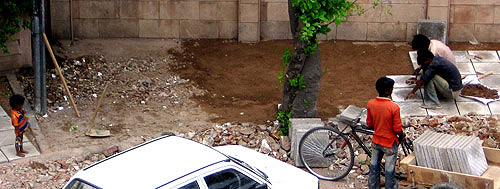
For unskilled labor, the best jobs are the ones that come with a place to stay. There was a construction site across the street from my flat in GKII that had a big dirt pile in front of it. By day I saw the families – men, women, children – shoveling dirt into pans and taking the pans into the site. At night, I saw the families – men, women, children – sleeping on the pile of dirt.

I don’t know if the privilege to sleep on a pile of dirt is a free perk (like Wunderman New York’s Friday morning bagels) or a subsidized benefit (like healthcare, of which Wunderman only paid for half). At Birender’s taxi stand, his drivers all live in a big canvas tent. One of them told me he gets paid 200 rupees a day, of which 100 rupees is deducted for room and board.

And as we’ve seen on roadsides across Delhi – and, this morning, across the road from our own flat — one of the perks of building a sidewalk is that your family gets a sidewalk to sleep on. At least, while it’s being built.

Categories: blah blah
Tagged: , , , , ,