Monthly Archives: September 2009

roopak vs. roopak

The new omelette wallah appeared out of nowhere one day. We were walking down the street towards the market, expecting to pass the same omelette wallah who had been selling cooked eggs from his folding table every day since we’d moved to Hauz Khas. But where there had been one omelette wallah, on this day there were two. Both had a table full of eggs, a small stove, and a few canisters of chilis and spices.

Both stared straight ahead. Neither acknowledged the other.

We didn’t think competition could get any more cutthroat than that. Until we found Roopak and Roopak.

roopak2

There on the left, that’s Roopak in Karol Bagh. And there on the right, well, that’s also Roopak, in Karol Bagh. Both sell spices, nuts, dried fruit, chutneys, that sort of thing. Judging from the wear and tear on the signs, both Roopaks look like they’ve been around for a while.

Even in a city where direct competition is shockingly direct, how do two businesses end up with the same name and the same inventory right next door to each other?

Maybe it’s nothing more exciting than a family schism, but I’d like to think this is the second omelette vendor’s brazenness on a massive scale—except it turned out that Karol Bagh was big enough for the both of them. Whereas the second omelette vendor disappeared a few days after he arrived, the original Roopak and the new Roopak have maintained their cold war for years. Imagine the scene every morning: the two owners arriving to open the shutters, each angrily unlocking and lifting and slamming with all the ritual stomping and preening and chest puffing of the flag lowering at Wagah.

One thing I’d like to know: which Roopak came first?

the mystery of Khan Market

We could never believe the rumors, despite the variety of sources who assured us it was fact: Khan Market is, everyone told us, the most expensive shopping real estate in the world.
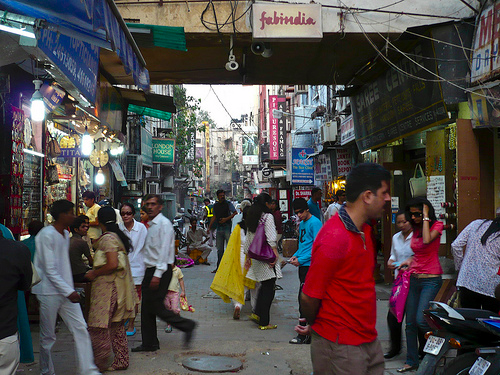
kersy83
Photo by Kersy83

When we finally decided to research it, we uncovered a truth that was slightly less grand but no less implausible: Khan Market is actually the 16th most expensive shopping real estate in the world, according to Cushman and Wakefield, with a rent of $280 per square foot in 2007. It’s more expensive than the most expensive shopping districts in Moscow, Beijing, Oslo, and São Paulo, and only 14% less expensive than Orchard Road in Singapore.

Singapore’s Orchard Road is incessantly mobbed, lined by the world’s most modern malls, and filled with luxury and excitement. It’s easy to imagine its revenue driving real estate prices into the sky. As for Khan Market—the Delhi economy works in mysterious ways, true, but it’s hard to imagine Khan Market generating the kind of revenue that puts it on par with Orchard Road, even with its reputation as Delhi’s most cosmopolitan shopping area.
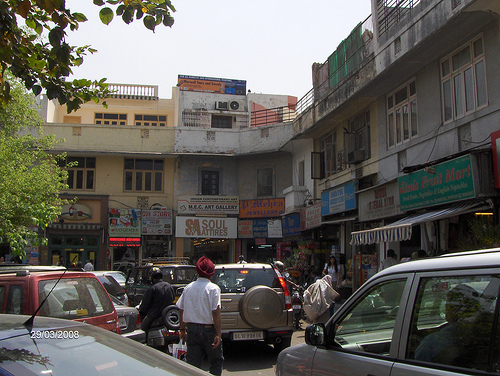
elluliini
Photo by elluliini

Khan Market is an elongated U-shaped collection of buildings, with storefronts running around the U and an underdeveloped inner alley dividing the middle. Its main entrance is flanked by magazine vendors, an electronics and music store, and a crowded and chaotic bookseller. A steady stream of tourists gape at the inner alley, rich foreign mothers wearing jeans and salwar shirts steer their children towards Chokola, and young men in pink polo shirts with popped collars head towards the sunglasses stores. Many of Khan Market’s tenants—appliance stores, plastics stores, butchers, chemists, stationary stores—are indistinguishable from those in every other market but for marginally inflated prices.

There are a number of clothing boutiques and upscale restaurants in the inner alley, but there are just as many drooping, dust-covered power cables and tourists crowded around open manholes watching men clear sewer blockages by hand. There is a McDonalds and a Subway, a few coffee shops, and a few luxury housewares stores, but Delhi’s Louis Vuittons, Christian Diors, Fendis, and Armanis are all ten miles down the road at the Emporio Mall in Vasant Kunj. There are vegetable sellers and imported grocery stores selling the same stuff found at every other import grocery store, for only slightly more money. Khan Market is crowded on the weekends, but no more so than any other market.
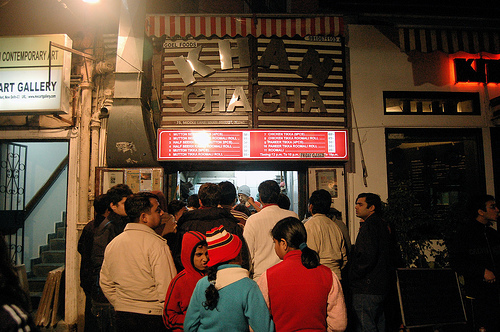
engineer
Photo by engineer

It’s a nice market, but it’s not nearly as nice as one would expect the 16th most expensive real estate in the world to be. It’s not selling particularly high-ticket items or generating unusually high volume—a latte at this Cafe Coffee Day costs the same as a latte in every other Cafe Coffee Day. With the exception of tailors who speak perfect English and design shirts and suits for Western tastes at Western prices, its selection isn’t terribly unique. So how can it be the 16th most expensive real estate in the world?
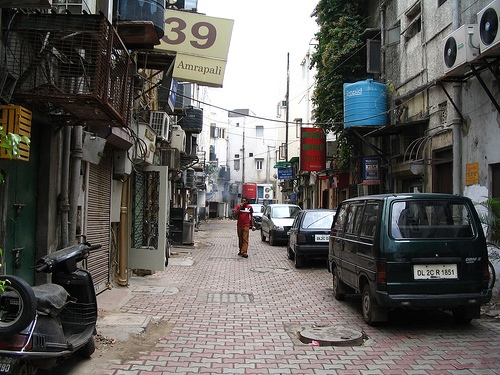
fluxsingh
Photo by fluxsingh

Khan Market certainly has its reputation working for it—it was, along with INA Market, one of the few places where one could buy imported goods in the decades before liberalization. Combine that with its location near many exclusive neighborhoods with heavy expat presences, Khan Market was probably where the rich and foreign used to spend their leisure time, before the air-conditioned malls began springing up and legalized imports rendered under-the-table cheddar cheese smuggling obsolete.
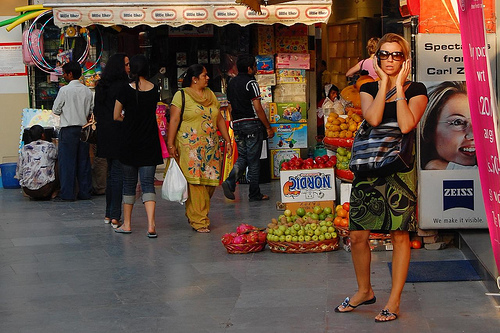
alvaro_macedo

So did reputation alone land Khan Market on Cushman & Wakefield’s list? Or is it somehow possible that the vegetable sellers and restaurants and butchers, despite the fact that they charge pretty much the same as every other upscale market, really are paying some of the world’s highest rent?

ajit the driver

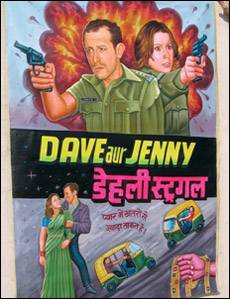
Every morning I’d call the local taxi stand for my ride to Gurgaon. And every morning they’d send a different driver to pick me up. One of them was Ajay. Another one was Ajit.

Ajit was wild, square-jawed, terrifying behind the wheel, with a perpetual scowl on his twenty-year-old face. He spent his first day as my driver shouting gleefully at me the entire ride home: “Me you Hindi! You me English! Straight! Seedha! Left! Baayein! Right! Daayein! You request me every day, I you Hindi you me English! You my only friend!”

When we would reach a breakthrough in vocabulary—“Cow! Guy!”—he would get excited and begin dancing in his seat, taking both hands off the wheel to point upwards in punctuation of his hip thrusts, closing his eyes in ecstasy and throwing his head back and somehow managing to open his eyes and grab the wheel and slam on the brakes at exactly the right instant to avoid a herd of guyain trotting casually down the road.

One day, half-drunk on some after-work beers, I got the bright idea to teach him curse words. “Choothia! Bastard!” I told him. “Lund! Dick! Gaand meh le lo! Kiss my ass!”

Ajit laughed and howled and danced and screamed and repeated my words in deeply-accented shrieks, each new abuse eliciting an equally elaborate reaction from him. And then, suddenly, he grew quiet and contemplative. He turned to me, looking me in the eyes as I sat in the back seat with the car still barreling down MG Road. “You, you wife. Lie bed?”

I knew what he was getting at. I also knew that he took Jenny on errands from time to time, and I was uncomfortable with the idea of him glowering at her in the rear-view mirror with this prurient fact confirmed in his mind. I played dumb, hoping he’d get the hint. “Kya? Huh? I don’t understand. Tati! Shit!”

Ajit refused to be drawn back into the vocabulary lesson. He screwed up his face in concentration, searching his mind for a phrase he desperately wanted to find. “You, wife! Bed! Lie bed? You—” And then he made a gesture I didn’t recognize but understood immediately, pounding his hands together with an unmistakable crudeness of rhythm. “You, wife?”

What else could I say? “I suppose so, yes.”

Ajit howled and danced his victory dance, honking and weaving and pointing his fingers towards the heavens in celebration of my good fortune.