Monthly Archives: December 2010

our double Delhi Christmas faux pas

To celebrate our first Christmas in Delhi, we invited our friends and coworkers over to enjoy as authentic an American Christmas as we could manage, given the fact that neither of us are practicing Christians, that we couldn’t purchase half the food we’d normally eat on the holidays, and that we didn’t have an oven for roasting anyway.
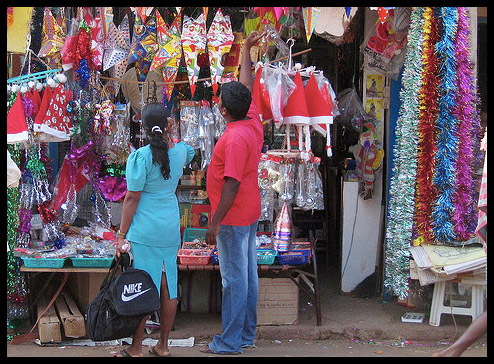
Christmas in an Indian market. Photo by Flickr user DanBrady.

Our menu was a mishmash of our traditions: Jewish potato latkes, hot mulled wine, ginger cookies, sweet potato casserole (technically a Thanksgiving dish, but we didn’t tell anyone), and homemade eggnog. Assembling the feast required great effort—beyond our lack of oven, we were also lacking a food processor, an electric mixer, and the assertiveness to ask Ganga to help with the labor. So the hours preceding our party were spent peeling yams for the casserole, grating onions and potatoes for the latkes, and beating cream for the eggnog.

When our second Delhi Christmas rolled around a year later, we wanted to recreate all of the fun but with none of that effort. So, rather than cook everything ourselves, we decided to make the event a “potluck”: we asked each guest to bring a dish to share with everyone else.

This request was not very well received.

Within a moment of sending my email invitation at work, some coworkers descended upon my desk to mock my backwards American practices. “Who brings food to a party?” Sonia demanded as the others nodded. “You’re supposed to have food served to you!”

And so we nearly ruined another Delhi Christmas.

You see, our first Christmas party had nearly ended as soon as it began. Having spent all that time preparing our feast, we wanted our guests to eat it while it was hot. So we’d assembled it buffet-style on our dining room table, and we’d handed out plates practically as soon as the guests arrived.

The American attendees ate. The Indian attendees refused.

“No, man,” I remember Pankaj telling me as he handed the plate back. “I’ll eat later.”

And the more we insisted they eat, the more uncomfortable they grew. The retreated into groups. They eyed us suspiciously. They whispered amongst themselves.

We didn’t know what we’d done wrong. And it wasn’t until we were guests at a few house parties ourselves that we finally figured it out.

In Delhi, we finally learned, there is generally an order to how parties progress: you drink, you  dance, and then you eat. The booze loosens you up, the dance floor bounces you around, and then, in the wee hours, the food calms you down for the ride home.

Food is the signal that that party is over.

And it’s a universally understood signal at a party. Somewhere around 2 AM, we’d hear the doorbell over the sounds of Dard-E-Disco. Delivery from the dhaba! The living room floor—which, until that moment, was being eagerly bhangra’d upon by even the most uncoordinated gora—suddenly empties.

Kebabs are imbibed. Chinese noodles are slurped up. And then goodbyes are said, handshakes are exchanged, and the ritual drunk driving begins.

Behold my uncoordinated bhangra!

American parties usually begin with food. Indian parties usually end with them. The difference creates a dramatic incongruity: at our first Christmas party, our offer for guests to eat right away was interpreted as a request that they leave.

Fortunately, that party survived the faux pas. But a year later, at our second Christmas, our cultural ignorance threatened the party before it even began. Because if serving food implies that it’s time to go home, what were we implying by asking them to bring their own signal to leave?

Once my coworkers pointed out my foolishness, I quickly sent out an email clarifying the potluck concept. And fortunately, on the day of the party, we managed to assemble quite a spread.

Still, attendance at the party was half of what we hoped. And we found out later that the timing of the meal wasn’t the only thing we’d messed up. My coworker Anurag told me of his mother’s reaction when he’d mentioned the invitation to her: “At what kind of party,” she’d demanded incredulously, “do you have to bring your own food??”

Which actually made us feel better. We could chalk up the weak attendance as a reflection of the unfamiliarity of the potluck concept—and not of our friends’ and co-workers’ actual opinion of Jenny and I.

A book. Not THE book, but A book…

I don’t want to begin this essay with a revelation that the publication date for my book has been pushed back again.

So I won’t. Instead, I’ll share this picture with you.

That’s a book. And my writing is contained therein. Close enough, right?

Sure. To North India, With Love is a great book. Published by ThingsAsian Press and edited by Nabanita Dutt, it is a travel book — but not in the Lonely Planet sense. It doesn’t catalog restaurants or hotels or tourist traps; instead, it presents snapshots of moments. It’s a collection of about 40 short essays that together paint an affectionate portrait of North India, presenting experiences that have mattered to the travelers who came before you. And it couples those experiences with just enough information for you to run off to Dehradun or Allahabad or Old Delhi and create an experience of your own.

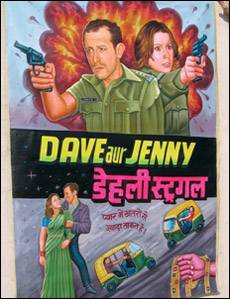
If you’re in the US, you can buy it on Amazon; hopefully it’s available in Indian bookstores as well. Three of my essays have been re-edited and republished in this book. These include the story of Ruksana, my experience with Karim’s tandoori bakra, and a retelling of the story of our famous Bollywood poster. Here’s an excerpt:

I came back the next weekend with my father and the money for the deposit. Manesh wasn’t there. This time, we sat at the rickshaw stand with a drunk mechanic who kept telling us, “I speak English tutti-frutti,” and “Vijay is my brother,” and “You want some whiskey?” Finally Vijay and Ranjeet, his English-speaking partner, pulled up. We discussed again the poster while the drunken mechanic danced around, sent a peon for soda, and interrupted us with “Vijay famous artist!” and “My cousin-brother!” and yet more “You want whiskey?”

Jenny and I had anticipated a small poster, perhaps two feet in length — after all, our main goal was to reprint it on a postcard. Vijay, however, insisted that his work could be no less than five feet tall. We agreed, the peon returned, and we celebrated with Pepsi and whiskey. As we were walking out, the mechanic turned to me to whisper conspiratorially, “I speak English tutti-frutti.”

You can read the full essay on the ThingsAsian site. And you can see a picture of the poster that I’m talking about in this unrelated article that appeared in the Gujarati newspaper, Divya Bhaksar. Here’s how it looked in print:

After the article came out, the author assured us that it was saying nice things. But is it? As bad as our Hindi is, our Gujarati is worse. Does it complement our writing style? Does it repeat that last February’s denunciation of our imperial arrogance? Does it accuse us a pivotal role in the 2G scam?

Nope. Nice things. We know that thanks to my coworker Pankaj’s friend Vimal, who relieved our fears (Thanks, Vimal!) with an abridged translation that I’ll paste below:

Delhi through the eyes of a Foreigner

One American couple came for 3 years to stay in Dil walon ki Delhi, and what they saw here it is.

The author starts off by writing Osho Rajneesh’s saying: “the best way to hide anything from a person’s eyes is to place it in front of his eyes.” He talks about India in the same way: child beggars pulling arms of the people on the streets, a bridegrooms procession in midst afternoon with the mercury soaring at 42 degrees Celsius, blaring loud speakers in the night enough to tear one’s ear drums, crazy honking vehicles, little boys serving tea in dirty clothes, pirated dvds and cds selling in the open, choked-full buses and trains, cars parked in no parking zones, etc.

Then he goes on to say: Lets meet Dave & Jenny, who came to Delhi in Nov 07. They did not come to see the Taj, but for the work project and to work for an NGO, and chose to see Delhi through their eyes, rather than using a conducted tour.

He talks about their blog and reproduces the same. He begins with the matrimonial ad in Mumbai, and then goes on to their trip to Daryaganj to make a film poster for themselves. How they managed to find Vijay and how Vijay was surprised they managed to find him. Vijay printing a 6 foot poster instead of a 2 foot poster requested by them and how thrilled they were. The poster is reproduced along with the article.

He also narrates how “do one thing” fascinated and amazed Dave and Jenny.

It’s nice to be appreciated. And that warm feeling of appreciation gives me the fortitude to sigh and bare to you the pain I mentioned at the beginning: our book release has indeed been pushed back to April, and possibly later. Apparently there are simply too many books about Delhi on the market right now, thanks to the tourists who failed to materialize during the Commonwealth Games.

Which means the release parties will be postponed. Which means we won’t be visiting Delhi in February. Which means our memories of the hot winter carrot halwa steaming outside the Jama Masjid will, for now, remain just that.

Sigh.

The good news is that we should be revealing the cover soon. We haven’t seen it yet ourselves, but we do know that the publisher was at one time talking to Vijay the Bollywood poster painter about doing the art. And if that’s indeed the case, then here’s a sneak peak at the source material we provided him:

Hopefully Vijay can once again do us justice.

(And if this picture at all convinces you that I’m capable of writing 250 entertaining pages about life in Delhi, then make sure you email us to join our book mailing list. We’re in discussions for something like nine release events in six Indian cities, and we’ll be inviting everyone on the list. Whether it takes place in April or July or sometime in the 23rd Century, you don’t want to miss out.)