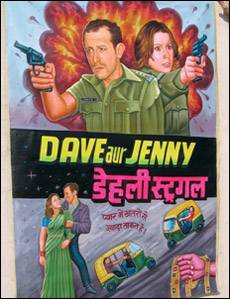
Our first brush with danger came from plugging things in. Electrical plugs in India are two-pronged or three-pronged, and thin-pronged or thick-pronged. Some outlets can accommodate both thick prongs and thin prongs, and very special outlets can accept almost everything: thin three-pronged plugs, extra-thin two- pronged plugs, and American-style plugs to boot.

Such a marvel of engineering!
This variety of sockets was confusing to us, leading to a surprising amount of time wasted shoving large prongs into small holes. But even more confusing was the inner shield in these outlets. This spring-driven shield presumably protected empty sockets from prodding baby fingers; they lifted only when a three pronged-plug was stuck into it.
So what to do when trying to stick a two-pronged mobile charger into a three-pronged socket?

See the shield? See the problem?
For our first few weeks in India, we jammed toothpicks and pencils into the third hole to lift the shield. (And we were never electrocuted even once!) Eventually, though, we discovered the deft wrist motion that enabled our two-pronged chargers to slide in where they didn’t belong: an initial approach at an acute angle to reach under the shield, and then the rapid lift-and-shove to stick the prongs in before the shield slammed shut.
Which gives you a method for telling tourists from locals: ask them to plug in your charger.
* * *
Light bulbs were our second challenge. Bulbs in India didn’t screw in—instead, we had to push them into the socket against the pressure of a surprisingly resistant spring, and then maintain the force as we twisted the bulb to slip the prongs into the grooves.

Officially known as the bayonet mount (as opposed to the Edison screws Americans are used to), this supposedly-simple technique terrified us every time because the spring was always so strong. We’d have to push on the bulb itself with far more pressure than a glass dome should be capable of sustaining. Half our dead bulbs never got replaced for fear of squeezing too hard, shattering the bulb, shredding our hand, plunging our fingers into the socket, and electrocuting ourselves in tragedy made hilariously ironic by how flippantly we stuck toothpicks and pencils into electrical outlets without incident.
* * *
A less ironic death for us would be a cooking gas mishap. Gas for our counter-top burners came from two heavy iron canisters locked on our terrace. Each canister contained about two months’ worth of fuel, which meant that we’d invariably run out with our dinner half-cooked on the stove.
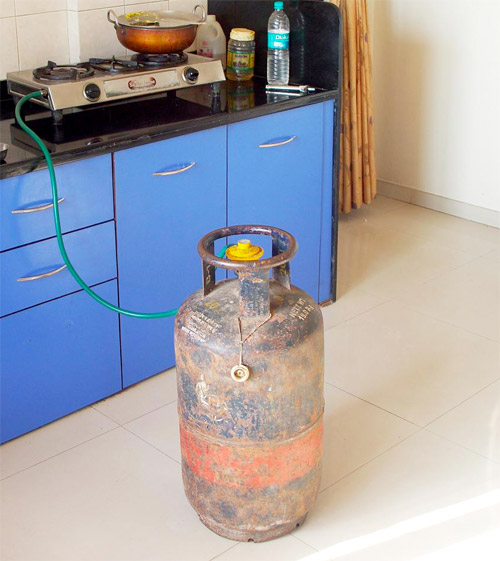
Ours was like this, except the canisters were outside. This photo by Flickr user überkenny.
There were just a couple valves and knobs that required turning when it was time to switch canisters, but the technique confounded me every time. I’d struggle, grunt, sweat, curse, smell leaking gas, panic, and finally ask our elderly neighbor for help.
Our elderly neighbor would have it switched within seconds.
Still, you can’t say I didn’t try. But I was frightened by the explosive potential just waiting to be unleashed by my clumsy American fingers. I treated the iron canisters as porcelain vases, terrified of their delicacy until the day Jenny saw how workers unload them from the truck: they threw the tanks to the ground, where they’d land on their sides with enough momentum to roll down to where they were being delivered.
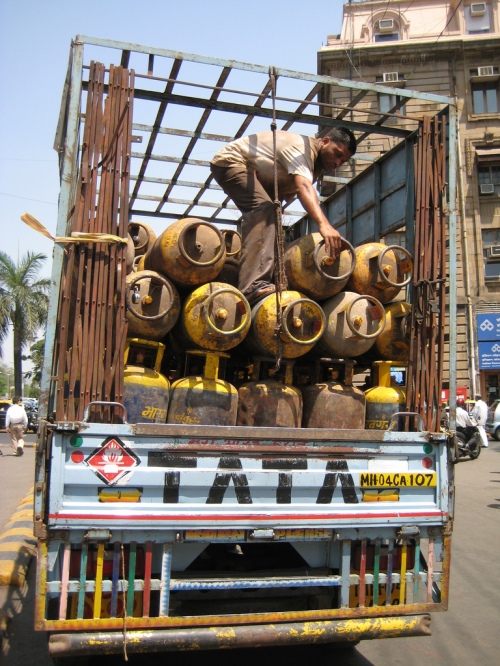
Photo by Flickr user miselenaeous.
Canisters that rugged surely wouldn’t blow up just from changing the valve. So the next time I had to switch canisters, I put all my strength into it. But the problem persisted—I couldn’t get the valve to close. The valve must have been jammed, or perhaps it was rusted shut. So after a few more minutes of unrequited shoving, I finally called my elderly neighbor to get his opinion on the matter.
He took the valve in his hands and it was attached not ten seconds later. Nothing was harmed, except my ego.