Monthly Archives: July 2010

the opposite of NBC’s Outsourced: the BBC’s Goodness Gracious Me

Last week we posted about NBC’s upcoming sitcom Outsourced, in which an American goes to work in India and makes fun of their funny names. A reader named Sumit responded with a link to one of the funniest Indian-related sketches I’ve seen. This comes from an old BBC show named Goodness Gracious Me that was known for turning Indian stereotypes on their head. Watch what happens when an English guy named Jonathan shows up to work at an Indian company:

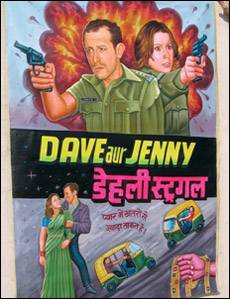
Seeing this reminded me of the name I was given in our Delhi office. Not that anyone had any trouble pronouncing my name, but my coworker Dipankar insisted that if I was going to work in India, I needed to have a proper Indian name. None of this American “Dave” nonsense. He studied me intensely for a moment before announcing to the office that I was henceforth rechristened as “Dev Prasad.”

The name stuck. That’s what half of my coworkers still call me.

———-

Clicking around Youtube to find more from Goodness Gracious Me, I came across this sketch, which is even funnier than the last one.

And this one is just weird.

Thanks for the lead, Sumit! If anyone else has any other Indian-related comedy bits to share, please post in the comments. Russell Peters, perhaps?

NBC takes on expat life in India

There’s no doubt that America is growing obsessed with India. Slumdog Millionaire was just the beginning: Indian food, Hindi music, and Bollywood dance are all trending skyward, and Oprah has even had Aishwarya Rai and Abhishek Bachchan on her glorious couch. Julie Roberts just shot Eat, Pray, Love in Gurgaon. And now NBC has jumped on the bandwagon with Outsourced: a comedy about an American sent to work at a call center in India.

One thing is clear: judging from this promo, they already stole my joke about Frogger. Eagle-eyed readers will have to see if they used any other jokes from this site.

Hey readers, what do you think about portrayals of India like this? It’s clear they’re going to make jokes about “funny” headwear and “silly” names, but they’re also going to take their digs at the American lifestyle as well. Based on this four-minute promo, readers, what are your thoughts?

this sunday: walk the dying flower markets of Delhi

Delhi is a city that fights for your nose. Pollution squeezes through loosely-fitted windows. Simmering chole bhature drifts around the market. The public urinals brazenly announce their presence. But underlying all those bullying odors, always there when the wind blows just right, is the true scent of Delhi: flowers.

Streetside shrine near Nehru Place. Photo by us.

Flowers are the foundation all Delhi’s nasal signature. It’s the reminder that the plagues of the expanding city are fleeting, and that nature will reassert itself when humans are done playing their games — the frangipani trees will rise through the pavement, the oleander will climb the steps of Raisina Hill, wrap the Rashtrapati Bhavan, and collapse it in the floral embrace in which all civilizations eventually end.

Flowers bloom in Delhi’s parks and on its medians; frangipani trees drip blossoms onto the sidewalks; discarded orange garlands hang from tree branches. (We were told that you’re not supposed to throw ceremonial flowers away — instead, you hang them from trees so they can return to nature). More ubiquitous than the blooming flowers are those that are for sale: the market florists in their canvas tents, the old ladies stringing together bright orange marigolds outside of temples, the young boys walking through traffic selling plastic bags full of petals to scatter when you get home.

Diwali-time flowers for sale in Hauz Khas market. Photo by us.

All these flowers come from wholesale markets. And Sunday may be your only chance to tour these markets — because, according to Red Earth India, they’re about to close.

Red Earth is the organization that helped us discover the joy (and bhang) of Holi. This weekend, they’re hosting a tour of Delhi’s three main wholesale flower markets — all three of which, they tell us, the city is soon shutting down. Here’s what they say:

The walk will take you to the three main flower markets of Delhi. The flower markets of Delhi are temples of beauty amidst the concrete jungle of the city, and an integral part of the city’s heritage and culture.

Delhi flower market. Picture by Flickr user Douglas Martell. 

Sadly however, the Government of Delhi, in an extremely myopic vein is relocating these flower markets to one singular flower market in Ghazipur. We at The Genda Phool Project however are formulating a strategy of building public opinion against this proposal. We are working towards the possibilities of a campaign to save these markets on grounds of right to livelihood, issues of displacement, as well as issues of urban heritage and aesthetics, and those of people’s participation, involvement and consent in development initiatives.

Each of the three flower markets is beautiful in that they have a distinct and unique character, which will be lost once they are relocated in a strange ‘flower market building’ on the outskirts of the city.

Another flower market in Delhi. By Flickr user kdombrowski. (Spot the monkey!)

We will start our Phool Mandi walk with the market at Baba Kharak Singh Marg, opposite Hanuman Mandir. The mandi operates from 4 am to 9 am, and accomplishes business worth crores in this duration. The flash in the pan phenomenon – here now, gone in a second, is fascinating. This is the city’s largest flower market, and specialises largely in cut flowers of all varieties and even some dry flowers and flower decoration equipments.

From New Delhi we move to Old Delhi, to explore the Genda Phool Mandi at Fatehpuri Masjid, Chandni Chowk. Again, only a morning mandi. Farmers and flower sellers are seen milling around, and again, by around 9 am the mandi vanishes, and the spice market of Khari Baoli, around which the mandi is located, emerges. This mandi only sells genda phool (marigold flower) in its loose form.

A Blueline tries to camouflage itself. Photo by Bradford Daly.

Finally, we will take you to another city of Delhi – Mehrauli. The Mehrauli flower market again largely specialises in Genda Phool (in loose and garland form) but also some cut flowers. This Mandi however, is open all day, unlike the other two which are temporary / morning ones.

Do join us for this one, it may be one of your last chances to see these lovely flower markets if the government has its way. But we are hoping it will not…”

It sounds like a spectacular tour. Here are the details:

  • Sunday 18th July 2010
  • 6 am: Collecting at meeting point
  • 11 am: Walk finishes at meeting point
  • Meeting Point: Near Ticket Counter, Dilli Haat, Opp. INA Market
  • Please park your vehicles here, the group will proceed in an AC bus from here.
  • Contribution: Rs. 500/- per person.
  • No contribution to be paid for children if they are sharing a seat.
  • To register and for details contact Himanshu Verma / 41764054 / [email protected]. (Make sure you tell him you read about this here!)
  • Please carry the following: umbrella / hat, water.
  • We will provide some sharbats (traditional Indian cold drinks) / tea / refreshments on the bus.
  • Carry bags for buying flowers. Say no to plastic!
  • Dress Code: Wear genda colours – orange, yellow, red & maroon.

We encourage all our readers to go. Send us pictures that we’ll post here after the event!

did we ever enjoy ‘white privilege’?

A reader name Gayatri recently emailed us this pointed question:

Had a question for you guys. Have you ever been out clubbing in Delhi or to a pub in the evening. Would they let you guys cut the queue and let you enter even if to the rest of the people waiting they’d say the club is full?? :) It kind of co-incides with the privileges to white-folk in India. If you guys have a story regarding – think it could be funny, especially with the humor you two have. :) Hope to see both of you in September!

We’d be lying if we didn’t admit skin-based advantages are bestowed on foreigners in India. Auto drivers, for instance, would hone in on us at the expense of everyone else waving their arms at them. (And they’d give us choice grumbles when we’d refuse to cut ahead of those who’d been bypassed their rightful ride.) The sidewalk chaiwallah near my office would always boil a fresh batch for me, even as he poured from a premade kettle for the factory workers who arrived the same time as I did. And while the guards at Saket Citywalk would grope us for poorly-hidden bombs just like every Indian shopper — as if Al Qaeda’s training manuals advised keeping their explosives in their front pockets — their hands always seemed to linger more tenderly with us.

Wait, that’s not a good thing.
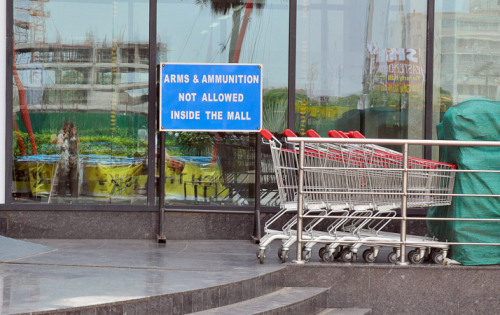
Also, Al Qaeda always obeys signs. Image by Flickr user 3_second_memory.

So we don’t deny that white people are given deference in India. But Jenny and I will insist that we never actively took advantage of it. Especially when it came to queues.

In fact, there were many times when our foreign-ness made us easy beacons for queue abuse. Our American standards of personal space always meant three or four fellows could slip into queue in front of us between the moment our eyes began to blink and the moment the blink was completed. If we weren’t constantly crotch-checking the people ahead of us, we learned, we might as well be moving backwards.
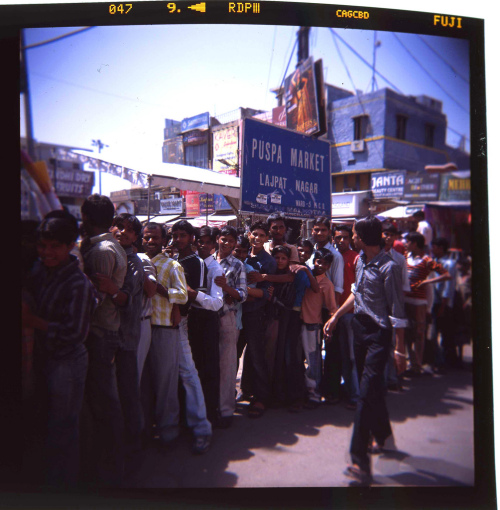
Image by Flickr user Loulou H.

And there was certainly no advantage for us at tourist sites — we’d have to elbow our way up to the ticket counter just like everyone else, jamming our fistful of bills under the metal grating along with all the others, waving the sweet scent of sweaty rupees under the ticket taker’s nose until his eyes met ours and our transaction was complete.

We certainly could have bulldozed queues and hopped unrightful autos like the worst of the tourists. Such modern expressions of the Imperialist mindset are impassively tolerated by the citizens of our host country; Indians are far more polite to Western rudeness than we Westerners would be to such behavior back home. But Jenny and I saw ourselves as ambassadors, and we fashioned our queuing behavior accordingly.

In fact, we recall a time when our fellow back-of-the-queuers tried to invoke our “white privilege” for us. This was at the conclusion of our birdwatching trip to Bhatarpur, when we decided to catch the late afternoon train back to Delhi rather stay another night and leave as scheduled in the morning. Arriving at the train station, we dutifully joined the 20-person queue; but, being off the tourist track as we were (Bharatpur gets its share of Westerners, but most have arranged their tickets in advance), we were quickly noticed.
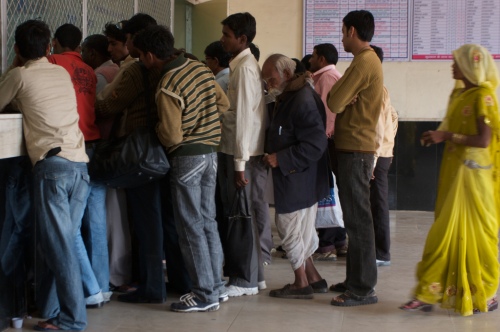
“Ticket Queue – Bharatpur Junction Railway Station – India” by Flickr user string_bass_dave. (Who isn’t me.)

“You please go,” said the man directly in front of us, gesturing to the head of the line. Other nearby members of the queue signaled their agreement. But Jenny and I shook our heads and smiled in polite refusal. They insisted again. We refused again. They gestured more adamantly, insisting that our ticketing needs outweighed theirs; we refused more theatrically, insisting that progressive values can be no better illustrated than via a multiracial ticket queue.

Our egalitarian insistence won the day. Although twenty minutes later, when we reached the window and discovered we’d been in the wrong line the whole time, we kinda wished it hadn’t.

———–

Incidentally, when Gayatri said, “Hope to see both of you in September!”, she was talking about our book release party. She knows about it because she’s on our mailing list (and following us on Twitter).

We’re expecting the big event about a month before the Commonwealth Games. We already know the official title, which we’ll reveal, along with the cover design, soon. (The title of our book is NOT “Our Delhi Struggle” — as we’ve mentioned before, we regret that name, and we’re not going to make the same mistake.)

Beyond Delhi, we’re hoping for release events in Mumbai, Pune, Kolkata, Bangalore, Chennai, and so on. You, dear reader, have direct influence in the matter: email us to join our mailing list, and then pledge in the comments below that you’ll attend an event in your city. Our publisher will surely take note.