My office in Gurgaon didn’t exactly provide the most ideal working conditions. The municipal power was completely unreliable, so we had a shipping container-sized generator running almost full-time in our driveway, spewing diesel fumes into our office when the wind was right. We had no microwave, no refrigerator, and nowhere appropriate to wash our dishes. Worst of all, the improperly-installed urinals emptied into the same drain-line used to drain the floor, essentially creating a stagnant open-air sewer that filled the office with the stench of urine. But we made do.
And this is the most important concept we learned during our time in India: jugaad. Making do.
The nearest English equivalent is “jury-rigging”, but that translation doesn’t do jugaad justice. My coworker Anurag translated it as “a duct-tape arrangement.” Artist Sanjeev Shankar describes it as “attaining any objective with the available resources at hand”. Jugaad is about improvising a solution. It’s about ingenuity in the face of adversity.
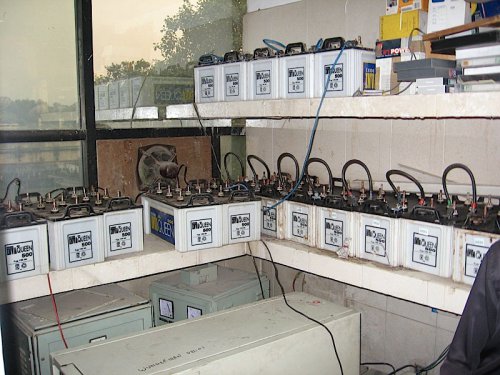
Backup power for our server room, jugaad style.
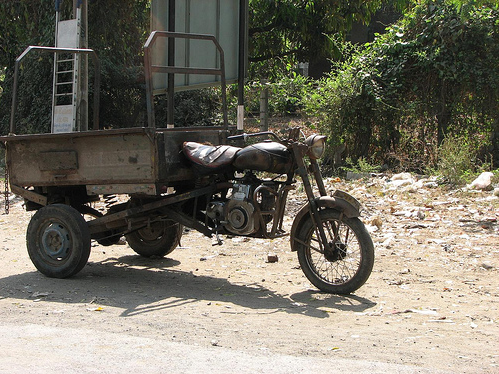
Many of our friends, when we asked them about it, said that the concept is best illustrated by a common rural sight that people actually refer to as “a jugaad“: a homemade vehicle made by cobbling together a wooden cart with the kind of diesel water pump farmers use for irrigation.
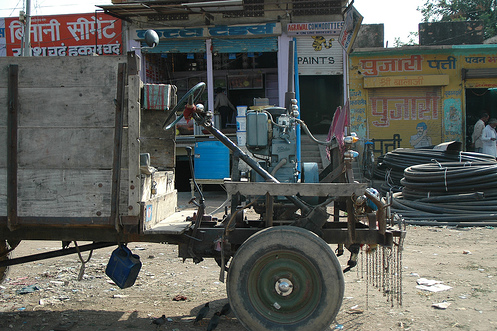
Picture by Flickr user Stuart-Cohen.
Fitted with makeshift steering and braking mechanisms, these jugaad vehicles are used for everything: for transporting people from one village to another, with dozens of riders crammed together tighter than the bundles of sugarcane they are also used to transport; for trips to regional markets; and for transporting the pump itself. Farmers share or rent these pumps, and this arrangement lets the pump actually transport itself to wherever it’s needed next.

Picture by Flickr user lakshman_M.
No two jugaad vehicles are the same, because each one is an improvised solution using unlikely parts. These vehicles are the purest representation of this spirit of ingenuity, and everyone we spoke to swelled with pride at India’s capacity for jugaad. “We are like that only,” my boss Murali would tell me when describing solutions to situations that would send most goras scurrying for the nearest five-star hotel.
The variety of solutions to seemingly intractable problems we saw supported this patriotic esteem: motorcycles chopped in half and welded to carts to create centaur goods haulers. The way families would fit mother, father, and three kids onto a single scooter. The clever repurposing of used water bottles as cooking oil containers. Rope spun from discarded foil packets. Cricket wickets made from precariously balanced stacks of rocks. And, as Anurag sardonically pointed out in a political statement I don’t understand but assume to be insightfully hilarious, Atal Bihari Vajpayee’s government: a duct-taped coalition of thirteen political parties.
As one blogger put it when describing those diesel water pump trucks, “these vehicles reflect the true spirit of innovation in rural India.”
But we think the spirit of jugaad is actually broader than clever mechanics.
Jugaad is the philosophical outlook necessary to make it work, regardless of what “it” is. It’s about solving problems with what you have, not with what you wish you had. For the office workers who would wait on Delhi corners for rides to Gurgaon in private cars driven by drivers looking to make a few bucks, jugaad is obviously the human Tetris that fits ten people into a car built for five for a shared commute to Gurgaon; but it’s also the stoic patience that’s essential for total strangers to sit on each others’ laps and breath in each others’ sweat for a ninety-minute sauna down MG Road. Jugaad is the ability of families to endure thirty-two hours on the train from Mumbai to Amritsar, when the three-hour stretch Jenny and I rode it from Bharatpur to Delhi left us exhausted and claustrophobic. It’s the hope for the future that lets a woman and her son spend two days waiting on a median for someone to pick them up.
Jugaad is how everyone gets by.
Jenny and I come from a tool-addicted culture. Before we came to Delhi, we couldn’t function without a certain baseline of modern conveniences: we needed adequate light, temperate air, comfortable chairs, and personal space; and if we lacked any of those, we’d be unable to do our jobs.
But the jugaad philosophy suggests a different approach: modern tools and technology are appreciated when they’re there, but they are not cardinal requirements for existence. Technology is a comfort, but not a necessity, and a lack of technology doesn’t change the fact that the job’s got to get done. Under the jugaad philosophy, only we Americans whine that the air conditioning has gone out; everyone else rejoices in the good fortune of having had air conditioning at all, and gets their work done anyway.
Picture by Flickr user Primus D’Mello.