Editor’s note: we’re reposting some of our early essays, from when we were first opening our eyes to India. It’s interesting to read now what we wrote then. Here’s the original.
The stereotype of India is true: cows wander the streets with impunity. They block traffic, they sleep on the sidewalk, they eat food scraps and plastic bags off the ground. Indians don’t eat beef because they consider cows holy, but just because they’re holy doesn’t mean they’re not an annoyance. In an upscale market in Delhi last December, I was passing a group of about thirty people waiting outside a restaurant when a cow came wandering by. It was a narrow lane with a small sidewalk, and the people waiting had spilled into the street, leaving barely enough room for cars to pass. Just as the cow came from one direction a car came from another, its horn blaring. The cow dodged away from the car and directly into the group of people. There were shouts as the crowd surged back into the unyielding wall, and the panicked cow bore down on the panicking people.
In cases like this, even a holy incarnate needs a little prodding. The day was saved when a parking attendant dashed up and slapped the cow on the side, hard, angrily, repeatedly, until she turned around in her confusion and returned the way she came.
Why would Indian society put up with these giants that obstruct their streets, nose through their garbage, and menace their restaurant patrons? Because for the hundreds of millions of Indians who will never have enough money to even visit a restaurant, the cow is truly a gift from god: from its udders comes food, and from its ass comes fuel.
The prevalence of cow poop as a fuel becomes clear the moment you leave the city. Lining the roads in the countryside — in fact, lining any available space not already given over to crops or housing — are row after row of circular foot-wide cowpies drying in the hot Indian sun.
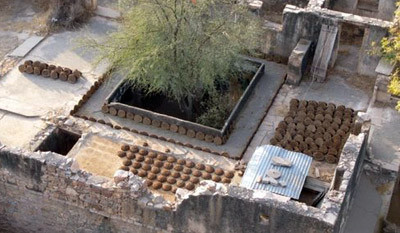
One blogger describes how the cowpies are prepared and what they’re used for. “I would then help my mother to make sheni from the heap of dung collected in the field. Sheni is/are about 30 cm in diameter, 3 cm thick disc made by mixing water, rice husk and chopped rice straw, pulverized by feet, and the balls of mix are pressed flat by hand, and sun dried. These were stacked and stored mainly for monsoon. It was a ‘free’ energy — fuel — for cooking; this practice still continues.
“The cow dung helped us to help grow food in the farms, helped to cook our food, and helped us to maintain our mud house; thus helped us to sustain. And finally the used cow dung in — all forms — went to the soil.”
Even in Delhi itself, it’s not surprising to see cowpies drying on sidewalks and embankments. Two months ago, however, on a trip to the rural Indian village of Karanpur, I noticed a new manifestation of cow poop: cow poop houses.
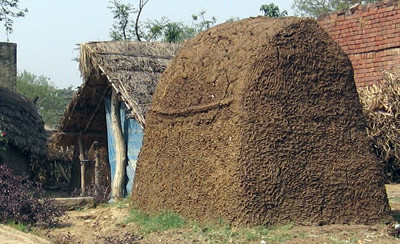
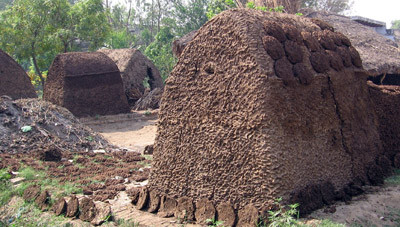
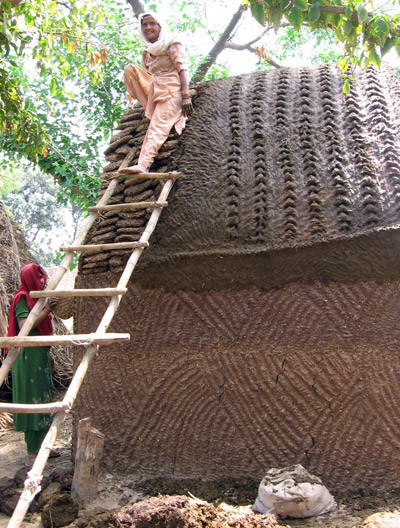
The monsoon is coming. In fact, it might already be here — a downpour this morning turned the road outside my flat into a two-foot deep lake. The rains in India fierce enough to destroy any cowpie left unprotected, melting cowpies into mud, fertilizing the ground but destroying the chance at a hot meal. To protect against this, rural Indians spend the months leading up to the monsoon building huts to store their cooking fuel.
The huts, of course, are also built out of cow poop.
While in Karanpur, we stumbled upon a group of villagers in the process of building a cowpie house. The women laughed at themselves as we came upon them — they were clearly a little embarrassed to be seen by foreigners as they kneaded the poop like bread dough. But it wasn’t a humiliated kind of embarrassment — rather, it was an acknowledgment that we caught them in an awkward moment. It’s how you’d feel if a political candidate dropped by on a door-to-door and caught you mowing the lawn in your rattiest t-shirt.
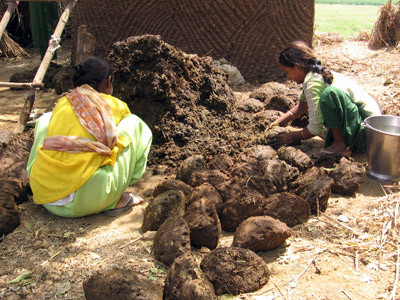
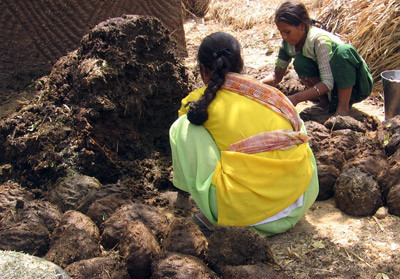
Building the huts seemed like a straightforward process. Dried cowpies are placed into stacks numbering into the hundreds. Wet poop is then molded around them. The poop is presumably mixed with a higher concentration of straw than normal, probably to function much like rebar would in cement. The exterior poop is spread thick and strong to keep the interior poop dry through the rains. It’s doubtful that the houses can survive much more than a few weeks of rain, but that should be enough to keep the fuel flammable until the weather clears up enough to dry more cowpies.
This is why the cow is holy, and why Indians are so accommodating of them. Not because the Indians arbitrarily worship what we see as dinner, but because the cow provides so much required for sustaining their lives. Cows need to be revered, because they’re far too valuable to eat.