Monthly Archives: February 2010

feet

We hadn’t lived in India for very long before Jenny had a spiritual revelation. It wasn’t a let’s-go-smoke-hash-with-the-sadhus kind of revelation, nor was it a let’s-dedicate-ourselves-to-free-love-and-yoga-and-live-at-Osho kind of revelation. Instead, her revelation was much more fundamental to a particular Bible story that she’d never fully understood:  “Now I know why Jesus washed those feet!”

The story in the Bible is this: at some point after his last supper, Jesus decided to teach his disciples a lesson. Grabbing a bucket and a bar of soap, he bends down and starts scrubbing his buddies’ feet. They protest and try to dissuade him until he revs up the ol’ parable machine, looks them in the eye, and says, “The servant is not greater than his lord; neither he that is sent greater than he that sent him.”

Though Jenny is not religious, the symbolic lessons of this Sunday School passage had always been clear: the dangers of arrogance, the sin of pride, the imperative of respect that all leaders should have for their followers and all people should have for each other. But what had never been clear to Jenny, from the moment she frowned at that Sunday School text until this very point in her adult life, was this: why would anyone want their feet washed?

Now she knew: as it was in in ancient Jerusalem, so too is it in modern New Delhi: walking around a hot and dusty city in sandals gets your feet really, really dirty.

Calling me to the shower to show off her blackened soles, Jenny explained to me her revelation not about symbolic meaning, but about literal necessity: that Jesus was washing feet because, man, look how dirty feet can actually get!

She was right. Man, was she right.

Then Jenny handed me the bar of soap and gestured spiritually. I thought about the danger of arrogance, the sin of pride, the imperative of respect; and then I handed the soap back to her, headed back to the sofa, put my own filthy feet back up on the coffee table, and went back to watching Friends.
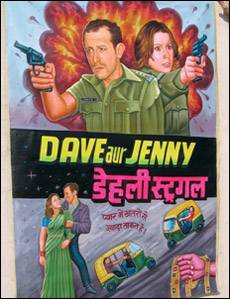

meet Vijay, our Bollywood poster painter

This weekend, NPR’s Studio360 ran an interview with Jenny and I and Vijay, the artist who painted our Bollywood poster. It was really interesting to hear his history and his side of the story. We were especially heartened when he leaped to our defense to dispel the reporter’s half-baked notion that it’s somehow “patronizing” or “maybe just plain wrong” of us to insert ourselves into a symbol of Indian culture. Give it a listen!

self-respect

“My mom has given my matrimonial ad,” my coworker Anurag told me one day. “One of the respondents is an account manager with an ad agency in Mumbai. Drawing seven lahks per annum! That’s double my salary. So I told my mom, ‘I don’t think she’s my type.’”

Not your type…? I was dumbfounded. What could be a more perfect type than a wife who pulls in a boatload of cash?

So I argued with him. I tried to explain the benefits of that arrangement from the perspective of his future financial security, to say nothing of all the extra time he’d get to watch TV. But my arguments of real estate prices, private school tuition, and syndicated sitcoms didn’t make a dent. He wanted to be the breadwinner because, well, that’s what men were supposed to do. “What about my self-respect?”

“My friend,” I said, “you can drive your self-respect around in a gold-plated BMW.”

He laughed. And then: “You have absolutely no male ego. Are all American men like that?”

two bargaining tactics

A few weeks into my career in India, my coworker Dipankar and I decided that we needed some beanbag chairs to turn our shared cubicle into the “cool” corner of the office. This was back when MG Road was still apocalyptic, and the only sign of life along the road was those abandoned storefronts where a few beanbag vendors had set up shop.

So Dipankar and I skipped out on work and headed up MG Road, shockingly free of traffic at this time of day. Approaching a vendor sitting by a stack of dust-covered beanbags, Dipankar explained our intention to buy. We followed the vendor through an alley and into the bowels of the abandoned building, where empty beanbag skins were piled in clear plastic bags in areas cleared of debris from the attempted “sealing” of the building. A stairwell rose to the sunlight where a second floor used to be.

Dipankar and the vendor got down to business. The bargaining took place in Hindi I couldn’t understand, a rapid back-and-forth that seemed to be going nowhere until Dipankar said something that made the vendor laugh. Suddenly the vendor clapped Dipankar on the back and agreed to a price. I gaped at the suddenness of the completion to the negotiations. The vendor waved someone over to clean the beanbags of the road dust that permeated even this far indoors, and then we were on our way.

“What did you say to him? What did you say to him?” I asked eagerly, bounding along in Dipankar’s triumphant wake. Dipankar told me his magic words: once they’d reached impasse, with Dipankar pushing for less and the vendor refusing, Dipankar suggested they meet in the middle. He named a price and then made it seem fair by saying, “It’s not your price, it’s not my price.” It was a friendly tactic that made it sound like both parties were making a concession — as if both had an equal stake in the outcome. At the same time, it was so absurd that the vendor couldn’t help but laugh, and then agree.

Jenny and I added it to our repertoire of bargaining techniques. It worked really well on auto drivers.

*   *   *

When Jenny and I moved out of Brooklyn, we posted our stuff on Craigslist and sold as much as we could. There was very little bargaining involved, because most Americans see a number attached to an item and accept it as take-it-or-leave-it. Our dresser, our Ikea rug, our second-hand couch — we advertised a price, and if it didn’t sell, we advertised a lower price.

Obviously it didn’t work like that in Delhi. Anyone who showed up at our flat to look at our stuff would immediately offer half of whatever price we’d written down. “1200 rupees for that electric heater?” They’d say. “It’s too small to heat my flat, it’s not a name brand, and winter is over anyway. I’ll give you 600.”

With bargaining thus initiated, it was then up to me to make some concession to their offers. They expected me to drop my price by 200 rupees or so, after which they’d probably move up 200, until we met at 900. But I didn’t want to play their game — so instead, I tried to short-circuit it.

“I’m an American,” I’d say back.  “Americans don’t know how to bargain. We both know that you’re better at bargaining than me. So can you just give me 1200 rupees so I don’t get confused?”

Believe it or not, once or twice, that actually worked.